Investigation — Propaganda & Manufactured Consent

The Man Who Taught the Wealthy How to Control What You Think — and the Men Still Doing It Today

Edward Bernays • Frank Luntz • Documented • Primary Sources

Before We Begin — A Question About Your Breakfast

You Didn't Decide Bacon and Eggs Was Breakfast. A PR Firm Did.

Have You Ever Asked Yourself Why You Dislike Liberals or Conservatives?

In This Post — Meet the Men Who Are Responsible for Your Likes and Dislikes.

Did You Decide On Bacon & Eggs — Or Did Someone Else Decide For You?

Their Goal Is Not To Inform You — It Is To Make You Feel.
Because the moment you feel, you stop thinking.

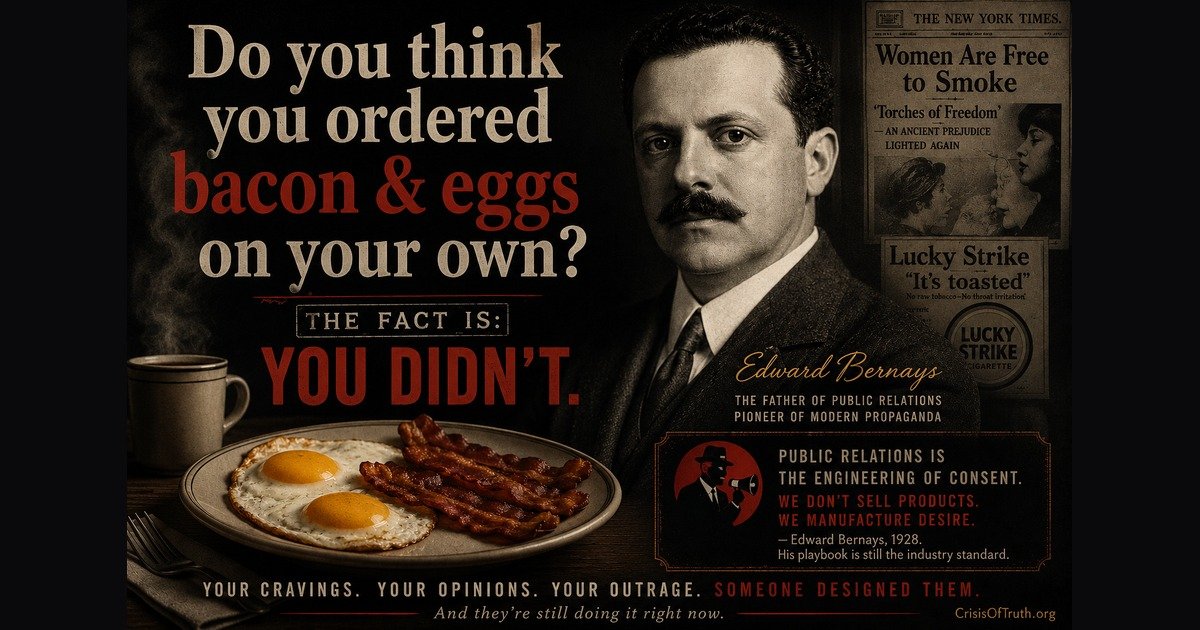
Do you think you ordered bacon and eggs on your own? The fact is: You didn't. Edward Bernays — the father of public relations, pioneer of modern propaganda.
Your cravings. Your opinions. Your outrage. Someone designed them. — CrisisOfTruth.org
Watch Before You Read

George Orwell's 1984 — Hate Week.
A crowd manufactured into fury in three minutes. Watch the faces. Then ask yourself where you've seen that look before.

▶ Watch Now →

Americans historically ate light breakfasts — toast, coffee, a piece of fruit. In the 1920s, the Beechnut Packing Company hired Edward Bernays to sell more bacon.

His solution was not an advertisement.

He contacted physicians across the country and asked them a simple question: Is a hearty breakfast better for your health than a light one? Of roughly 5,000 doctors contacted, approximately 4,500 said yes. Bernays sent their collective endorsement to newspapers nationwide — reported as independent medical news. Not as advertising. Not as a promotion. As fact.

Within years, bacon and eggs became the default American breakfast.

Most people alive today assume this tradition evolved naturally — passed down through generations, rooted in culture and preference.

It was manufactured in a PR office in a single campaign by one man on behalf of a company that needed to move more product.

If they manufactured what you eat for breakfast — what else did they manufacture?

Your brand loyalties. The politician you trust. The group of people you instinctively distrust. The anger you feel when you see "them" in the news.

This page is about the man who built that system — and the men who are still running it today.

Want the full documented story of how your everyday preferences were manufactured — including two must-watch videos?

How Your Preferences Get Manufactured →

The Man Who Invented the System

Edward Bernays was born in Vienna in 1891, the nephew of Sigmund Freud twice over — his mother was Freud's sister, and his father's sister married Freud. He died in 1995 at 103 years old. In between, he invented an entirely new profession: the systematic manufacture of public opinion.

He coined the term "public relations" specifically to replace the word "propaganda" — which had acquired negative connotations after World War I. The technique did not change. Only the name did.

Bernays took his uncle Sigmund's insights about the unconscious mind and applied them to mass manipulation on behalf of corporations, governments, and political campaigns. He documented all of it, with pride, in his own writings.

"The conscious and intelligent manipulation of the organized habits and opinions of the masses is an important element in democratic society. Those who manipulate this unseen mechanism of society constitute an invisible government which is the true ruling power of our country."

— Edward Bernays, Propaganda (1928)

He was not describing a conspiracy. He was selling his services. This is what he believed, what he practiced, and what he documented openly. His clients paid him to make it happen.

"If we understand the mechanism and motives of the group mind, is it not possible to control and regiment the masses according to our will without their knowing it?"

— Edward Bernays, Propaganda (1928)

What He Did — With Names, Dates, and Evidence

Torches of Freedom (1929)

The American Tobacco Company hired Bernays to break the social taboo against women smoking in public. Bernays consulted psychoanalyst A.A. Brill, who told him cigarettes represented "torches of freedom" — symbols of masculine power women could claim as their own.

Bernays hired debutantes to light cigarettes during the 1929 Easter Parade on Fifth Avenue in New York City. He tipped off the press in advance. The images ran in newspapers across the country. The New York Times covered it on April 1, 1929 under the headline: "Group of Girls Puff at Cigarettes as a Gesture of 'Freedom.'"

Within years, women's smoking rates climbed dramatically. He didn't advertise cigarettes. He linked them to an idea women already wanted: freedom.

The Bacon and Eggs Campaign (1920s)

The Beechnut Packing Company hired Bernays to increase bacon sales. Americans ate light breakfasts. Bernays asked a physician whether a heavier breakfast was healthier. The physician agreed. Bernays had that physician write to roughly 5,000 colleagues asking them to confirm it. Approximately 4,500 doctors said yes.

Bernays sent their collective endorsement to newspapers nationwide. It ran as independent medical news. Not as advertising. Within years, bacon and eggs became closely associated with the default American breakfast, a connection that is still widely reported today — though exact modern consumption figures vary by source and are difficult to verify precisely.

President Coolidge's Image (1924)

President Coolidge had a cold, stiff public image. Bernays organized breakfast meetings at the White House with Broadway stars including Al Jolson — engineered as spontaneous human interest stories. The press covered them as genuine news. Coolidge won the 1924 election.

Documented

All three campaigns are documented in Bernays's own writings, in newspaper archives (the New York Times Easter Parade story, April 1, 1929), and in multiple biographies including Larry Tye's The Father of Spin (1998) and Adam Curtis's BBC documentary The Century of the Self (2002).

He Helped Overthrow a Democracy — For a Fruit Company

In the early 1950s, Bernays was hired by the United Fruit Company — an American corporation with vast landholdings in Guatemala. Guatemala's democratically elected president, Jacobo Árbenz, had passed land reform laws redistributing unused land to landless peasants. United Fruit stood to lose significant holdings.

Bernays launched a campaign to brand Árbenz as a dangerous communist to the American press and government. He arranged press tours of Guatemala for American journalists. He placed stories. He built the narrative.

The campaign worked on the Eisenhower administration — which was not a neutral audience. Secretary of State John Foster Dulles had been a partner at the law firm that negotiated United Fruit's sweetheart tax deal with Guatemala. CIA Director Allen Dulles had served on United Fruit's Board of Trustees and owned stock in the company. President Eisenhower's personal secretary Ann Whitman was the wife of United Fruit's own PR director.

In August 1953, Eisenhower authorized the CIA to execute Operation PBSuccess. On June 27, 1954, Árbenz resigned under military pressure backed by CIA air power and psychological warfare. A military dictatorship took power. The land reforms were reversed. United Fruit's holdings were restored. Guatemala was plunged into a civil war that lasted three decades and killed an estimated 200,000 people.

When Bernays died in 1995, the Library of Congress released 53 boxes of his papers related to United Fruit and Guatemala. They document in detail his behind-the-scenes maneuvering, his press strategy, his front organizations, and his coordination with U.S. government officials. These are primary source documents available to researchers today.

$500K+
United Fruit spent on Bernays's
propaganda campaign
53
Boxes of Bernays's
Guatemala papers, Library of Congress
30
Years of civil war
that followed the coup
200K
Estimated Guatemalans
killed in the conflict

Bernays Died in 1995. His Methods Did Not.

The techniques he systematized did not retire with him. They became the operating standard of every major industry, political party, and government communications office in the country.

1928

Bernays publishes Propaganda

Documents his methods openly. The book is still in print. Still used in PR and marketing curricula.

1954

Guatemala coup — Operation PBSuccess

Bernays's propaganda campaign for United Fruit Company directly precedes CIA-backed overthrow of a democratically elected president.

1990

The GOPAC Memo — Frank Luntz and Newt Gingrich

A distributed script instructs Republican candidates nationwide to describe Democrats using words like "corrupt," "devour," "sick," and "traitors." The Bernays playbook updated for the cable news era.

2002

Iraq War — The White House Iraq Group

A coordinated campaign to manufacture public support for war. Weapons of mass destruction. Mushroom clouds. All manufactured. Bernays would have recognized every technique.

2007

Frank Luntz publishes Words That Work

"It's not what you say. It's what people hear." Bernays's core principle, republished as a bestseller.

Today

The system operates at industrial scale

Every major corporation, political party, and media operation employs Bernays's techniques. The tools have been refined. The goal has not changed.
Have You Ever Asked Yourself Why You Dislike Liberals or Conservatives?

Not where you first heard about them. Not which channel reported it.

Why you feel it. In your gut. The way you do.

Because Bernays understood something most people never consider: human beings are fundamentally self-focused. We respond to what threatens us, what angers us, what feels like an attack on who we are.

He built a system to reach directly into that instinct — and aim it wherever his clients needed it pointed.

That system did not stop with him. Billions of dollars are spent every single year to guide exactly how you feel about "them" — and most people are completely unaware it is happening.

Bernays wrote the blueprint in 1928. George Orwell showed us where it leads in 1949. And a man named Frank Luntz has been running the updated version for the last thirty years — in plain sight — and writing books about it.

Bernays Built the Machine. Orwell Told Us Where It Leads.

Most people treat 1984 as a story about a foreign dictatorship — something that happens somewhere else, to someone else. They miss the point. Orwell was describing what happens when the tools Bernays invented get handed to governments and corporations with no accountability and no limits.

"The war is not meant to be won. It is meant to be continuous."

George Orwell — 1984

Ask yourself: who is your enemy right now? Was it the same enemy five years ago? Ten? Has the target changed — but the anger never stopped? Permanent outrage requires a permanent enemy. Someone is producing that enemy for you. Someone profits when you never stop being afraid.

"The war is waged by the ruling group against its own people. Its object is not victory over an enemy — but to keep the very structure of society intact."

George Orwell — 1984

While you are angry at the person in a different zip code, a different church, a different political party — the people at the top of the economic ladder are not fighting each other. They are keeping the structure intact. Bernays called it "organizing chaos." Orwell called it what it actually is.

Meet the Man Who Is Responsible for Your "Feelings"

His name is Frank Luntz. And he has been deciding what words you use to think for thirty years.

Bernays died in 1995 at 103 years old. His techniques did not retire with him. They were picked up, refined, and handed to a new generation of propagandists — the most influential of whom openly documents what he does and charges corporations and political parties millions of dollars to do it.

His name is Frank Luntz. His own title for his work: "It's not what you say. It's what people hear." That is Bernays, word for word, updated for the 21st century.

Documented: Language Substitution

"Estate Tax" → "Death Tax"

Luntz's own polling found that "death tax" triggered voter resentment in ways "estate tax" never could. He recommended Republicans stage press conferences at funeral homes. The phrase entered mainstream media as neutral vocabulary — exactly as Bernays would have engineered it. (Source: Congressional Record; Luntz documented in multiple interviews)

Documented: Climate Denial Strategy

"Global Warming" → "Climate Change"

In a confidential memo to the Bush administration, Luntz advised abandoning "global warming" because it sounded too frightening — too urgent. "Climate change" was softer, vaguer, easier to dismiss. A documented strategy to slow public response to a documented scientific emergency. (Source: Leaked Luntz memo, widely reported — Guardian, NYT, BBC)

Documented: Weaponizing Language Against People

The GOPAC Memo: Words to Use Against Democrats

Working with Newt Gingrich, Luntz helped produce a memo instructing Republicans to describe Democrats and their policies using words like "corrupt," "devour," "greed," "hypocrisy," "sick," and "traitors." This was a distributed script — handed to candidates across the country to ensure the same emotional triggers fired in every district. (Source: GOPAC memo, 1990 — publicly available)

Now Watch What It Looks Like On Your Television

Same Man. Same Program. Opposite Position.
Zero Principles. Pure Emotion.

This clip from 2013 shows Sean Hannity arguing both sides of NSA surveillance depending on who occupies the White House. Under Bush: surveillance keeps us safe, opposing it means you're weak on national security. Under Obama: Big Brother is watching, the Fourth Amendment is being violated, tyranny will follow. Same program. Same constitutional questions. Completely opposite emotional triggers.

This is not hypocrisy. This is the Luntz system working exactly as designed. The position doesn't matter. The feeling does. And the feeling always points at whoever the script says is the enemy today.

Under Bush — Pro Surveillance

"Our techniques are working. It's staggering to me that we're even debating the use of these techniques in this country."

Under Obama — Anti Surveillance

"Big Brother is monitoring your every move. This is a clear violation of the Fourth Amendment. If we do not honor the Constitution, tyranny will follow."

Source: YouTube — published June 12, 2013 — 267,599 views. Same words. Different president. Judge for yourself.

"People forget what you say. They don't forget how you made them feel."

Frank Luntz — Words That Work (2007)

Bernays said it in 1928. Luntz put it in a bestseller in 2007. The goal has never changed: bypass reason, reach the gut, produce a feeling. Because a person acting on feeling doesn't stop to ask who manufactured that feeling — or why.

Luntz has conducted more than 2,500 surveys, focus groups, and dial sessions for over 50 Fortune 500 companies and has advised political campaigns across six continents. He is not a fringe operator. He is the mainstream. He is what Bernays built — grown up, fully funded, and operating at industrial scale.

The Question Worth Sitting With

Have you ever asked yourself why
you feel the way you do about "them?"

Not what you think about them. Not what you've heard. Why you feel it.

Because Bernays understood that people fundamentally care about themselves first — their safety, their family, their identity, their future. He built a system that reaches directly into those instincts and aims them. Luntz refined it. Media companies monetized it. Political campaigns weaponized it.

The anger you feel toward "them" did not come from nowhere. Someone studied how to produce it. Someone paid for it. Someone is still paying for it right now.

For The Curious — Watch These

You Didn't Decide Bacon and Eggs Was Breakfast. A PR Firm Did.

Have You Ever Asked Yourself Why You Dislike Liberals or Conservatives?

In This Post — Meet the Men Who Are Responsible for Your Likes and Dislikes.

Most people don't read long investigations. That's fine. These six videos cover the same ground — from different angles, at different depths. Watch one or watch all six. Every one of them will change something about how you see the news, the ads, and the arguments you're having with people you used to agree with.

Watch This First — They Taught You To Hate

Before You Press Play —
Understand What You Are About to Watch.

A crowd is being whipped into fury at a designated enemy.
The enemy doesn't matter. The hatred is the point.

Watch the faces. Watch how fast it happens. Watch how people who seemed rational three minutes ago are now screaming at a screen.

Then ask yourself one question: Where have I seen that look before? In a real crowd. In a real year. Aimed at real people — just like you.

George Orwell — 1984 · Hate Week Scene · 3 minutes

Orwell wrote this in 1949. He wasn't describing a foreign country. He was describing what happens when the tools Bernays invented are handed to a government with no accountability and no limits. The crowd in this scene didn't choose to hate. They were manufactured into it. The same way you were. The same way everyone is.

▶ Watch on YouTube →
Now Watch How It Was Built
Watch Second · ~20 min

A Guide to Propaganda — How Bernays Built the System

Now that you've seen what manufactured hate looks like in a crowd — this video shows you exactly how it gets produced. Bernays's methods, his contempt for ordinary people, and why his book written in 1928 reads like a blueprint for the world you live in right now. His own words do the most damage.

▶ Watch on YouTube →
Go Deeper — The Academic Case
Academic Lecture · ~75 min

Propaganda and Manipulation: How Mass Media Engineers Your Perception

Dr. Jerry Kroth, Professor of Psychology at Santa Clara University, documents five major techniques — reframing, repeated affirmations, distraction, denial, and conditioning — with specific documented examples from advertising, politics, and the Iraq War. The most comprehensive publicly available lecture on how mass media engineers belief.

▶ Watch on YouTube →
Education · ~15 min

America Being Dumb Is Not an Accident. It Was the Intent.

How Rockefeller and his allies shaped the American education system from the ground up — not to produce critical thinkers, but to produce compliant workers. The manipulation starts before most people are old enough to question it.

▶ Watch on YouTube →
See It In Real People — The System In Action
Real People · ~5 min

What's the Matter with Mississippi?

The poorest state in America is also the most conservative. This is not an attack on the people in this video. It is a demonstration of how effectively the system works — people voting directly against their own economic interests because manufactured beliefs feel more real than documented facts. This is what Bernays built.

▶ Watch on YouTube →
Psychology · ~23 min

Mass Psychosis — How Propaganda Takes Root in a Population

How an entire population can be led into manufactured belief — the psychological mechanisms, the stages, and why intelligent people are not immune. Understanding this is the first step toward not being a subject of it.

▶ Watch on YouTube →

Want more? The companion investigation goes deeper into how your everyday preferences were manufactured — your breakfast, your brand loyalties, your political instincts.

You Think You Chose That. Someone Else Paid For You To Believe It. →

How to Recognize When We Are Being Played

These are not foolproof tests — but they are useful signals. When several of these operate simultaneously, we are almost certainly inside a propaganda campaign.

You Now Know Who Built The System

Bernays Didn't Just Manipulate Governments and Tobacco Companies.

He Rewired Your Everyday Life — and You Never Knew It Was Happening.

Here Is Exactly What He Did — and Who Has Been Doing It Since.

Bernays didn't just manufacture public opinion for governments and tobacco companies. He rewired everyday American life — what you eat, what you buy, what you trust, and who you fear.

The companion investigation documents exactly how that was done — product by product, campaign by campaign, belief by belief. With named practitioners, published methods, and measurable results. Nothing in it requires you to take anyone's word for it.

What The Investigation Covers
  • ▶ Why bacon and eggs became the American breakfast
  • ▶ How McDonald's playgrounds engineered brand loyalty in children
  • ▶ How the Iraq War was sold to the American public
  • ▶ How your political beliefs were manufactured the same way
  • ▶ The one question that changes how you see everything
George Orwell Warned Us. We Just Stopped Paying Attention.

It does not matter if the war is not real, or if victory is impossible.

The war is not meant to be won. It is meant to be continuous.

The war is waged by the ruling group against its own people. Its object is not victory over an enemy — but to keep the very structure of society intact.

Orwell wasn't describing foreign enemies.

He was describing how populations are kept obedient.

Permanent outrage. Endless enemies. Simplified slogans. No time to think — only react.

A society kept angry is easy to control.

A society kept afraid doesn't ask questions.

A society kept ignorant mistakes noise for truth.

This isn't fiction anymore.

It's a warning — and too many people are cheering instead of thinking.

You Think You Chose That. Someone Else Paid For You To Believe It. Read The Full Investigation →

Primary sources only. No opinion required. Two videos included.

Primary Sources & Documentation

  • Bernays, Edward. Propaganda. Horace Liveright, 1928. Available free at Internet Archive →
  • Tye, Larry. The Father of Spin: Edward L. Bernays and the Birth of Public Relations. Crown, 1998.
  • Curtis, Adam. The Century of the Self. BBC Documentary, 2002. Watch on YouTube →
  • Library of Congress — Edward Bernays Papers: 53 boxes related to United Fruit Company and Guatemala. Available to researchers.
  • CIA FOIA Reading Room — Operation PBSuccess declassified documents. CIA Reading Room →
  • New York Times, April 1, 1929 — "Group of Girls Puff at Cigarettes as a Gesture of ‘Freedom.’"
  • Luntz, Frank. Words That Work: It’s Not What You Say, It’s What People Hear. Hyperion, 2007.
  • GOPAC Memo, 1990 — Language: A Key Mechanism of Control. Publicly available.
  • Gunderman, Richard. The Manipulation of the American Mind: Edward Bernays and the Birth of Public Relations. The Conversation, 2015. Read →
  • Kroth, Jerry. Propaganda and Manipulation: How Mass Media Engineers and Distorts Our Perceptions. Lecture, Santa Clara University.