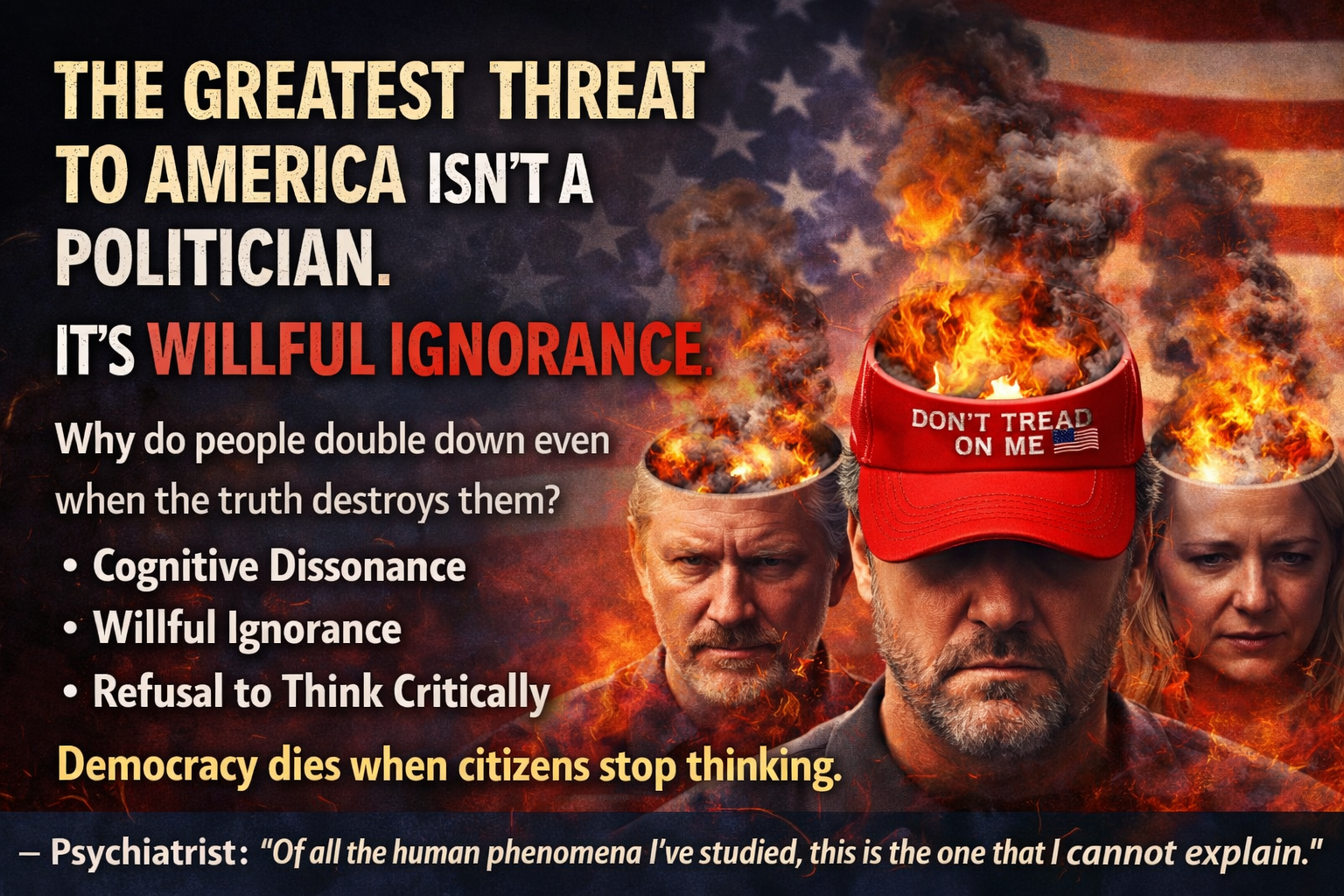
A British psychiatrist asked on air: of everything you've studied about human nature, what surprised you most?
The answer, after only a brief pause:
"The inability of people to change their minds despite overwhelming evidence to the contrary."
Not war. Not genocide. Not greed. The single most astonishing observation from a lifetime of studying human behavior: when facts collide with identity, people do not update — they double down.
This 11-minute discussion explores the psychology behind it, using the Exodus story as a case study. Watch it. Everything below will make more sense.
It's not about one leader. It's about how we think as citizens.
If we defended the Constitution with informed judgment — no politician could ever get away with it.
In 1957, psychologist Leon Festinger published his landmark theory of cognitive dissonance. The core finding: when new information conflicts with a deeply held belief, the brain processes it as a physical threat. Brain imaging studies confirm actual stress responses in regions associated with pain and danger.
The critical variable: this response is most powerful when the challenged belief is fused with identity — with who someone believes themselves to be. At that point, changing the belief becomes neurologically indistinguishable from self-annihilation. The mind's defense: attack the evidence and retreat deeper.
Festinger's famous case study was a doomsday cult whose prophecy failed. When the predicted event didn't occur, the most committed members didn't leave. They became more convinced. They proselytized harder. The disconfirmed prophecy deepened the belief. This is not an edge case. This is how the human mind works under identity threat.
And it is the exact mechanism that makes political manipulation possible at scale — and profitable for those who know how to use it.
"It is almost impossible to get someone to change their opinions once it is anchored solidly into their personhood."— From the psychiatrist discussion in Video 1 above
🞼 Transcript Excerpt — Video 1: Cognitive Dissonance Discussion
"Of all the human phenomena that I've studied — which is the one that surprised me the most about human nature?"
Answer: "The inability of people to change their minds despite overwhelming evidence to the contrary."
The biblical framework offered: Moses asks Pharaoh to change his mind. The Pharaoh doubles down. Ten plagues follow. The first eight destroy the present. The last plague destroys the future. Only when both are obliterated does the Pharaoh relent — and even then he reverses course immediately, sending his army after the Israelites.
"Why do people double down instead of changing, even in the face of accelerating evidence of error?"
Because the belief isn't just a belief. It's who they think they are. Threatening it activates the same neural response as a physical threat to survival. The mind does not distinguish between "you're wrong about taxes" and "I'm going to kill you." Both trigger defensiveness, counter-attack, and entrenchment.
This is documented psychology, not opinion. See the sources section below for peer-reviewed research on identity-protective cognition.
If identity is that hard to move, what happens when a foreign government tries? In 2023, researchers published in Nature Communications the best measurement yet of Russia's 2016 Twitter campaign. They linked a three-wave election survey of about 1,500 Americans to those same people's actual Twitter feeds.
One percent of users received 70% of all exposure to Russian troll posts. Strong Republicans saw about nine times as many as Democrats or independents.
The trolls mostly reached people whose minds were already made up, and the researchers found no measurable change in those people's issue positions, polarization, or votes. That doesn't make the operations harmless: they put real Americans face to face in the street, and the study covered one platform in one election. But it fits everything above. Foreign operators didn't convert Americans. They fed identities that were already fused with belief. The authors raise one more possibility worth sitting with: the campaign's biggest effect may have been convincing Americans that it worked.
A real interview. Real contradictions. Documented on camera in Mississippi.
Mississippi: poorest state in America. Most conservative state in America.
These are not unrelated facts.
Mississippi ranks 48th out of 50 states in median household income. It has voted Republican in every presidential election since 1980. It leads the nation in poverty, food insecurity, and lack of healthcare access.
In this filmed street interview, a man living in poverty — on food stamps, without health insurance, in conditions visible on screen — explains his worldview: he opposes government assistance, hates Obamacare, holds factually incorrect beliefs about the president, and votes Republican without exception.
When asked whether Republican policy has worked for him, he answers: "It hasn't. But it could." When asked why the poorest state is the most conservative, he answers: "We would rather go broke and die hungry than give up our moral beliefs."
This is cognitive dissonance at full operating strength. His daily material reality is completely overridden by an identity he will not surrender. That identity was not formed accidentally. Billions of dollars and decades of deliberate messaging were invested to build it.
Mississippi's rank in median household income — yet it votes reliably for the party that cut food stamps, blocked Medicaid expansion, and consistently opposed minimum wage increases.
🞼 Transcript — Video 2: Mississippi Interview (Bill Maher)
"Why is Mississippi so conservative?" → "We're in the heart of the Bible Belt. We believe in family. We believe in Adam and Eve, not Adam and Steve."
On the president: "His name is Obama. This is America. Our president should be American, not Muslim." [Obama was born in Hawaii and is Christian. Both claims are factually false.]
On race: "Is it because he's Black?" → "I guess I'm a little prejudiced."
On assistance: "I get food stamps. But I think I deserve food stamps. I have no unemployment." / "I hate Obamacare. I think it's pointless." / "But a lot of people in Mississippi need healthcare." → "Yeah."
On results: "Republican policy hasn't worked for you, but it could?" → "It hasn't. But it could."
On conviction: "We would rather go broke and die hungry than give up our moral beliefs. I feel like voting God and voting faith is more important to me than voting for free money or voting for a handout."
Final words: "The South will rise again."
This transcript is presented without added editorial framing. The facts stand on their own. This man is not the villain of this story — he is its clearest victim. The people profiting from his certainty are not visible in this video. They are in the next section.
The historical record — from the Rockefeller Education Board to the prison industrial complex — documents a deliberate system.
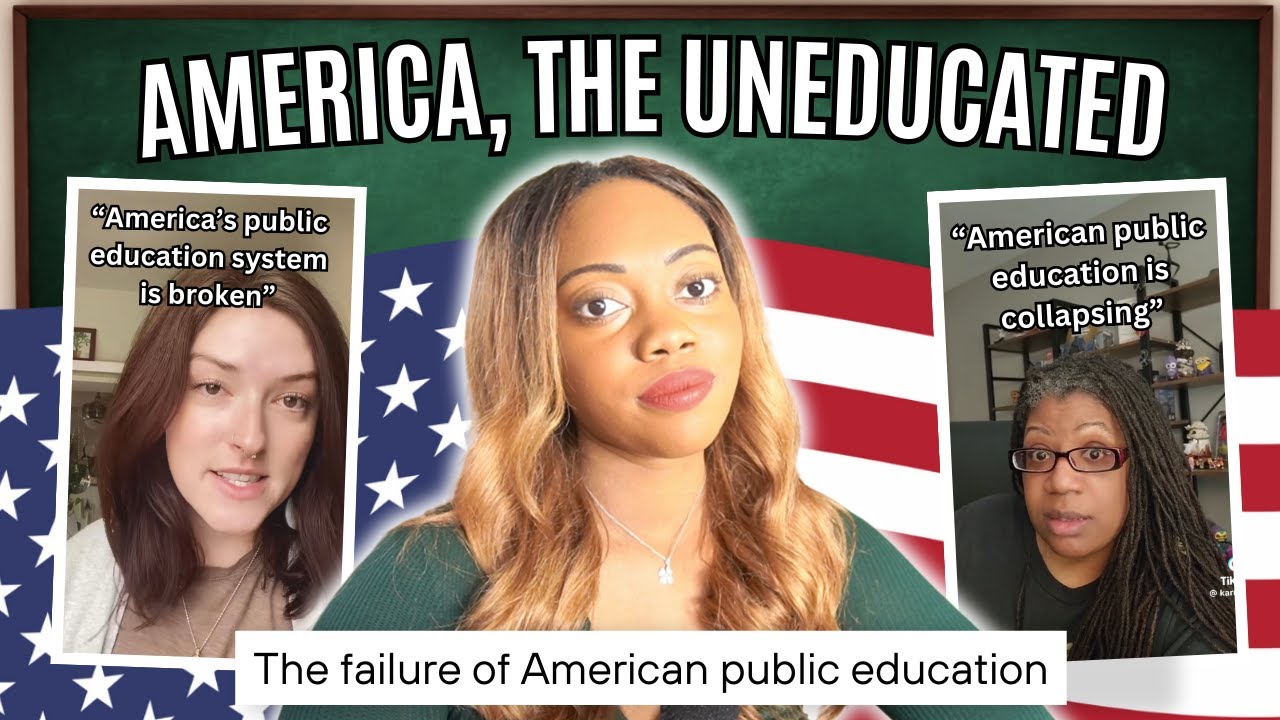
Click to watch on YouTube. This video documents the deliberate suppression of American critical thinking — from 1800s factory schooling to today's privatization push and social media algorithms.
The average American adult reads at a 7th-to-8th grade level. Only one in four Americans can name all three branches of government. The United States — the richest nation in human history — ranks below developing nations in key educational metrics.
This did not happen by neglect. This video traces the documented history of how American public education was deliberately designed not to produce thinkers, but to produce compliant, docile, economically useful workers.
Frederick Gates, co-founder of the Rockefeller Education Board in 1902, wrote in 1913: "We shall not try to make these people philosophers or men of learning... The task we set before ourselves is very simple: we will organize children and teach them to do in a perfect way the things their fathers and mothers are doing in an imperfect way."
The system has functioned exactly as designed. The less educated a population, the more susceptible it is to propaganda, the more reliably it votes against its own economic interests, and the more efficiently it feeds the prison industrial complex, the healthcare industry, and the predatory lending market. Every one of those systems profits from your ignorance.
Americans who struggle to understand basic health information — including medication instructions. (U.S. Dept. of Education / NCES)
Of U.S. prison inmates who cannot read above a 4th-grade level. The U.S. has the world's largest prison population and runs much of it for corporate profit.
🞼 Transcript Highlights — Video 3: Engineered American Ignorance
"There are two ways in which people are controlled: first, frighten them. Second, demoralize them. An educated, healthy, and confident nation is harder to govern."
"The perception that Americans are uneducated has persisted for decades — but what if I told you that's all by design? Those in power have an incentive to keep Americans uneducated."
On the founding framework: "Poor children were sent to public schools not to gain intellect, but to prepare them to become the next generation of docile worker bees."
Frederick W. Taylor, the father of industrial efficiency, on the ideal factory worker: "He shall be so stupid and phlegmatic that he resembles, in his mental makeup, the ox." [Written as a prescription, not a critique.]
On the Rockefeller Education Board (1902): "They intentionally trained students in public schools to develop skills that would make them fit to work in factories."
On legal and medical complexity: "Legal documents are written in old English jargon by design. Medical writing has been called 'a highly skilled, calculated attempt to confuse the reader.' Financial documents are written in complex jargon — and public schools don't teach financial literacy. All of it makes you more susceptible to predatory systems."
On culture war mechanics: "Politicians want us to compete with each other in culture wars — because when we're competing with each other, we're not competing with them. They know that if we wise up, we will rise up."
On social media: "The algorithm feeds you content based on past behavior. If you're consuming misinformation, it feeds you more. You end up in a bubble — a shortsighted, surface-level way of thinking that serves the people who profit from your distraction."
Conclusion: "Powerful entities stand to benefit from Americans being uneducated — the healthcare industry, the pharmaceutical industry, the government, corporations. The sooner we become aware of the ways we're being manipulated, the sooner we can band together to demand better."
Every factual claim in this video is independently verifiable through the sources listed below. Verify everything. That's the whole point.
RAND Corporation data. Not opinion. Not partisan. Mathematics.
Transferred from the bottom 90% of Americans to the top 1% since 1975, per the most recent RAND Corporation analysis.
RAND Corporation / Updated 2024The raise every full-time worker in the bottom 90% would receive TODAY if income distributions had simply held at 1975 levels.
RAND Corporation, 2024What the median American worker would earn annually if economic gains had been shared as they were in the 1950s-60s. Actual median: ~$50,000.
RAND / Fast CompanyIncome growth for the top 1% from 1975-2018. For working Americans below the 90th percentile: effectively zero in real terms.
RAND CorporationOf Americans who can name all three branches of government — the same citizens making national electoral decisions every two years.
University of PennsylvaniaOf juveniles facing trial in juvenile court who are functionally illiterate. Literacy and incarceration rates are directly linked — and both are policy choices.
National Literacy Institute"This upward redistribution was not inevitable. It was a choice — a direct result of trickle-down policies chosen after 1975. We chose to cut taxes on billionaires. We chose to deregulate. We chose to permit monopolies. $79 trillion is the price tag of those choices, paid by working Americans."— Synthesized from RAND Corporation research, reviewed in TIME Magazine and Democracy Journal
Cognitive dissonance does not maintain itself. It is manufactured, amplified, and sold back to us. The same donor networks and lobbying organizations that gut healthcare, suppress wages, offshore jobs, and rewrite the tax code also fund the culture war machine that keeps working Americans focused on bathrooms, borders, and flags — instead of their bank accounts and medical bills.
This is not a conspiracy theory. It is a documented business model with a 50-year paper trail. If you're angry at the wrong people, you'll vote for the wrong candidates. If you can't read the healthcare form, you can't fight the hospital bill. If you don't know the three branches of government, you can't hold any of them accountable. These are not bugs. They are features.
The man in the Mississippi video is not the enemy. He is the target. So is anyone watching tribal media at 11pm. So is anyone caught in a social media algorithm that feeds outrage because outrage is profitable. The algorithm, the culture war, the engineered ignorance — these are products. They have investors, quarterly earnings reports, and shareholders.
The only force that has ever interrupted this cycle is a citizenry that learns to recognize the manipulation before it lands — and chooses to think instead.
Nature Communications — Peer-Reviewed, 2023
Exposure to the Russian Internet Research Agency Campaign on Twitter and Its Relationship to Attitudes and Voting (Eady et al.)
RAND Corporation — Primary Research
Trends in Income From 1975 to 2018 (Price & Edwards) — Original Paper
TIME Magazine
The Top 1% of Americans Have Taken $50 Trillion From the Bottom 90%
U.S. Senate — Sen. Bernie Sanders
Nearly $80 Trillion Redistributed from Bottom 90% to Top 1% Since 1975 (RAND, 2024)
Fast Company
'We Were Shocked': RAND Study Uncovers Massive Income Shift to the Top 1%
Psychology Today
Cognitive Dissonance — What It Is, How It Works, and Why It Matters
Simply Psychology
Cognitive Dissonance: Festinger's Theory, Research, and Real-World Examples
The Decision Lab
Cognitive Dissonance — Why We Justify Our Own Destructive Decisions
YouTube — Jordan B Peterson Clips
What Is Cognitive Dissonance and Why Do We Suffer From It? (11 min)
YouTube — Bill Maher
Mississippi Interview — "We'd Rather Go Broke Than Change Our Beliefs"
YouTube — Documentary
America Being Dumb Is Not an Accident. It Is the Intent. (Full Video)
U.S. Dept. of Education / NCES
National Assessment of Adult Literacy — 90M Americans Struggle with Health Information
Network for Public Education
Charter Schools Cost Districts $400M+ Annually in Funding Diverted From Public Schools
Prison Policy Initiative
Incarceration, Poverty, and the Prison Industrial Complex — Data and Analysis
Brennan Center for Justice
Voter Suppression, Electoral Integrity, and Democracy Research
Hofstadter, 1964 — Pulitzer Prize Winner
Anti-Intellectualism in American Life — Historical Foundation for Everything Above
Especially someone you disagree with. The goal isn't to win an argument. It's to ask one question: Who actually benefits from your anger — and is it the person you think it is?