The Diesel Deal:
Who Gained, Who Paid
In one weekend, Washington eased sanctions on Russian fuel, told Ukraine to find a new leader, and watched its closest allies refuse to follow. Here is the ledger.
Video: third-party commentary on the week's events. Crisis of Truth verified its core claims against the sources listed below. One headline framing is corrected in Section 4.
The Bottom Line
To bring down diesel prices three weeks before the midterm elections, the administration handed Russia an export market it had lost, pressured Ukraine to stop the refinery strikes that caused that loss, and broke ranks with every major ally. The United States got one shipment and a temporary price dip. Russia got relief it had publicly asked for. That is a short-term domestic political gain purchased with long-term American credibility.
01Four Days in October
- Friday, Oct 9 VerifiedAfter a call with Vladimir Putin, President Trump announced a deal for Russian diesel. Treasury's Office of Foreign Assets Control immediately issued General License 135, allowing Russian diesel transactions through April 7, 2027. AP reported it is the first diesel waiver longer than the standard 30-day window since the war began.[1][2]
-
Saturday, Oct 10
VerifiedTrump told Zelensky he had "better damn well stop" attacking Russian refineries, and said of Ukraine: "I suggest they get a new leader who can make a deal."[5]
VerifiedThe same day, Germany's government spokesperson said Berlin "remains committed to the decisions on sanctions against Russia and is working with its European partners on further sanctions."[3] -
Sunday, Oct 11
VerifiedTrump announced an "energy ceasefire." Zelensky told Axios the post was the first he had heard of it. He later accused Russia of striking a Kyiv power plant after the announcement.[5][6]
VerifiedCanada's Prime Minister's Office said the diesel agreement "is in direct opposition to the efforts of Ukraine, Canada, and our allies."[4]
VerifiedRepublican Senators Collins, Murkowski, Tillis and Curtis joined two Democrats in a statement that the decision "runs directly counter" to the 2022 law banning Russian energy imports.[7] - Monday, Oct 12 VerifiedThe EU adopted its largest-ever single set of Russia sanctions listings: 826 companies and 743 executives in Russia's military-industrial complex. More than half target the ballistic-missile supply chain.[8]
02The Motive Is on the Record
VerifiedThis page makes no claim about hidden motives. The stated one is enough.
"Lower prices for Americans, especially our Great Farmers, Ranchers, and Truckers, is my Greatest Priority."President Trump, announcing the deal, Oct 9 [1]
AnalysisLower fuel prices are a legitimate American interest. The question this page asks is whether this trade served that interest at an acceptable price, or whether it spent something more valuable to buy something temporary. The ledger below is the answer.
03The Ledger
What America Got
What America Paid
- VerifiedPublic breaks with Germany, Canada, and the EU within 72 hours.[3][4][8]
- VerifiedDoubt about enforcing the bipartisan Russia sanctions law Trump signed only last month.[1]
- AttributedSen. Thom Tillis said there is a legitimate case the president is not following the 2022 import ban.[7]
- AnalysisA signal to Moscow that U.S. pressure is negotiable when American gas prices rise.
What Russia Got
- VerifiedA reopened export market. Russia had banned diesel exports since July after Ukrainian strikes cut output by about 30%.[10]
- AttributedAn energy analyst told AP the deal is a "great benefit to Russia and to Putin," letting Moscow unload summer-grade diesel before winter.[10]
- VerifiedU.S. pressure on Ukraine to stop the refinery strikes that caused the shortage.[5]
- VerifiedWhat Putin had publicly asked for: two days earlier he said Russia had ample diesel but could not sell it because of sanctions.[2]
The pattern
AnalysisRussia's diesel problem was created by Ukraine's strikes. The deal solved it two ways at once: it gave Russia buyers, and it put American pressure on the country doing the striking. Meanwhile, the U.S. president's call for Ukraine to change leaders lined up with a long-standing Kremlin goal. AttributedZelensky made the same point, saying it is up to Ukrainians to choose their leader and noting that Putin would also like to change who leads Ukraine.[6]
04What the Headlines Got Wrong
Many headlines this week said the EU "hit back" at Trump with 1,600 sanctions. The record shows otherwise.
- Aug 31VerifiedPolitico reports roughly 1,600 names being prepared for a new EU list.[11]
- Sept 16VerifiedThe EU's diplomatic service formally proposes 1,576 listings.[12]
- Oct 7VerifiedEU ambassadors approve the package.[12]
- Oct 9The diesel deal is announced.
- Oct 12Ministers formally adopt the already-approved package.
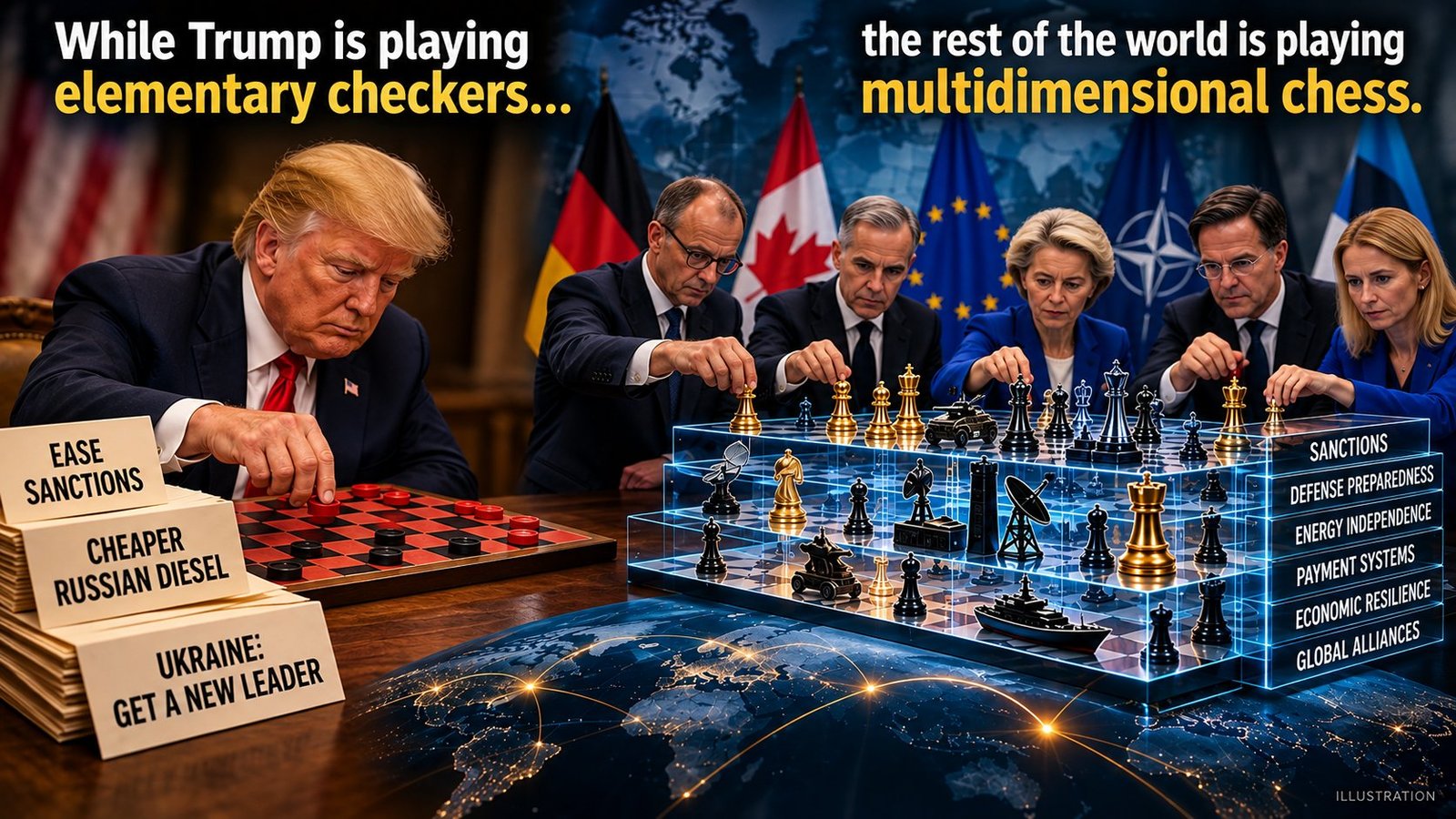
AnalysisThe EU did not react to Trump. It had already done the work. That is the stronger story: allies planned for an unreliable Washington months in advance. Sweden's offline card-payment system, built so Swedes can buy food if the network goes down, went live July 1.[13] In 2025, Norway (3.28% of GDP) and Denmark (3.25%) both spent more on defense as a share of their economies than the United States (3.12%).[14]
When a headline implies cause and effect, check the dates.
05A Claim We Declined to Make
Claim: "Trump is a Russian agent."
What is documented: Special Counsel Mueller found that "the Russian government interfered in the 2016 presidential election in sweeping and systematic fashion."[18] The same report found the Trump Organization pursued a Trump Tower Moscow project "through at least June 2016," well into the campaign.[18] The bipartisan Senate Intelligence Committee found in 2020 that Trump's campaign chairman, Paul Manafort, "on numerous occasions" sought to pass internal polling data and campaign strategy to Konstantin Kilimnik, whom the committee identified as a Russian intelligence officer. It called Manafort's conduct "a grave counterintelligence threat."[19][20] At Helsinki in 2018, standing beside Putin, Trump said of Russian interference: "He just said it's not Russia. I will say this. I don't see any reason why it would be."[21]
What is not documented: Mueller's investigation "did not establish that members of the Trump Campaign conspired or coordinated with the Russian government."[18] No public evidence shows Trump was recruited, directed, or paid by Russian intelligence. The later Durham report criticized how the FBI opened its investigation.[22]
Why we declined: This page does not need it. The stated motive, the dates, and the ledger show who gained without any claim about secret loyalties. Crisis of Truth publishes what it can prove.
06For the Record
The strongest case for the administration's decision, and the facts that cut against this page's conclusion:
- Prices hurt real people. Diesel drives the cost of food, freight, and farming. A president acting to bring it down is acting on a genuine American interest.[1]
- The license is narrow. It covers diesel only, temporarily. All other Russia sanctions remain, and transactions tied to Russia's central bank, sovereign wealth fund, and finance ministry are excluded.[2]
- The price spike has other causes. Most experts attribute high diesel prices mainly to the Iran war, not Ukraine. The administration's defenders and critics both cite this, for different conclusions.[4]
- Some allies backed part of the effort. The UK publicly supported Trump's call for an energy ceasefire, and Zelensky said Ukraine would honor one if Russia did.[6]
- Europe is not spotless. Zelensky also criticized a recent EU decision to lift sanctions on two Russian oligarchs as part of a deal to extend others.[15]
- America still holds the financial center. Investors put a record $59.3 billion into U.S. government bond funds in the third quarter and nearly $14 billion more in early October.[16] Allies are hedging against Washington while still parking their money here.
AnalysisNone of these points changes the ledger. A narrow, temporary license still reopened Russia's market and broke allied ranks. Real price pain is a reason to act, not proof this action was the right one, and the senators who object belong to the president's own party.
07What to Watch
- April 7, 2027: General License 135 expires. Does Congress act on the 2022 import ban before then?
- The Russia sanctions law: Does the administration enforce the law it signed in September against top importers of Russian oil and gas?
- Canada and Saab: The GlobalEye term sheet signed Sept 25 is non-binding. A signed contract would confirm Canada's shift toward European suppliers.[17]
- Pump prices after Nov 3: If prices rise again after the election, the deal's value to Americans should be measured against what it cost.
08Sources
- Trump says U.S. to get diesel from Russia, relaxing pressure on Moscow
- Trump announces deal right after call with Putin
- Germany sticks to Russia sanctions after Trump announcement on diesel
- Trump's diesel deal in 'direct opposition' to Ukraine's efforts, Carney's office says
- Trump says Russia and Ukraine reached 'energy ceasefire'; Zelensky: 'News to me'
- Trump says Ukraine and Russia agree to 'energy ceasefire' · LBC
- Senators urge Trump administration to reverse Russian diesel plan
- EU lists 1,569 Russian companies and CEOs in largest sanctions round
- Trump eases sanctions as Russia supplies US with diesel to curb prices
- Trump strikes deal with Putin to get diesel in sharp reversal of US policy
- EU authorities plan to include about 1,600 in new sanctions package
- EU to approve 1,646-entry sanctions list against Russia on 12 October
- Offline payments
- Trends in World Military Expenditure, 2025
- 'A gift to Putin': Zelenskyy condemns Trump's deal
- Treasury selloff, institutions start to buy the dip
- Canada advances negotiations with Saab for GlobalEye
- Report On The Investigation Into Russian Interference In The 2016 Presidential Election, Vol. I
- Russian Active Measures Campaigns and Interference in the 2016 U.S. Election, Vol. 5: Counterintelligence Threats and Vulnerabilities
- Senate report finds Manafort passed campaign data to Russian intelligence officer
- In Helsinki, Trump appeared to side with Russia over U.S. intelligence community
- Report on Matters Related to Intelligence Activities and Investigations Arising Out of the 2016 Presidential Campaigns