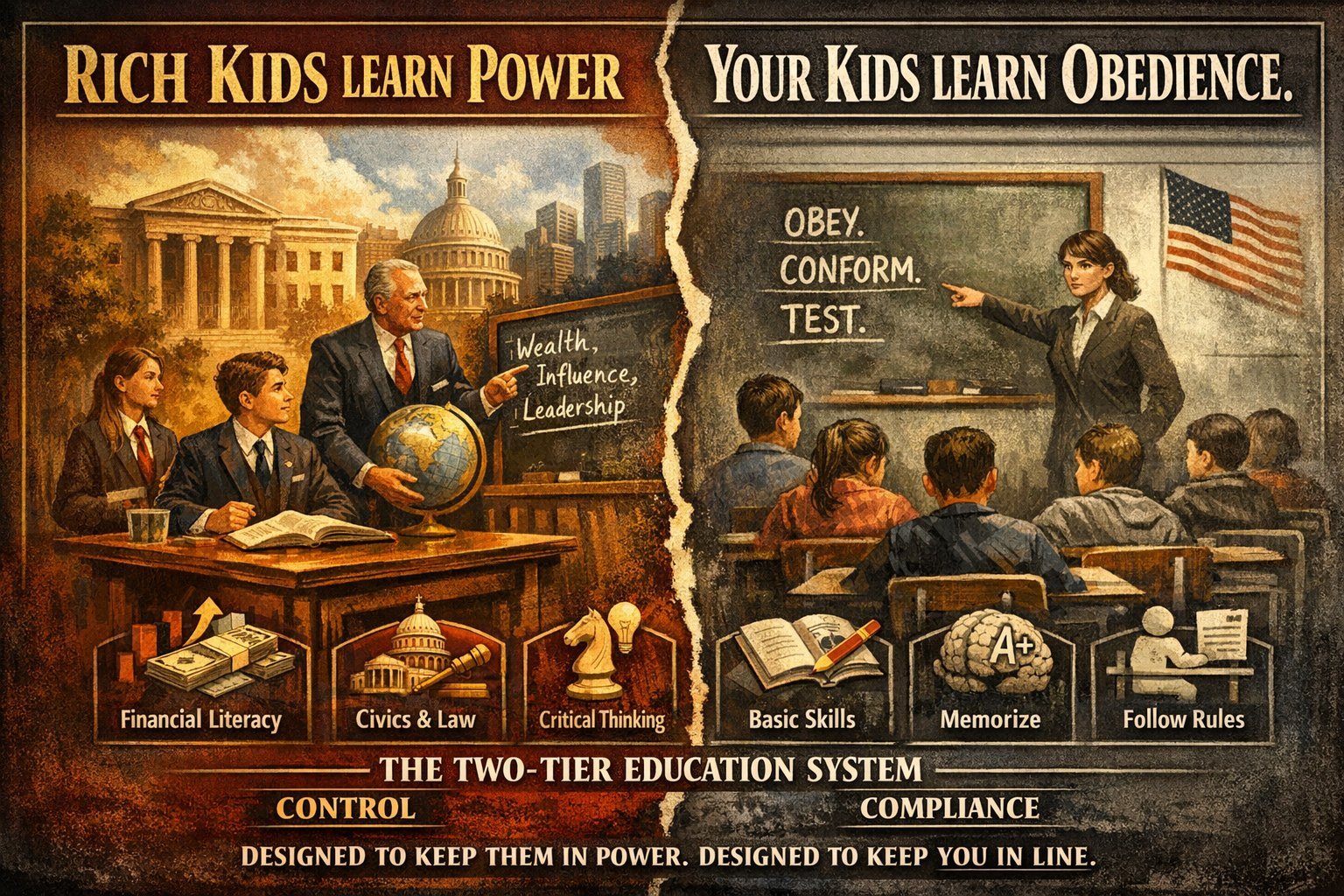
There are two education systems in America. One teaches children how the world actually works. The other teaches them to sit down, shut up, and pass a test. This is not about intelligence. It's about what they deliberately didn't teach you.
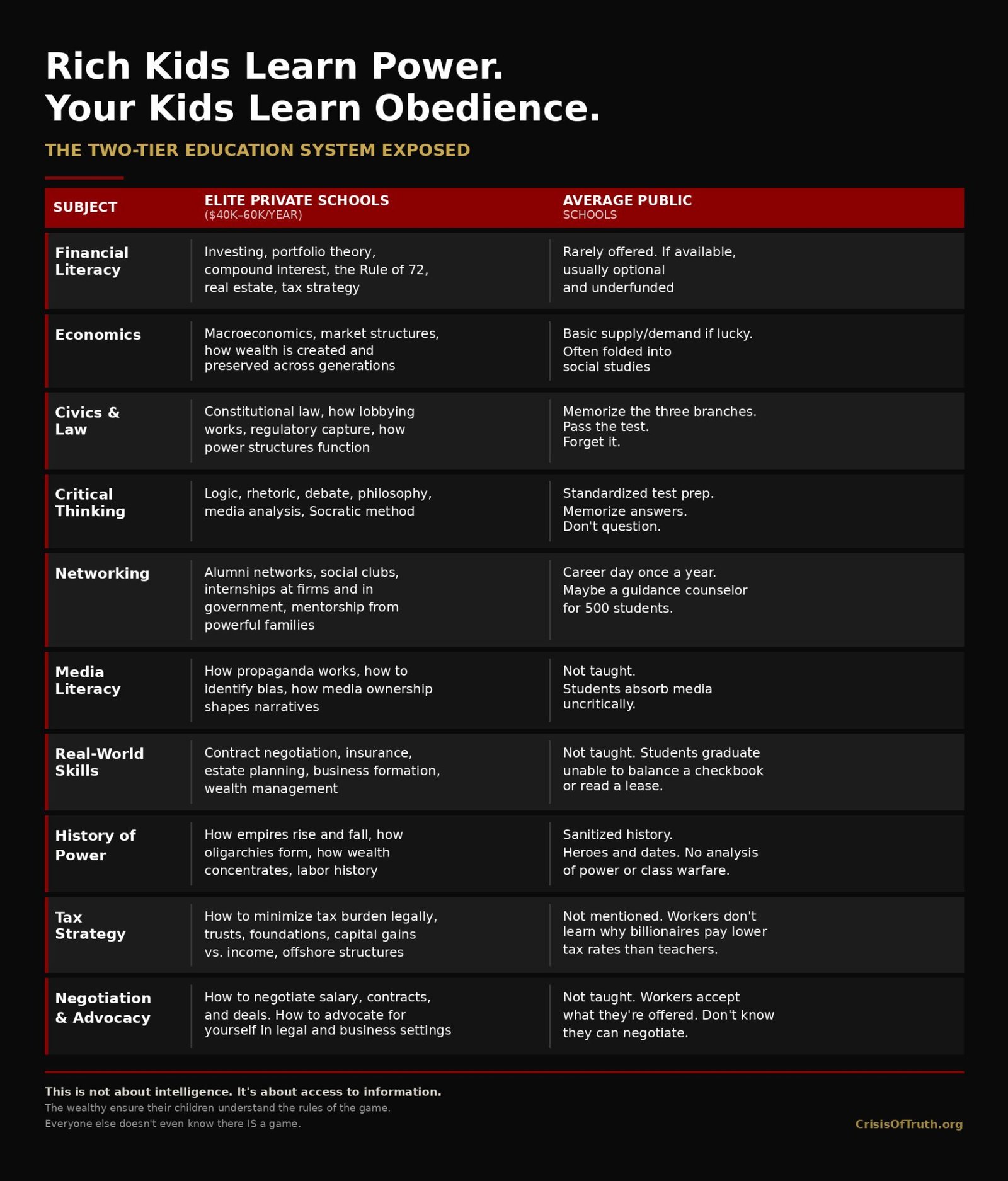
The image above is a side-by-side comparison of what children learn at elite private schools — institutions that charge $40,000 to $60,000 per year — versus what children learn in average American public schools. It covers 10 subjects. In every single one, the wealthy children receive education that prepares them to run the world, while working-class and middle-class children receive education designed to make them useful workers who don't ask questions.
This is not an accident. This is not a funding problem that nobody noticed. This is by design.
In the early 1900s, industrialists like John D. Rockefeller created the General Education Board and funded the restructuring of American public education. The Board's own literature stated its purpose plainly: "We shall not try to make these people or any of their children into philosophers or men of learning, or men of science... The task we set before ourselves is a very simple as well as a very beautiful one: to train these people as we find them to a perfectly ideal life just where they are."
Translation: Don't teach them to think. Teach them to work.
More than a century later, the system is working exactly as designed.
Here is every subject from the comparison image, expanded with the full explanation of what the wealthy learn, what you were denied, and why it matters.
Why it matters: If you don't know the Rule of 72, you can't understand how the wealthy double their money every 7–9 years while your credit card debt doubles every 4 years. The Rule of 72 says: divide 72 by the interest rate and that's how many years it takes to double. At 10% return, money doubles in 7.2 years. At 18% credit card interest, your debt doubles in 4 years. The banks know this. The credit card companies know this. You were never supposed to.
Why it matters: If you don't understand how money moves through the economy, you can't understand how $50 trillion was transferred from the bottom 90% to the top 1% over four decades (RAND Corporation, 2020). You can't understand why billionaires pay a lower effective tax rate than schoolteachers. You can't understand why wages haven't kept pace with productivity since the 1970s. That's the point.
Why it matters: If you don't know how the system works, you can't fight the system. You can't hold your representatives accountable if you don't understand what they're doing. You can't protect your rights if you don't know what they are. An ignorant citizenry is a controllable citizenry.
Why it matters: Critical thinking is the single most important skill a citizen can have. Without it, you cannot evaluate a politician's claims. You cannot recognize propaganda. You cannot distinguish between a fact and a talking point. You cannot tell when someone is lying to you. A population that can't think critically is a population that can be told anything.
Why it matters: In America, who you know matters more than what you know. Elite schools are not just selling education — they're selling entry into a network of power. Research from Yale found that social networks at elite universities generate top corporate roles and political positions. UK studies show alumni of just 9 elite schools are 67 times more likely to enter the national elite than average citizens. Your child isn't failing. They were never given a ticket to the game.
Why it matters: The Fairness Doctrine was eliminated in 1987. The Smith-Mundt Act was amended in 2012 to allow domestic government propaganda. Today, you live in a media environment where there is no legal requirement for news to be balanced, fair, or truthful. If you were never taught to recognize propaganda, you have no defense against it. The wealthy know this. Their children are taught to see through it. Yours are taught to consume it.
What a media-literate reader would catch: In 2024 the Justice Department disrupted a Russian bot farm whose fake accounts posed as ordinary Americans, including a supposed Minneapolis resident posting Putin videos. A second Russian operation built look-alike copies of real newspaper websites, such as a Washington Post address ending in ".pm" instead of ".com".
Five habits that defeat both: check who is really behind an account before trusting it, type a news outlet's address yourself, look for the original source of a claim, slow down when a post makes you furious, and never assume someone is a bot just because you disagree with them.
Practice it with our interactive exercise: Russian Bot Farms: Spot the Warning Signs →
Why it matters: Every one of these skills costs you money when you don't have them. You pay more for loans because you don't understand interest. You sign leases with hidden terms because you can't read contracts. You accept lowball salary offers because nobody taught you to negotiate. You get bankrupted by medical bills because you don't understand your insurance. Your ignorance is someone else's profit.
Why it matters: If you don't know the history of how the powerful exploit the powerless, you can't recognize when it's happening to you. If you don't know that workers fought and died for the rights you take for granted, you won't fight when those rights are taken away. History they don't teach you is history they plan to repeat.
Why it matters: Warren Buffett famously admitted he pays a lower tax rate than his secretary. In Florida, the average teacher pays an effective tax rate of 9.5% while the richest 1% pay just 2.7%. The tax code is not broken. It's working exactly as designed — for them. If you were never taught how it works, you were never meant to question it.
Why it matters: Studies show that failing to negotiate your first salary can cost you over $1 million in lifetime earnings due to compound raises built on that initial number. Every job, every lease, every loan, every medical bill is a negotiation. If nobody taught you to negotiate, everyone you deal with has the advantage.
The 10 subjects above aren't even the full picture. John Taylor Gatto — a New York City and New York State Teacher of the Year — spent years studying the curricula of America's most prestigious private schools. He identified 14 core lessons taught at elite institutions that are completely absent from public education:
How many of those 14 lessons did you receive in your education? Gatto documented his findings in two essential books: Dumbing Us Down and Weapons of Mass Instruction. Both should be required reading for every parent in America.
It gets worse. School voucher programs are now draining public school funding and redirecting your tax dollars to subsidize private education for the wealthy. This isn't conspiracy — it's documented policy:
In Arizona, 60% of families claiming school vouchers have incomes over $200,000. In Virginia, it's 87%. In Louisiana, it's 99%. These programs were sold to the public as helping poor kids escape failing schools. In reality, they are a wealth transfer from public education to private institutions that serve the rich.
The organizations behind the voucher push — the DeVos Family Foundation, the Koch Foundation, and their network — have spent hundreds of millions of dollars lobbying for these programs. As Senator Bernie Sanders noted, just four hedge fund managers on Wall Street made more money last year than all the kindergarten teachers in America combined.
Meanwhile, public school teachers earn almost $100 less per week, adjusted for inflation, than they did 28 years ago.
1. Share this image and page. Most people have never seen the education gap laid out this clearly. Send it to every parent you know. Post it everywhere.
2. Teach your children what the schools won't. Start with the Rule of 72. Teach them about compound interest. Teach them how to budget, how credit works, how to read a contract. If the schools won't do it, you have to.
3. Demand financial literacy and critical thinking in your local schools. Go to school board meetings. Contact your state legislators. As of 2024, only 26 states require a personal finance course to graduate high school. Push to make your state one of them.
4. Read the books they don't want you to read. Start with John Taylor Gatto's Weapons of Mass Instruction and Dumbing Us Down. Read David Cay Johnston's The Fine Print. Read Jane Mayer's Dark Money. Read David Pakman's The Echo Machine. Knowledge compounds just like interest — the earlier you start, the more powerful it becomes.
5. Contact your representatives. Call 202-225-3121 or visit congress.gov/contact-us. Demand they explain why billionaires pay a lower tax rate than teachers. Demand financial literacy education in every school. Demand accountability.
Working-class children are just as smart as wealthy children. The difference is what they're taught. The wealthy ensure their children understand the rules of the game. Everyone else doesn't even know there IS a game.
Now you know. What are you going to do about it?