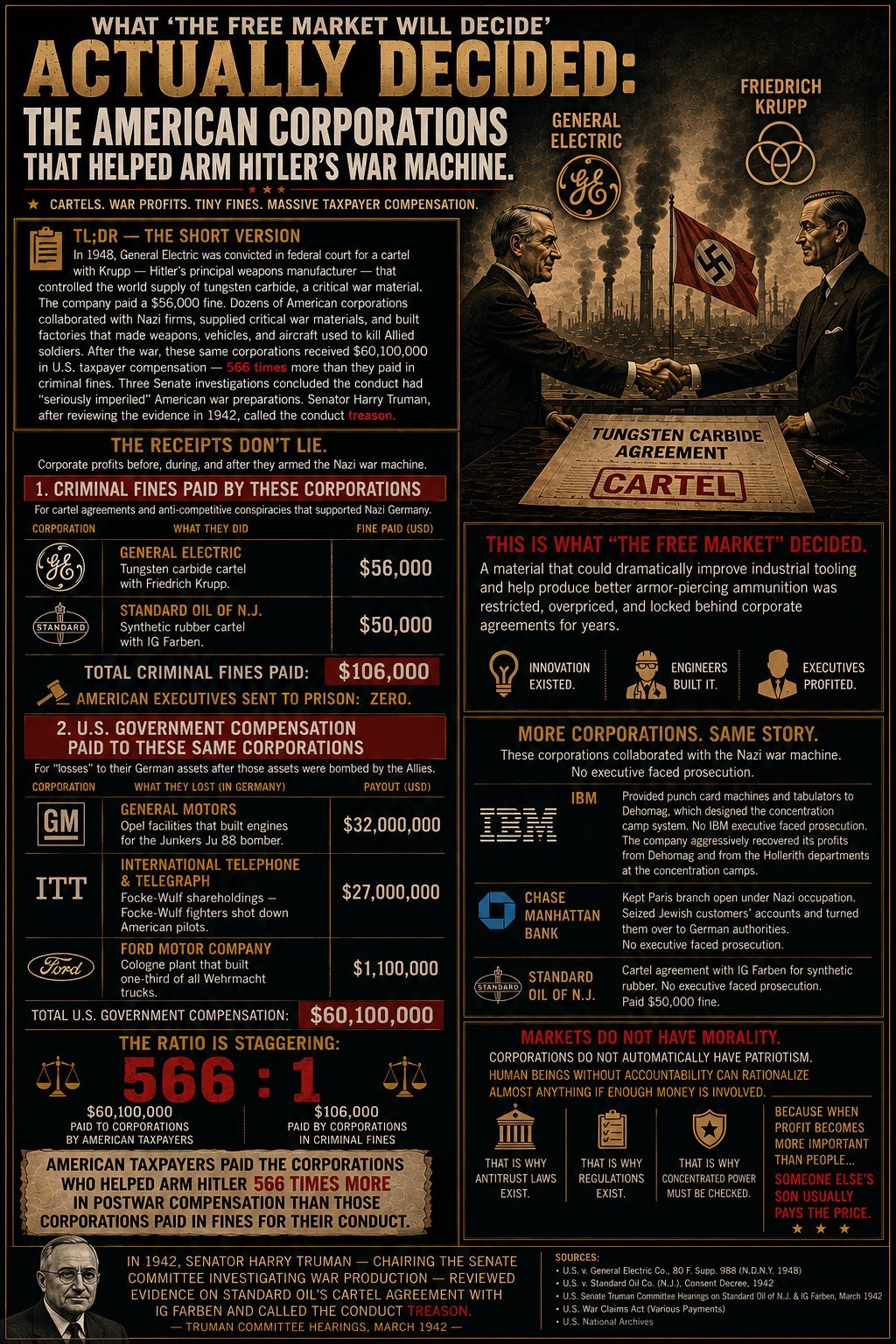
In 1948, General Electric was federally convicted of running a wartime cartel with Krupp — Hitler's principal weapons manufacturer — to control the world supply of tungsten carbide. The fine was $56,000. No executive went to prison. The same pattern is documented across Ford, General Motors, ITT, IBM, Chase National Bank, and Standard Oil. After the war, the U.S. government paid these corporations approximately $60 million in compensation for bombing damage to their Nazi-collaborating subsidiaries — 566 times more than they paid in fines. Three U.S. Senate investigations concluded the conduct had "seriously imperiled" American war preparations. Senator Harry Truman called it treason. This page documents what the public record shows.
§ 01 — The PhraseThe most powerful sentence in American political debate
"The free market will decide."
It ends arguments. It closes conversations. It dismisses regulation as overreach, antitrust enforcement as anti-business, labor protection as interference. It carries the weight of inevitability — as though the market were a force of nature, neutral and self-correcting, that would punish bad actors and reward good ones if only government would step out of its way.
It is the phrase that justified four decades of deregulation, deunionization, and deindustrialization. It was used to defend the deals that closed the factories, gutted the pensions, and emptied the towns. It is still used today to defend the system that prices insulin out of reach, denies medical claims by algorithm, and concentrates more wealth in fewer hands than at any point in American history outside the original Gilded Age.
But the phrase has a problem.
When American corporations were genuinely left free to decide for themselves — without effective regulation, without serious antitrust enforcement, without state interference — what they decided to do was sell to Hitler.
Not a small number of marginal companies. The largest American corporations of the era. General Electric. General Motors. Ford. ITT. IBM. Standard Oil. Chase National Bank. They were free to choose. They chose to keep the contracts. They chose to keep the patents. They chose to keep the factories operating in Germany after Pearl Harbor, after America was at war with Germany, after the death camps were known. In several documented cases they chose to actively suppress American war production rather than abandon their cartel agreements with German firms.
Most of them faced no meaningful punishment for any of it. Several were paid by the United States government, after the war, to compensate them for the bombing damage Allied forces inflicted on the Nazi factories they owned.
This is not the story Americans are taught about World War II. It is a story that sits in declassified federal court rulings, Senate investigation transcripts, and US Army field reports — exactly where it has always sat, on the public record, available to anyone who wanted to look.
It is the story of what concentrated private power actually does when it is genuinely free to decide.
§ 02 — October 21, 1941Six weeks before Pearl Harbor
On October 21, 1941, the United States Department of Justice returned a federal indictment against the General Electric Company and the Friedrich Krupp armaments works of Germany. The case was filed under the Sherman Anti-Trust Act and the Wilson Tariff Act. It charged the two corporations — one American, one the principal weapons manufacturer of the Third Reich — with criminal conspiracy to maintain a worldwide monopoly over a strategic war material called tungsten carbide.
Tungsten carbide was, and remains, one of the most important metals in modern industrial production. Its hardness allows it to cut, drill, and machine other metals at speeds and precisions impossible with steel alone. It was essential to manufacturing rifles, artillery shells, aircraft engines, tank components, and every machine tool that produced any of the above. By the late 1930s the German military had standardized its industrial base on tungsten carbide tooling. The American military had not.
The indictment alleged that General Electric and Krupp had divided the world market between them. Krupp would dominate Europe. General Electric, through its subsidiary Carboloy Inc., would dominate the United States. They would set prices in concert. They would limit production. They would restrict who else could enter the market.
According to the cartel agreement, General Electric would license tungsten carbide manufacturing in the United States to "preferably not more than two" companies. In practice it was licensed to exactly one — General Electric's own subsidiary. The agreement granted Krupp the contractual right to determine which other firms General Electric was allowed to license at all.
The result was that the Third Reich had abundant tungsten carbide for its armaments industry. The United States, on the eve of its own entry into a war against the same Reich, did not.
Three separate Senate investigations during and after the war — the Truman Committee, the Bone Committee, and the Kilgore Committee — would all conclude that cartel arrangements of this kind had "seriously imperiled the war preparations of the United States." Assistant Attorney General Thurman Arnold, the trust-buster who built the case, told the Truman Committee in 1942 that there was "no essential difference between what Standard Oil has done in this case and what other companies did in restricting the production of magnesium, aluminum, tungsten carbide, drugs, dyestuffs and a variety of other critical materials vital for the war."
The General Electric indictment was suspended at the outbreak of World War II. The case did not come to trial until 1947. By then, six years had passed. The bodies were buried. The Reich was rubble. The judge who heard the case was Chief Judge John C. Knox of the Southern District of New York.
§ 03 — 1948The verdict
Judge Knox issued his ruling in 1948. The court found General Electric, the Carboloy Company, and the International General Electric Company guilty under the Sherman Anti-Trust Act and the Wilson Tariff Act. The cartel was real. The market division was real. The price-fixing was real. The restriction of tungsten carbide production at a moment of national emergency was real.
The fine was $56,000.
It was distributed across the corporate defendants and the named individual executives. The judge refused the government's request that any of the defendants serve prison time. From his ruling, he had "a very strong indisposition not to punish stale crimes too severely."
"The business community regards fines in antitrust cases as a license fee, which may be charged off as part of the cost of doing business." — Statement by the government's own attorney, in open court, during the General Electric trial
Among the documents introduced as evidence at the trial were letters from Krupp executives to General Electric executives, dated through the 1930s, ending with the salutation "Heil Hitler."
The trial was attended by exactly one journalist for most of its duration. His name was Irving Lerner, a reporter for UE News, the newspaper of the United Electrical Workers union. He had reported on the original 1941 indictment. He returned in 1947 to cover the trial and found that he was the only press in the room. From his contemporaneous account: "If you don't see anything about the GE-Krupp cartel trial in your local newspaper, don't be surprised. There's no one at most sessions of the trial to report it."
The mainstream American press did not cover the conviction. Most Americans never learned that General Electric had been criminally convicted of cartel agreements with the principal weapons manufacturer of Nazi Germany. Most Americans still don't know.
§ 04 — The PatternGeneral Electric was not the anomaly
What follows is a partial catalog. It is partial because the full catalog is longer than any single article can carry. What is documented below sits in court records, Senate hearing transcripts, US Army investigation reports, declassified Treasury files, and in some cases the corporations' own internal memoranda, released through litigation in the decades since.
Each of these companies operated through wholly-owned or majority-controlled German subsidiaries. Each maintained those subsidiaries throughout the war, in some cases through neutral-country shell arrangements after Pearl Harbor. Each contributed materially to the German war effort. Each faced minimal or no criminal consequences. Several were compensated by the United States government, after the war, for the damage Allied bombing had inflicted on their German operations.
The names of the companies have changed in some cases. The pattern has not.
Ford Motor Company
Ford opened its Cologne plant in 1931. Henry Ford himself laid the foundation stone alongside Konrad Adenauer, then mayor of the city. By 1935 Ford-Werke was the second-largest producer of trucks for the Wehrmacht. By 1941, after the Nazi invasions of Poland and France, Ford of Germany had stopped manufacturing passenger vehicles entirely and was devoting its full production capacity to military trucks for the German army.
The 1945 US Army investigation report, prepared by investigator Henry Schneider and now sitting in the National Archives, documented that Ford-Werke had begun producing strictly military vehicles for the Reich before the war began, and had established a war-mobilization plant near Berlin "with the approval of Dearborn." By 1942, of the 350,000 trucks used by the motorized German Army, roughly one-third were Ford-made. The Schneider report contained the line: "Ford trucks prominently present in the supply lines of the Wehrmacht were understandably an unpleasant sight to men in our Army."
Ford-Werke used slave labor from 1941 through 1945. Approximately half the workforce was forced labor — Soviet, Polish, French, Belgian, and Ukrainian prisoners, including Buchenwald concentration camp inmates. The plant manufactured trucks, half-tracks, and turbine components for the V-2 rocket program.
In 1938 Henry Ford personally accepted the Grand Cross of the German Eagle from Adolf Hitler — the Nazi regime's highest honor for foreigners. Ford was 75 years old. The character of the regime was not in doubt; Kristallnacht occurred the same year.
General Motors
General Motors purchased Adam Opel AG, the largest German automobile company, in 1929. Opel became, and remained throughout the war, a wholly-owned subsidiary of General Motors.
In 1934, GM Overseas Corporation president James D. Mooney met personally with Adolf Hitler in his chancellery office. The meeting was reported in GM's company publication General Motors World, which described Hitler as "a strong man, well fitted to lead the German people out of their former economic distress." Mooney himself received the Order of the Merit of the Eagle from Hitler in 1938.
The principal product of Opel during the war years was the Opel Blitz truck — the vehicle that, in the literal sense, put the Blitz in Blitzkrieg. Approximately 130,000 Blitz trucks were produced between 1935 and 1944. They moved Wehrmacht troops into Poland, France, the Soviet Union, and across North Africa.
In 1974 the United States Senate Subcommittee on Antitrust and Monopoly published an exhaustively documented report, written by staff attorney Bradford C. Snell, titled American Ground Transport. The Snell report documented that during the war years the GM-owned Rüsselsheim facility assembled 50% of all propulsion systems produced for the Junkers Ju 88 medium-range bomber — the Luftwaffe's most important bomber for most of the war — and 10% of the jet engines for the Messerschmitt Me 262, the world's first operational jet fighter. Together, GM and Ford built nearly 90% of the armored half-tracks and over 70% of the Reich's medium and heavy trucks.
"General Motors was far more important to the Nazi war machine than Switzerland. The Nazis could have invaded Poland and Russia without Switzerland. They could not have done so without GM." — Bradford C. Snell, Senate Subcommittee on Antitrust and Monopoly, 1974
International Telephone & Telegraph
ITT, through its German subsidiary C. Lorenz AG, owned 25% of Focke-Wulf — the German aircraft manufacturer that built some of the Luftwaffe's most successful fighter planes. Focke-Wulf 190 fighters shot down American pilots over Europe throughout the war.
ITT also held shares in Signalbau Huth, which manufactured radar equipment and military transceivers for the Wehrmacht in Berlin, Hanover, and other locations. According to a 1946 banking investigation report by the Office of Military Government, United States, ITT's German contact Baron Kurt von Schröder served as a conduit of funds from ITT to Heinrich Himmler's SS organization.
ITT CEO Sosthenes Behn was among the first American businessmen Hitler personally received after taking power. The meeting took place on August 3, 1933.
The historian Antony C. Sutton described the contradiction at the heart of ITT's wartime operations: "While ITT-Focke-Wulf planes were bombing Allied ships and ITT lines were passing information to German submarines, ITT direction-finders were saving other ships from torpedoes." The corporation was selling to both sides simultaneously.
International Business Machines
The German subsidiary of IBM was named Deutsche Hollerith Maschinen Gesellschaft — Dehomag for short. From the rise of the Third Reich in 1933 through the collapse of the Reich in 1945, Dehomag operated as IBM's principal European operation, providing punch-card data processing systems to the German government.
In 1937, IBM CEO Thomas J. Watson personally accepted the Merit Cross of the German Eagle from Hitler. Watson was, at that point, Hitler's second-largest customer worldwide. The medal was returned in 1940 under public pressure. The contracts were not terminated.
Hollerith systems ran the German census of 1933 and 1939 — the database that identified Jewish citizens across the Reich. Hollerith systems ran the prisoner-tracking operations at concentration camps. Every major camp had a Hollerith Abteilung — a Hollerith department — operated by IBM-trained technicians using IBM-leased machines and IBM-printed punch cards. The Auschwitz prisoner tattoo system began as an IBM-issued numbering scheme. Hollerith systems ran the German railway, the Reichsbahn — Dehomag's largest customer — that transported Jews to the death camps.
After the United States entered the war, IBM maintained operational control of Dehomag through its Geneva office, allowing the parent company to claim plausible deniability while continuing to profit. The investigative historian Edwin Black, working from IBM's own internal files at New York University and from archives in five countries, documented this operation across more than five hundred pages in his 2001 book IBM and the Holocaust. Black's central finding:
"Not a single sentence written by IBM personnel has been discovered in any of the documents questioning the morality of automating the Third Reich, even when headlines proclaimed the mass murder of Jews." — Edwin Black, IBM and the Holocaust, 2001
Chase National Bank
When Germany occupied France in 1940, most American businesses operating in Paris closed their doors and withdrew. Chase National Bank — the predecessor of today's JPMorgan Chase — did not. Neither did J.P. Morgan. Both kept their Paris branches open and continued operations under Nazi occupation throughout the war.
In May 1942, five months after Pearl Harbor and the formal American declaration of war against Germany, Chase's Paris branch chief Carlos Niedermann wrote to his supervisors at Chase headquarters in New York. The bank, he reported, enjoyed "very special esteem" with top German officials and was experiencing "a rapid expansion of deposits." His letter is preserved in United States Treasury Department files.
Chase's Paris branch seized the bank accounts and safe-deposit boxes of Jewish customers and turned the contents over to Nazi authorities. A French government commission investigating the wartime seizure of Jewish accounts later identified five American banks that had participated in the practice: Chase Manhattan, J.P. Morgan, Guaranty Trust Company of New York, Bank of the City of New York, and American Express. Approximately one hundred Jewish accounts were handed to the Nazi occupiers by these institutions.
Standard Oil of New Jersey
The cartel agreement between Standard Oil of New Jersey and IG Farbenindustrie — the Nazi chemical trust that manufactured the Zyklon B gas used in the death camps — dated to 1929. Under the agreement the two corporations divided the world chemical and petroleum markets between them.
Critically, IG Farben held the patents on synthetic rubber. The cartel agreement empowered IG Farben to refuse licensing of those patents in the United States. It did refuse. Throughout the late 1930s, the United States therefore had no significant synthetic rubber production capacity. After Pearl Harbor and the Japanese seizure of Southeast Asian natural rubber supplies, the resulting American rubber shortage became one of the most severe industrial crises of the war.
In March 1942, after Standard Oil signed a consent decree on the synthetic rubber patents, Assistant Attorney General Thurman Arnold appeared before the Truman Committee. He laid out the documentary evidence. Senator Harry S. Truman, chairing the committee, listened to the presentation and declared the conduct "treason."
The Truman Committee's final report concluded that Standard Oil "did hamper the development of synthetic rubber in the United States."
§ 05 — The ReceiptsWhat the system was actually paid
The financial result of the conduct documented above is itself a documentary fact. It can be tabulated. The numbers are not in dispute. They sit in court records, Treasury files, and US government compensation rolls.
Every one of the compensation payments came from American taxpayers. Many of those taxpayers were veterans who had fought against the German army that General Motors and Ford had spent the war supplying. Many were the parents of soldiers who had died fighting that army. The American government, after the war, took money from those taxpayers and gave it to the corporations whose German factories had been bombed by American planes — bombed because they were producing weapons for the enemy.
The fines were less than the compensation. The compensation was a fraction of the wartime profits. The wartime profits compounded into the dominant industrial positions these corporations held throughout the postwar era and in some cases continue to hold today.
The system worked. It worked exactly as concentrated private power, left genuinely free to decide, designed it to work.
§ 06 — On the Word "Capitalism"This is not the system Adam Smith described
The defenders of the modern American economy frequently invoke "the free market" as though they were defending a tradition that runs back through Milton Friedman to Friedrich Hayek to Adam Smith. They are not.
Adam Smith, the eighteenth-century Scottish moral philosopher whose 1776 work The Wealth of Nations is the foundational text of capitalist economic theory, was hostile to monopolies. He was hostile to merchants conspiring against the public interest. His most famous observation on the subject:
"People of the same trade seldom meet together, even for merriment and diversion, but the conversation ends in a conspiracy against the public, or in some contrivance to raise prices." — Adam Smith, The Wealth of Nations, 1776
What General Electric and Krupp did with tungsten carbide was the precise conduct Adam Smith warned against. What Standard Oil and IG Farben did with synthetic rubber was the precise conduct Adam Smith warned against. The cartel agreements documented across this entire catalog were not examples of the free market. They were examples of the conspiracy against the public that Smith identified as the inevitable tendency of trade left unsupervised.
The American conservative tradition before Ronald Reagan understood this. Theodore Roosevelt, a Republican president, built his political career on breaking up the trusts. William Howard Taft, his Republican successor, prosecuted more antitrust cases than Roosevelt did. The Sherman Antitrust Act of 1890, under which General Electric was eventually convicted in 1948, was passed under a Republican administration and signed by a Republican president. The Clayton Antitrust Act of 1914 strengthened it further.
The intellectual move that defined the post-Reagan era was the redefinition of "free market" to mean "the absence of restrictions on what the largest corporations are permitted to do." That is not the same thing. It is, in fact, the opposite of what the phrase historically meant. The original purpose of antitrust law was to prevent the formation of corporate concentrations powerful enough to operate above market discipline. The current usage of "free market" defends the existence of exactly those concentrations.
When you hear "the free market will decide," ask: which market? whose decisions? in what direction? The market for tungsten carbide in 1941 had no real competitors because General Electric had eliminated them. The market for synthetic rubber in 1941 had no real American producers because Standard Oil had agreed with IG Farben to prevent them. The "decisions" of these markets were made not by impersonal forces but by a small number of named executives in named corporations who chose, with full information about what they were doing, to put profits above the lives of American soldiers.
This is not capitalism in the sense Adam Smith described. This is not capitalism in the sense Theodore Roosevelt fought to preserve. This is what concentrated private power, freed from public oversight, has always done.
§ 07 — The Continuing PatternIt did not end in 1945
Everything documented in this article happened more than three quarters of a century ago. The corporations are still in business. Some of them, under different names, are among the largest companies in the world today.
The mechanism that produced this conduct in 1941 has not been dismantled. The legal framework that punished it in 1948 has been progressively weakened in every decade since. The redefinition of antitrust law beginning in the late 1970s — under the influence of a school of economic thought that defined corporate concentration as a problem only when it could be proven to raise consumer prices — removed most of the tools that the Sherman Act and the Clayton Act had put in place.
The result is a corporate landscape today more concentrated than at any point since the original Gilded Age. Three companies control most of American eyeglasses. Four control most of American beef processing. Six control most of American media. Two control most of American payment processing. The list is long and continues to grow.
The same pattern of corporate behavior — placing private profit above public harm, paying trivial fines as a cost of doing business, escaping criminal prosecution while extracting billions in personal compensation — has continued without interruption. The Sackler family extracted approximately $10 billion from Purdue Pharma during the years it was misbranding OxyContin and contributing to the deaths of more than 700,000 Americans from opioid overdoses. No member of the family has gone to prison. Boeing's deliberate concealment of the MCAS system in the 737 MAX killed 346 people in two crashes. No executive has gone to prison. The 2008 financial crisis was caused by documented conduct across the major American banks. Almost no executive went to prison. Wells Fargo opened millions of fake accounts in customer names. The CEO walked away with hundreds of millions of dollars and no executive went to prison.
The story of what concentrated American corporate power did during World War II is not a closed chapter of history. It is the foundational example of a pattern that has never stopped. The companies' names have changed. The mechanism has not. The defenders of that mechanism still tell the same story about "the free market" that defenders of the same mechanism told in 1941.
The question for any American reader of this article is the same question Senator Truman asked in 1942, and that the United States Senate continued to ask through three separate investigations during and after the war:
What should be done about a system in which the people who own the country's largest enterprises are free to make decisions that the rest of us pay for in our lives?
The Same Pattern, Now
This article documented what concentrated corporate power did when American boys were dying overseas. The companion piece documents what it has done in our own lifetimes — opioids, Boeing, 2008, civil asset forfeiture, the insurance denial machine, NAFTA, and the deaths of despair.
Read Part Two — coming soon →Primary sources for everything in this article
Don't take our word for it. The documents are public. Read them.
The work this article is built on
- IBM and the Holocaust Five hundred pages of documentation built from IBM's own internal files at NYU and archives in five countries. The definitive source on the Hollerith systems and the concentration camps.
- American Ground Transport The formal Senate report documenting GM and Ford's wartime activities in Germany. Source for the JU-88 propulsion figure and the GM-was-more-important-than-Switzerland conclusion.
- Working for the Enemy: Ford, General Motors, and Forced Labor in Germany The historical record of forced labor at Ford-Werke and Opel, including interviews with surviving forced laborers conducted by the City of Cologne.
- Trading with the Enemy: An Exposé of the Nazi-American Money Plot 1933-1949 The book that first compiled the corporate-Nazi financial relationships into a single accessible narrative. Source material on Chase, Standard Oil, ITT, and the Bank for International Settlements.
- The Truman Committee Hearings The primary documentary record. Thurman Arnold's testimony on cartels begins in March 1942 and contains the "treason" exchange. Available through the Senate Historical Office.
- How GE Engineers Cracked The Secret To Destroying Panzer Armor A widely-shared video that introduced this story to a general audience. Note: some of the battlefield-causation framing in popular treatments of this material is contested by working armor historians (see Steven Zaloga and Nicholas Moran on Sherman survivability). The underlying antitrust case, the cartel agreements, and the corporate-Nazi commerce documented above are not contested — they are court record. This page is built on the latter.