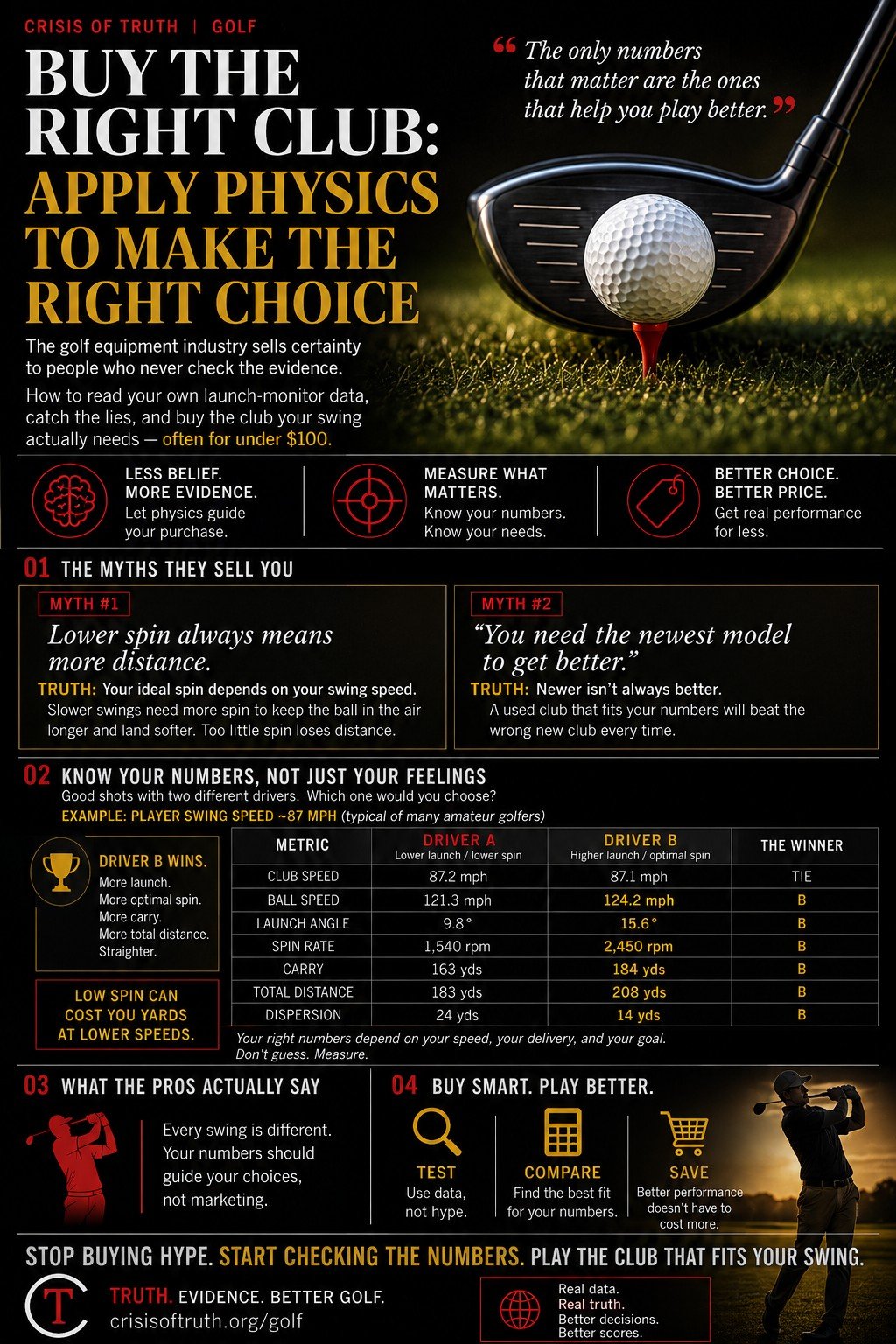
The golf equipment industry sells certainty to people who never check the evidence. Here is how to read your own launch-monitor data, catch the lies — including the ones the launch monitor itself tells you — and buy the club your swing actually needs. Frequently for under a hundred dollars.
Every industry that sells you confidence has a small library of claims that sound like physics but function like advertising. Golf has four. Each one is true for somebody — usually a tour professional — and quietly false for the person being sold to.
Low spin equals distance.
True at 110 mph. A lie at 85. Below tour speed, too little spin makes the ball fall out of the air early and lose carry. Most amateurs need more spin, not less — the opposite of what the box promises.
Stiffer shafts are for better players.
Flex is a fit to your speed, not a status symbol. A shaft too stiff for your swing robs launch and spin and is harder to load. "Playing stiff" because it sounds better is how good players hit it shorter.
This year's driver is longer.
The USGA capped ball speed and spring-face effect years ago. Gains since are measured in feet, inside the margin of error. The "10 more yards" usually comes from a fresh fitting, not a new head.
Premium shafts cost premium money.
The exact shaft a fitter would put in your driver is often available used, with the right adapter, for $50–$100. You are frequently paying $300 for the label and the newness, not the performance.
A modern launch monitor shows forty figures. You need eight, and they fall into two camps: what your club did, and what the ball did in response. The first camp is the cause. The second is the effect. Read them in that order and the picture tells itself.
Cause before effect. If you read the ball numbers first, you'll treat the symptom and never find the swing.
Here is the most useful number on any launch monitor, and almost nobody uses it the way they should. Smash factor — ball speed divided by club speed — has a hard physical ceiling of about 1.50. A struck golf ball cannot leave the face faster than roughly one and a half times the speed of the head that hit it. That ceiling is not a guideline. It is a law.
This is the entire Crisis of Truth method in one golf statistic. A claim arrives wearing the costume of data: a number on a bright screen, authoritative, precise to the decimal. The untrained response is to believe it — to feel briefly thrilled, or briefly crushed. The trained response is to check it against a law you already know. Ball speed cannot exceed 1.5× club speed. A 70-year-old does not carry a 7-iron 329 yards. When the evidence violates physics, you do not rewrite physics. You discard the evidence.
The same reflex protects you from the friendly version too. The fitter who shows you a glowing number after a swing change, the ad that quotes a carry gain, the playing partner certain his new driver added twenty yards — run each past the ceiling and the base rate before it goes in your bag or your head.
The marketing funnel wants you to skip straight to the cash register. The evidence says start at the other end: exhaust the free adjustments built into the club you already own, then the cheap swap, and only then — if at all — the expensive one. Almost everyone buys in the exact wrong order.
Note what the free tier does to the thing you actually came to fix. More loft doesn't only add distance for a slower swing — it reduces sidespin, so the ball curves less for the same mistake. The cheapest move on the board tightens your misses and lengthens your carry at the same time. The industry would simply prefer you didn't know the wrench in the box could do that.
If the data does call for a new shaft, the decision is not a brand and not a flex you'd like to be. It is three specifications matched to one number — your swing speed — and one detail the marketing never mentions: the adapter.
| Club speed | Flex | Weight | Launch / spin you want |
|---|---|---|---|
| 75–82 mph | Senior / A | 45–55 g | High launch, higher spin |
| 83–90 mph | Regular / Soft-Reg | 50–60 g | Mid-high launch, mid spin |
| 91–98 mph | Stiff | 60–65 g | Mid launch, mid spin |
| 99+ mph | X-Stiff | 65–75 g | Lower launch, lower spin |
The detail that voids most "great deal" shafts: the adapter. A driver shaft only drops into your head if the tip sleeve matches your brand's hosel. A perfect shaft with the wrong adapter is a paperweight. And beware the bait — the same model often sells far cheaper in fairway-wood length, two inches too short to ever play as a driver. Filter for three things every time: the right adapter, true driver length, and a flex at or just below your speed. Match those, and a hundred-dollar used shaft outperforms the new one you'd have been upsold.
Disinformation isn't only the lie that flatters you. Sometimes it's the standard that discourages you — the tour averages on the broadcast that make a good amateur feel slow. The honest move is to compare yourself to the right baseline.
A golfer swinging 88 mph at 70 isn't average for his age — he's swinging like a man two decades younger, and out-driving his bracket by thirty-plus yards. Measured against tour pros he looks slow. Measured against reality he's ahead. Pick the comparison that's true, not the one that stings.
This matters because the wrong baseline drives the wrong purchase. Convince a capable player he's deficient and he'll chase speed he doesn't need and spin he shouldn't lose. The fix for most aging swings isn't manufactured distance — it's converting the speed you still have into carry, and tightening the pattern. That's a fitting and a free wrench turn, not a credit-card swipe.
Everything above helps you spend wisely. None of it builds a golf swing. A club only delivers the motion you bring to it — it cannot manufacture one you don’t own. And swing instruction has the same disease as equipment marketing: a flood of confident, contradictory experts, each certain the others are wrong. The defense is identical. Anchor on the handful of fundamentals nearly everyone agrees on, let your own ball flight be the judge, and ignore the rest of the noise.
None of those are quick fixes, and that is the honest point. The gear in this guide is the last ten percent — worth getting right, but only after the ninety percent is in place. A perfectly fit driver swung with a faulty sequence just sends a bad shot farther offline. Build the engine first; let the fitting refine it.
A club can’t fix a swing fault. It can only help a sound swing reach its ceiling.
A short, curated set of lessons on the fundamentals above. Watch the motion, then go feel it — and always check the result against your own ball flight, not the instructor’s promise.
The most persuasive page on this subject is the one carrying your own receipts — your launch-monitor screens, the club in your hands, the before-and-after. Drop them in here; first-party evidence is the whole point.
Strip the clubs away and what's left is a procedure that works on any claim sold to you with confidence — a supplement, a stock tip, a political talking point, a driver.
Don't argue from the brochure or the broadcast. Get the readings off your own swing, your own numbers, your own situation. First-party evidence beats any narrative.
Before you believe a figure, test it against physics and base rates. If it violates a ceiling or a known average, the figure is wrong — not the world.
The glowing result is the symptom. Trace it back to what actually produced it. Treating effects keeps you buying solutions to the wrong problem.
"Newer," "stiffer," "premium," "longer" are story, not measurement. Notice when a claim is selling you a feeling and ask for the number underneath it.
Exhaust free, then cheap, then — rarely — expensive. Let the data, not the marketing, decide if you spend at all. Most of the time it decides you don't.
The fitter sells a club. The ad sells a feeling. Your data sells nothing — which is exactly why it tells the truth.
This guide is educational and not affiliated with, endorsed by, or sponsored by any equipment manufacturer or retailer. Brand and product names are referenced only to illustrate how to evaluate fit and verify claims; no endorsement is implied. Swing-speed and launch ranges are general starting points, not a substitute for a hands-on fitting with a qualified professional. The principle holds regardless of brand: read the evidence, check it against physics, and let it — not the marketing — decide what you buy.