On April 1, 2025, an American citizen named Kevin was driving through Texas at 3:00 a.m. when he was stopped at the Sierra Blanca Border Patrol checkpoint—not at the border, but more than 12 miles inside the United States. What happened next was recorded on both Kevin's phone and the agents' body cameras. The body cam footage was only released in January 2026, nearly a year later, and only because Kevin successfully sued US Customs and Border Protection for it. They're still withholding the footage from the initial stop.
What the footage reveals is a microcosm of everything going wrong with federal law enforcement in America. It is not an isolated incident. It is a pattern—documented, sourced, and accelerating.
Watch the Footage
This analysis by the Lackluster channel (1.5 million subscribers) breaks down both Kevin's phone recording and the body cam footage side by side. Watch what happens when an American citizen exercises his rights at a checkpoint that isn't even at the border.
What Happened to Kevin

The Playbook of an Unlawful Search
Agents claimed a canine "alerted" to Kevin's vehicle for concealed humans or controlled substances. This is a common pretext. Kevin, a verified human, was driving the vehicle—so of course a dog trained to detect humans would alert. Yet they used this as justification to send him to secondary inspection.
Before the K9 even arrived for the alleged "free air sniff," two agents were already conducting an unlawful search of the vehicle's interior. When the dog did arrive, Agent Vasquez stood directly in front of Kevin's camera to block his recording of whether the dog actually alerted. Then they sent the dog inside Kevin's car.
When Kevin objected to his camera being blocked—a well-established First Amendment right—he was locked in a holding cell. The stated reason? He "didn't want to listen" and was "just recording."
The Coercive Waiver
After finding nothing, the agents presented Kevin with a document and told him it would "free him from liability." That was a deliberate misrepresentation. The document actually stated:
"I therefore release and forever discharge the United States, its officers, agents, servants, employees, heirs, successors, or assigns from any and all actions, causes of action, suits, claims, and demands whatsoever in law or in equity which I now have or may have in the future."
This is a maximally broad waiver designed to extinguish all future claims—including constitutional claims arising from the illegal search they just conducted. When Kevin refused to sign, Agent Vasquez threatened that if anything was missing from his vehicle after he left, it wouldn't matter because "our body cams are recording."
Courts have repeatedly found such waivers unenforceable, especially when signed in an inherently coercive environment and when they attempt to waive claims the person doesn't even know exist yet.

The Constitutional Crisis No One Is Talking About
This checkpoint is more than 12 miles from the US-Mexico border. It is a permanent installation where every American who drives through is subjected to a suspicionless stop. This would be unconstitutional in any other law enforcement context. The Supreme Court carved out a narrow exception in United States v. Martinez-Fuerte (1976) that was supposed to allow brief immigration-related questioning only.
Instead, these checkpoints have become fishing expeditions for drug interdiction, pretextual vehicle searches, and retaliation against anyone who dares to record. A state court in New Hampshire found this exact practice unconstitutional, ruling that the checkpoint was a "ruse to unlawfully search and seize people for the purpose of general crime control."
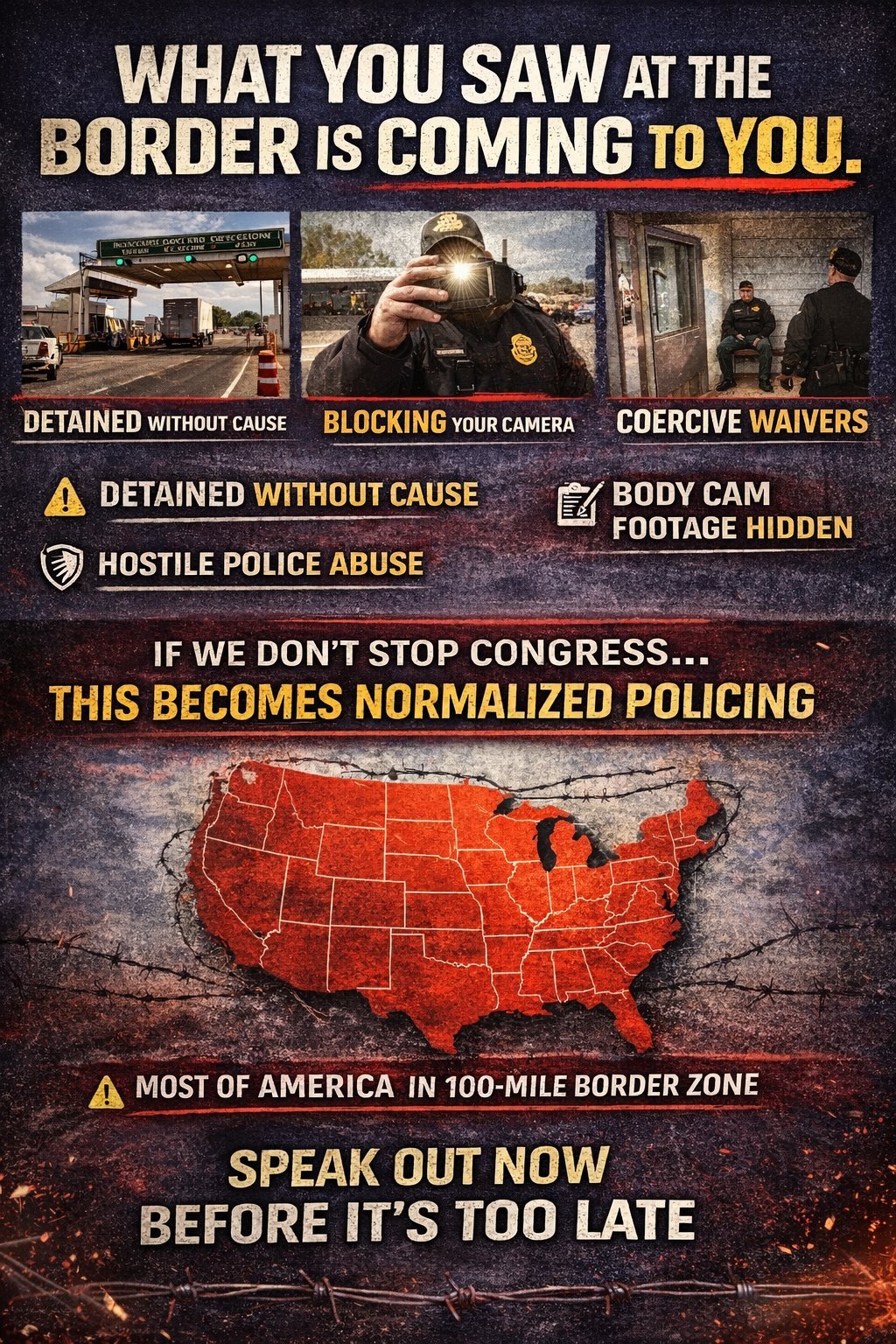
Federal law allows CBP to operate within 100 miles of any border or coastline. That zone covers roughly two-thirds of the American population and includes every major coastal city. Without congressional action, what happened to Kevin could happen to any of us.
This Is Not About Checkpoints. This Is About What Comes Next.
If you think what happened to Kevin is as bad as it gets, you haven't been paying attention to what's happened in January 2026 alone.
Donovan Porter, 43, Killed by Off-Duty ICE Agent
An off-duty ICE agent shot and killed Porter, a Black American, on New Year's Eve. DHS described Porter as an "active shooter." His family says he was firing a gun to celebrate the new year—an illegal but widely observed tradition. Porter's family attorney has demanded evidence that Porter fired at the officer. No body camera footage has been released. (Source: Al Jazeera)
Renee Nicole Good, 37, American Mother, Shot and Killed by ICE
An ICE agent shot Good in the head while she was in her car on a residential street during an immigration operation. She was a US citizen and was not the target of any investigation. Minneapolis Police Chief Brian O'Hara said the video shows "there is nothing to indicate that this woman was the target of any law enforcement investigation or activity." DHS spokesperson Tricia McLaughlin claimed Good "weaponized her vehicle." Minneapolis Mayor Jacob Frey, after viewing the video, called that narrative "b---s---." Multiple independent news organizations confirmed witnesses described Good trying to flee, not attack. (Source: NPR | NBC News)
Victor Manuel Diaz, Died in Federal Custody
Arrested in Minneapolis on January 6 during the immigration crackdown, transferred to Camp East Montana in Texas, found dead eight days later. ICE says "presumed suicide." His brother told ABC News: "I don't believe he took his life." The body was transferred to a military medical center for autopsy instead of the county medical examiner. (Source: Al Jazeera)
Alex Pretti, 37, ICU Nurse and Veteran, Shot and Killed by Border Patrol
Pretti, an American citizen with no criminal record, was an intensive care nurse at the VA hospital and a member of the American Federation of Government Employees. He was filming law enforcement with his phone and directing traffic during a protest. Verified video from Reuters, the BBC, The Wall Street Journal, and CNN shows Pretti standing between an agent and a woman who had been pushed to the ground. He was pepper-sprayed, wrestled to the ground by multiple agents, and shot multiple times while approximately six agents surrounded him.
DHS assistant secretary Tricia McLaughlin said carrying a gun meant Pretti wanted to "massacre law enforcement." Minneapolis police confirmed Pretti had a valid Minnesota carry permit. Minnesota's Bureau of Criminal Apprehension reported that DHS officials "blocked" state agents from accessing the shooting scene. Multiple Republican senators—including Ted Cruz, Susan Collins, Lisa Murkowski, and Rand Paul—called for independent investigations. The NBA postponed a Timberwolves game. A GoFundMe for Pretti's family reached $1 million within hours. (Source: PBS | CBS News)
In January 2026 alone, federal immigration agents killed two American citizens in one American city. A third died in federal custody under suspicious circumstances. A fourth was killed on New Year's Eve by an off-duty agent. In every case, the government's initial account was contradicted by video evidence or independent reporting.
You've Seen This Before. The Whole World Has.
Every authoritarian regime in history followed the same playbook. It did not begin with concentration camps. It began with checkpoints, papers, expanded police powers, and a government that told its citizens the people being targeted deserved it.
How the Gestapo Was Built
The Gestapo did not spring up overnight. Germany's Weimar Republic had a constitution that guaranteed individual rights and protected citizens from arbitrary police actions. The political police had to respect freedom of speech, freedom of the press, and equality before the law. Then, beginning in February 1933, the Nazi regime used emergency decrees to transform Germany. The Reichstag Fire Decree, issued February 28, 1933, suspended individual rights and legal protections, including the right to privacy. The political police were freed from constitutional limitations.
On February 17, 1933—just weeks into the new regime—Hermann Göring issued a decree instructing Prussian police to work with Nazi paramilitary organizations and to treat political enemies "ruthlessly." The decree stated that policemen would not be punished for shooting a Communist, and might be disciplined for failing to do so. Five days later, the Nazis began deputizing paramilitary members as auxiliary police. In Prussia alone, 50,000 armed paramilitary men patrolled alongside regular officers.
Within months, tens of thousands of people were detained under "protective custody orders"—a euphemism for imprisonment without trial. The Gestapo could jail anyone suspected of being a threat to national security. No charges required. No trial. No oversight.
Sources: US Holocaust Memorial Museum: The Gestapo | German Police in the Nazi State | German Police and the Nazi Regime
The Gestapo had roughly 32,000 agents for a population of 65 million. It maintained control not through size, but through an atmosphere of fear and a network of citizens who denounced their neighbors. Sound familiar?
The Parallels Are Not Subtle
In Nazi Germany, police were freed from legal constraints through emergency decrees. In America today, the 100-mile border zone creates a region where federal agents claim expanded authority to stop, question, and search any person without individualized suspicion. The Project on Government Oversight documented that a study of one Arizona checkpoint found agents were 26 times more likely to ask Latino drivers for identification and 20 times more likely to pull them over for secondary inspection.
In Nazi Germany, the regime created categories of people who deserved fewer protections. In America today, DHS spokesperson Tricia McLaughlin called an American nurse who was filming law enforcement a would-be "massacre" perpetrator—a claim directly contradicted by multiple verified video analyses from Reuters, BBC, The Wall Street Journal, and CNN.
In Nazi Germany, local police were pressured to cooperate with federal political police or be replaced. In America today, the Minneapolis Police Chief expressed concern about ICE tactics. The Minnesota Bureau of Criminal Apprehension was blocked from the crime scene. The Secretary of Defense—who is not in the law enforcement chain of command—publicly attacked state leadership on social media.
In Nazi Germany, the regime used the language of "protective custody" and "public safety" to justify imprisonment without trial. In America today, an American citizen was locked in a holding cell at a checkpoint because he was "just recording." Another was killed while standing between a federal agent and a woman who had been pushed to the ground.
"Understanding the history of the Gestapo's unchecked power and brutality serves as a warning. It reminds us why liberal democracies place restraints on law enforcement and why public oversight and accountability are vital."
— The Gestapo: History, Controversies & Modern Parallels (2026 analysis)
The Documented Pattern of Checkpoint Abuse
Kevin's experience is not unique. These abuses have been documented for years by the ACLU, federal courts, the Project on Government Oversight, and the Southern Border Communities Coalition.
Suspicionless Stops of Every Citizen
The Supreme Court ruled in United States v. Martinez-Fuerte (1976) that brief immigration-related questioning at fixed checkpoints is permissible. But the Court has also found in City of Indianapolis v. Edmond (2000) that checkpoints whose primary purpose is general crime control violate the Fourth Amendment. In Rodriguez v. United States (2015), the Court held that extending a traffic stop beyond its original purpose without reasonable suspicion is unconstitutional. Yet at interior checkpoints, thousands of Americans are subjected to dog sniffs, extended questioning, and vehicle searches with no more individualized suspicion than the drivers in Edmond.
Fabricated Canine Alerts
The ACLU documented cases of 15 US citizens, ages 6 to 69, whose constitutional rights were violated at six different Arizona checkpoints. These included "prolonged, unjustified detentions and unlawful searches based on service dogs 'alerting' to nonexistent contraband." In New Hampshire, a state court found that Border Patrol used its checkpoint as a "ruse to unlawfully search and seize people" for drug enforcement—a purpose the Supreme Court has explicitly found unconstitutional.
Retaliation Against People Who Record
The ACLU's Hold CBP Accountable project documents widespread First Amendment violations at checkpoints, including cases where agents harassed, detained, and retaliated against people for filming. NBC San Diego reported in 2019 that CBP maintains a secret database of lawyers, journalists, and activists who covered the migrant caravan or advocated for asylum seekers. People in the database reported being subjected to hours of secondary screening at border crossings.
Hidden Body Camera Footage
Kevin had to sue to obtain body camera footage of his own encounter—and CBP is still withholding the initial inspection footage. This is part of a larger pattern. Only approximately 4,400 of 22,000 ICE officers had been issued body cameras as of June 2025. After Alex Pretti was killed, DHS indicated body camera footage existed from at least four angles, but state investigators were blocked from the scene. In the killing of Renee Good, independent video contradicted the federal account, and it was bystander footage—not government transparency—that told the real story.
Corruption Within CBP Itself
A New York Times investigation revealed that CBP officials took $11 million in bribes between 2006 and 2016. Thirty-eight percent of agent corruption arrests were drug-related. Thirty-four percent were linked to immigration smuggling crimes. When the Justice Department banned racial profiling by federal law enforcement in 2014, CBP and DHS successfully lobbied for an exemption.
The Case Law They Don't Want You to Know
Fourth Amendment — Checkpoint & Search Limits
- United States v. Martinez-Fuerte (1976) — Established narrow authority for immigration checkpoints
- City of Indianapolis v. Edmond (2000) — Checkpoints for general crime control are unconstitutional
- Rodriguez v. United States (2015) — Extending a stop beyond its purpose without suspicion is unconstitutional
First Amendment — Right to Record Law Enforcement
- Glik v. Cunniffe (1st Cir. 2011) — Filming police in public is a constitutionally protected activity
- Turner v. Driver (5th Cir. 2017) — Recording police is protected under the First Amendment
- Fields v. City of Philadelphia (3d Cir. 2017) — Right to record police activity is clearly established
Coercive Waivers & Due Process
- Town of Newton v. Rumery (1987) — Release agreements obtained through coercion are unenforceable
- Fuentes v. Shevin (1972) — Due process protections cannot be waived through coercive conditions
FOIA & Body Camera Transparency
- DOJ v. Reporters Committee (1989) — FOIA disclosure standards for law enforcement records
- ACLU v. DHS (S.D.N.Y. 2018) — Public access to body camera footage
- Turner v. US CBP (D.D.C. 2020) — CBP body cam footage subject to disclosure
- Payne Enterprises v. US (D.C. Cir. 1988) — FOIA delays and bad faith by agencies
Government & Oversight Sources
- CBP Body-Worn Camera Policy — Official directive on body camera use
- CBP Legal Authority & Jurisdiction — Official statement of CBP's claimed powers
- ACLU: Constitution-Free Zone (100-mile map) — Interactive map of the border enforcement zone
- Project on Government Oversight: The Border Zone Next Door — Comprehensive investigation (Oct 2025)
- Southern Border Communities Coalition: Abuse of Power — Database of CBP violence
- Hold CBP Accountable: First Amendment Violations — Documented cases of retaliation for filming
- ACLU Arizona: Checkpoint Constitutional Violations — 15 citizens, ages 6-69, rights violated
- ACLU New Hampshire: Checkpoint Lawsuit Settlement — Court found checkpoint unconstitutional
What We Must Do
History does not remember the people who stayed quiet. It does not reward the nations that looked away. Every authoritarian regime succeeded because enough people believed it couldn't happen to them—until it did.
The 100-mile border zone covers roughly two-thirds of the US population and includes nearly every major American city. Without congressional action, the suspicionless checkpoints, the hidden footage, the coercive waivers, the fabricated canine alerts, and the killing of American citizens will not stop. They will expand. They will become "normal policing."
This is not a left issue or a right issue. This is an American issue. The Second Amendment supporters who oppose warrantless searches. The First Amendment advocates who defend the right to film. The Fourth Amendment originalists who believe in probable cause. The parents who don't want their children stopped at gunpoint while driving to school. We are all on the same side here.
Contact your representatives. The congressional switchboard number is (202) 224-3121. Tell them to support legislation that limits interior checkpoints, mandates body cameras for all federal law enforcement, requires independent investigations when agents use deadly force, and bans coercive liability waivers at points of detention.
Know your rights. You have the right to record law enforcement in any public space. You have the right to refuse to answer questions beyond basic immigration inquiries at a checkpoint. You have the right to refuse to sign any document. You have the right to request badge numbers and identifying information. Exercise these rights. They only exist if you use them.
Share this page. The most powerful weapon against authoritarianism is an informed citizenry. Every person who reads this, watches the video, clicks the sources, and shares the evidence makes it harder for this to be normalized.
The Gestapo maintained control over 65 million people with 32,000 agents—not through size, but through silence. The moment we stop talking about this is the moment we lose the ability to stop it.