What habeas corpus actually is
The words are Latin for “you shall have the body.” Centuries ago, an English judge would issue a written order, a writ, telling a jailer: bring me the prisoner and tell me why you're holding him. If the jailer had no lawful answer, the prisoner walked out.
That's still how it works. Habeas corpus doesn't decide whether you're guilty or innocent. It asks one narrower question: is the government allowed to hold this person at all? It's the check that stops anyone with a badge from simply making people disappear.
The founders considered it so basic that they put it in the original Constitution, before the Bill of Rights existed. In Federalist No. 84, Alexander Hamilton wrote that “arbitrary imprisonments” had been, in all ages, among “the favorite and most formidable instruments of tyranny,” and he quoted the English jurist William Blackstone warning of the same danger.
Here is the part most people miss: every other right you have depends on this one. Free speech, gun rights, the right to a lawyer, the right to a trial. None of them help you if you can be locked up and no judge is ever allowed to ask why.
Why it matters even if you're a citizen
The idea discussed in the White House was aimed at immigrants without legal status. It's natural to think, “That's not me.”
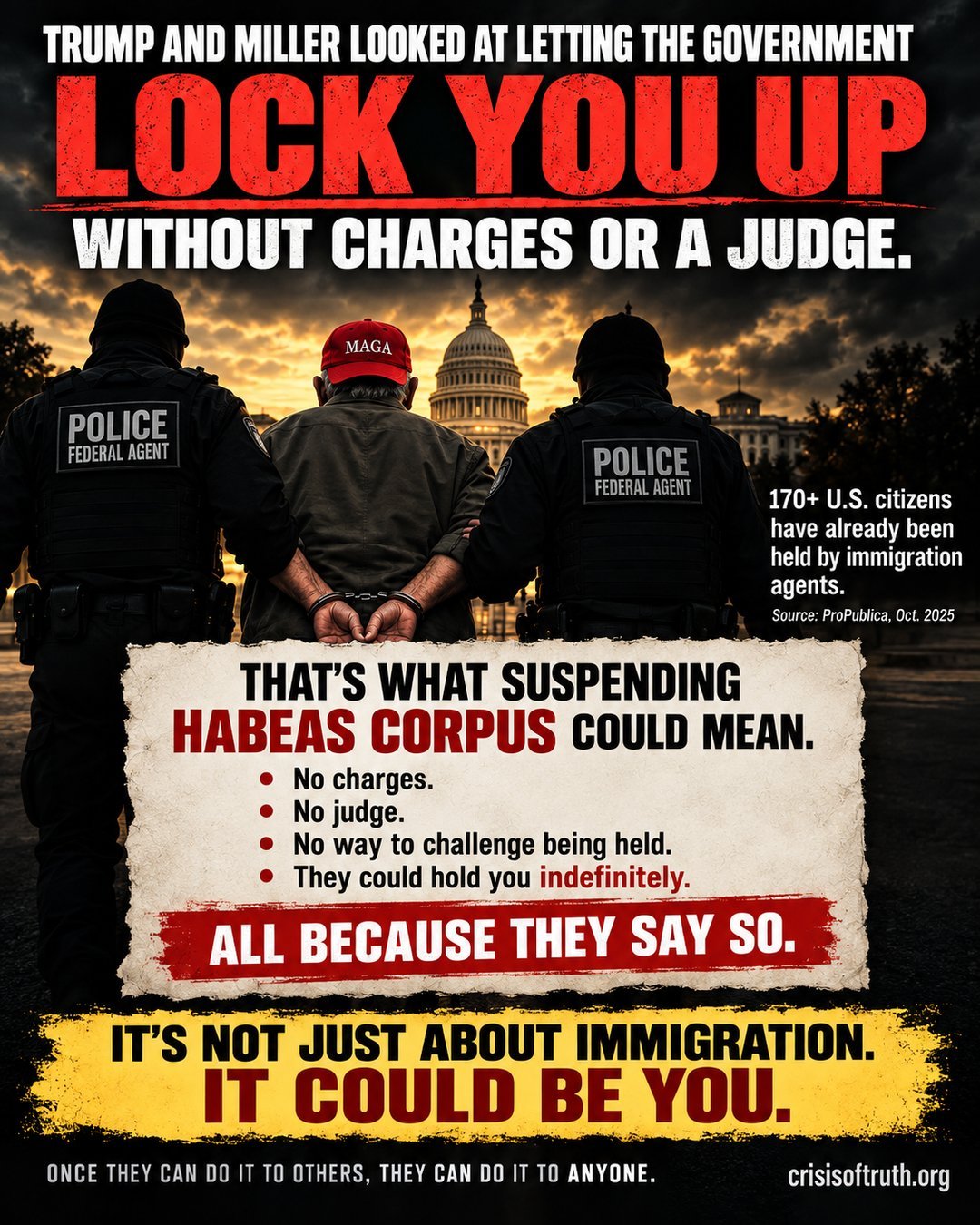
But think about how a mistake gets fixed. If agents detain you and claim you're here illegally, how do you prove you're a citizen? You go before a judge. That process runs through habeas corpus. Suspend it “only for immigrants,” and the people deciding who counts as an immigrant are the same people doing the detaining. There is no one left to check them.
This is not a hypothetical. George Retes is an American citizen and a combat veteran. ProPublica reported that immigration agents detained him on California's Central Coast and held him for three days without access to a lawyer. He missed his daughter's third birthday. ProPublica found more than 170 cases of U.S. citizens held by immigration agents in the first nine months of 2025, and noted that the count is almost certainly incomplete.
Those citizens had habeas corpus. Imagine the same mistakes with no judge available to hear them.
What happened, in order
In Trump v. J.G.G., the Supreme Court sides with the administration on where Alien Enemies Act cases must be filed. But all nine justices agree the detainees are entitled to notice and a chance to seek habeas corpus before they are removed.
White House staff secretary Will Scharf, a conservative lawyer, sends a confidential memo to Chief of Staff Susie Wiles titled “The Writ of Habeas Corpus.” He warns that courts have almost uniformly held that only Congress can suspend it, and that past suspensions all responded to war or armed rebellion.
At a Cabinet meeting, President Trump alludes to “one way” that has been used by three respected presidents, adding that he hopes not to have to go that route.
Deputy Chief of Staff Stephen Miller tells reporters outside the White House that the writ “can be suspended in a time of invasion,” and calls it “an option we're actively looking at.” He adds that “a lot of it depends on whether the courts do the right thing or not.”
The New York Times (Maggie Haberman and Jonathan Swan) reveals the Scharf memo and reports that Miller's remark reflected a serious internal debate. The idea was ultimately shelved after Scharf's objections.
Note what Miller tied the threat to: not an invading army, but whether courts rule the way the administration wants. That is the reverse of what the Suspension Clause is for.Quote: Associated Press / PBS NewsHour, May 9, 2025
Miller's claims, checked against the record
“The Constitution is clear” that the writ can be suspended in a time of invasion.
NuancedThe text does allow suspension in cases of rebellion or invasion when public safety requires it. What Miller left out is who can do it. The clause sits in Article I, Section 9, a list of limits on Congress. Justice Antonin Scalia wrote in Hamdi v. Rumsfeld (2004) that suspension has been so understood, “consistent with English practice and the Clause's placement in Article I.” The administration's own staff secretary told the chief of staff the same thing in writing.
Congress “stripped” the federal courts of jurisdiction over immigration cases.
False as statedCongress has limited some kinds of judicial review in immigration law. But in INS v. St. Cyr (2001), the Supreme Court held that those laws did not eliminate habeas corpus. And in April 2025, the Court itself told this administration that Alien Enemies Act detainees must bring their challenges through habeas. Federal courts hear immigration habeas cases every day.
The four times it has been suspended
In 237 years, the writ has been suspended four times. Every one involved war or an armed uprising, and every one was limited in scope.
| Year | Where and why | Who authorized it |
|---|---|---|
| 1861 | Civil War. Lincoln suspended it along military routes as Confederate sympathizers threatened Washington. | Lincoln alone at first. Chief Justice Taney ruled in Ex parte Merryman that only Congress had the power. Congress authorized suspension in 1863. |
| 1871 | Nine South Carolina counties, to break the Ku Klux Klan's campaign of terror. | President Grant, under the Ku Klux Klan Act passed by Congress. |
| 1905 | Two provinces of the U.S.-governed Philippines during an armed insurrection. | The territorial governor, under authority Congress granted in 1902. |
| 1941 | Hawaii, hours after the attack on Pearl Harbor. | The territorial governor, under the Hawaiian Organic Act passed by Congress. |
Even the Pearl Harbor suspension didn't escape the courts. In Duncan v. Kahanamoku (1946), the Supreme Court ruled that the military trials of civilians held under Hawaii's martial law had been unlawful.
Why historians treat this as a warning sign
February 28, 1933
One day after the Reichstag fire, Germany's president signed an emergency decree at the urging of Hitler's new government. It suspended the constitution's protection of personal liberty along with free speech, a free press, and the right to assemble.
According to the U.S. Holocaust Memorial Museum, the decree freed the regime to arrest and imprison political opponents without specific charges. The Gestapo used what it called “protective custody” to hold people indefinitely, without charge or trial, with no right to appeal and no judicial review. Within two months of the decree, it had arrested and imprisoned more than 25,000 people in Prussia alone.
The decree was presented as a temporary emergency measure. The Museum describes it as a permanent feature of the Nazi police state. Less than a month later came the Enabling Act.
This page does not claim anyone in the White House is a Nazi. The point is narrower and more important: removing a court's power to review detention is one of the first moves governments make when they stop answering to the law. That is why the founders wrote the Suspension Clause so tightly, and why a conservative White House lawyer treated the idea as a red flag.
This isn't a left or right issue
Look at who objected. Will Scharf is a conservative lawyer inside this administration. Scalia was the most influential conservative justice of his generation. Before she joined the Supreme Court, Justice Amy Coney Barrett co-wrote for the National Constitution Center that most agree only Congress can suspend the writ, and that during a suspension the president can imprison people indefinitely without any judicial check. The libertarian Cato Institute and Reason magazine both published pieces rejecting Miller's theory. Hamilton, who defended the writ in the Federalist Papers, was the architect of a strong federal government.
A power grab doesn't stay pointed in one direction. Any power you hand a president you like, you hand to the next one you don't.
The strongest case on the other side
The text says “invasion.” The Suspension Clause doesn't name which branch acts. Supporters argue a mass border crisis can qualify, and some state officials have formally described it as an invasion.
Lincoln did it himself. In 1861, Lincoln suspended the writ without waiting for Congress, and history largely judges him to have saved the Union.
Congress really has narrowed review. In DHS v. Thuraissigiam (2020), the Supreme Court upheld limits on habeas review for a migrant stopped soon after crossing, ruling that he sought more than release from custody.
It wasn't done. The idea was debated and shelved. Some will say that shows the system worked.
Why those arguments fall short
Most courts that have ruled on the merits have rejected treating migration or gang activity as an “invasion.” A Fifth Circuit panel ruled that way in 2025; the full court dismissed that case in August 2026 without deciding the question, though two of its judges would have sided with the President. Every past suspension of habeas involved actual war or armed rebellion. Lincoln faced a real armed rebellion with Congress out of session, his action was challenged by the Chief Justice, and Congress stepped in within two years. Thuraissigiam narrowed one kind of review; it did not approve suspending the writ. And the system “worked” because one staff lawyer wrote a memo. That's a thin line to stand on.
For the record: what this page leaves out
Dates in a widely shared CNN clip. The auto-generated transcript of a CNN segment on this story garbles the dates of past suspensions as “1918, 1944.” The correct years are 1861, 1871, 1905, and 1941, as shown above.
Which “three presidents” Trump meant. He didn't name them, and this page doesn't guess.
Reports that others pushed the idea. Some outlets have reported additional officials were involved in these discussions. This page names only what is documented in the primary reporting cited below.
Check it yourself
- The Suspension Clause, with annotationsConstitution Annotated (Library of Congress), via Cornell Law School / Art. I, Sec. 9, Cl. 2
- The Suspension Clause: common interpretationAmy Coney Barrett and Neal K. Katyal, National Constitution Center
- Video: Stephen Miller's remarksAssociated Press via PBS NewsHour / May 9, 2025
- CNN segment with Maggie Haberman and Elie HonigCNN via YouTube
- Trump v. J.G.G., docket and opinionsSupreme Court of the United States / No. 24A931 / April 7, 2025
- The Scharf memo and what it saidJacob Sullum, Reason / June 17, 2026 / summarizing New York Times reporting
- “Frustrated by Courts, Trump Weighed Suspending a Constitutional Right”Maggie Haberman and Jonathan Swan, The New York Times / June 15, 2026 / paywalled
- Hamdi v. Rumsfeld (Scalia dissent)542 U.S. 507 (2004)
- INS v. St. Cyr533 U.S. 289 (2001)
- Federalist No. 84Alexander Hamilton / Avalon Project, Yale Law School
- More than 170 U.S. citizens held by immigration agentsNicole Foy, ProPublica / October 2025
- The Reichstag Fire Decree, with translationU.S. Holocaust Memorial Museum, Holocaust Encyclopedia
- Arrests without warrant or judicial reviewU.S. Holocaust Memorial Museum, Holocaust Encyclopedia
- Fifth Circuit dismisses the Alien Enemies Act case without deciding itIlya Somin, The Volokh Conspiracy (Reason) / August 13, 2026
- Cato Institute on Miller's “invasion” theoryCato at Liberty / May 2025
I ask three questions of everything I publish. Is it legal? Is it constitutional? Is it morally and ethically acceptable?
A president suspending, on his own, the right to have a judge review your detention fails all three. It failed them in the eyes of this administration's own lawyer.
Don't believe me. Check it.
Brad Schrunk