First, the correction
You will hear this described as a $1 trillion cut to Medicare that happens on one day. That is wrong on both counts, and getting it wrong hands the other side an easy out.
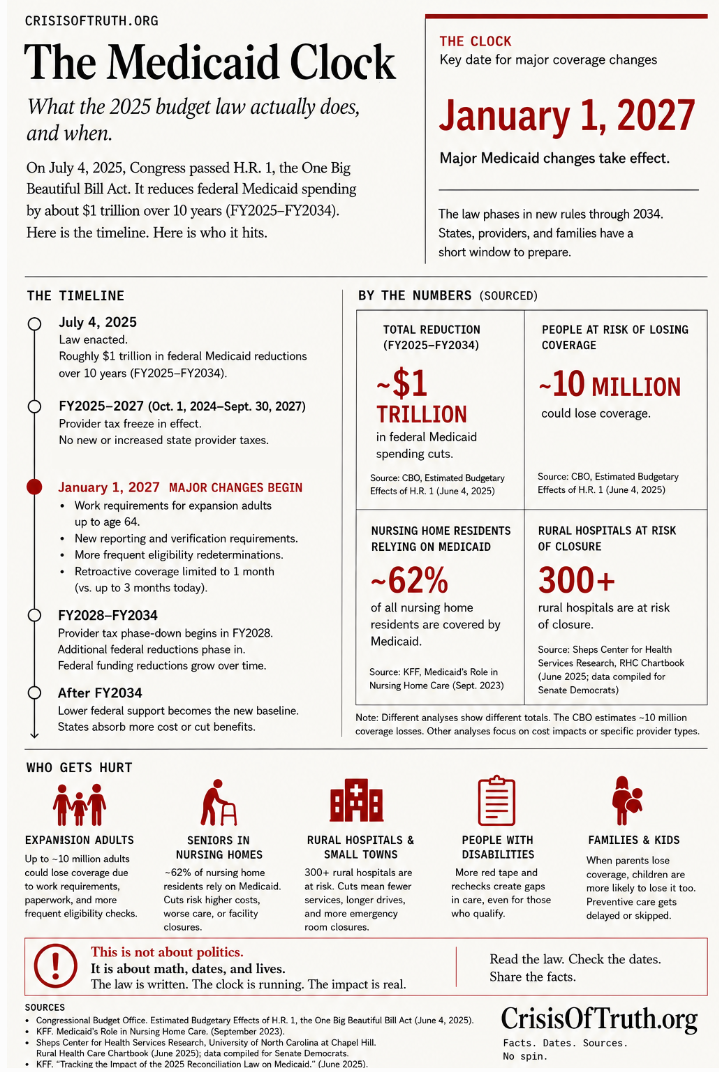
The law is the budget reconciliation act signed July 4, 2025 (Public Law 119-21, H.R. 1). It reduces federal Medicaid spending by roughly $1 trillion over ten years (FY2025–FY2034), according to the Congressional Budget Office, and CBO projects about 10 million more people uninsured by 2034. Medicare is affected separately, and indirectly — that is covered below.
Medicaid is not "welfare for people who won't work." It is the program that pays for most of the nursing home care in this country, four in ten births, and the coverage of roughly one in five Americans.
The dates
Nothing in this law is a single cliff. It is a sequence of deadlines, and each one is spaced so that the people affected won't connect it to a vote they cast in 2024.
- July 4, 2025Law enacted. The federal minimum-staffing rule for nursing homes is blocked from enforcement until 2034. The freeze on new or increased state provider taxes takes effect.
- December 31, 2026 → January 1, 2027Work requirements begin. Adults 19–64 in the Medicaid expansion group must document 80 hours per month of work, school, or community service, or lose coverage. States may receive extensions to as late as December 31, 2028 if they show a "good-faith effort," so the exact date varies by state. VERIFY MN implementation date
- January 1, 2027Six-month eligibility redeterminations begin for expansion adults, replacing annual renewal. Retroactive coverage is cut from three months to one for expansion adults. Every missed form, returned letter, or unanswered call is a potential loss of coverage.
- October 1, 2027 (FY2028)Provider-tax ceiling in expansion states begins stepping down from 6% toward 3.5% by FY2032. State-directed payments to hospitals and nursing homes are capped. This is where nursing home and rural hospital budgets get squeezed. VERIFY schedule
- October 1, 2028Expansion adults above the poverty line begin paying cost-sharing of up to $35 per service. VERIFY
- FY2026–FY2030A $50 billion Rural Health Transformation fund is spread over five years, against cuts that independent analysts estimate at several times that amount for rural providers. VERIFY
Who actually loses coverage, and how
The law does not send anyone a letter saying "you're out." It works through paperwork.
Precedent: Arkansas, 2018
Arkansas ran a Medicaid work requirement for seven months before a federal court stopped it. About 18,000 people lost coverage. Studies afterward found no measurable increase in employment; most of those who lost coverage were already working or should have been exempt and could not navigate the reporting system. VERIFY — Sommers et al., NEJM 2019
Precedent: Georgia Pathways, 2023–
Georgia's work-requirement program enrolled a small fraction of the people eligible while spending most of its budget on administration and consultants. VERIFY current enrollment and cost figures
Who is exempt on paper
People 65 and older, people with disabilities, the "medically frail," pregnant women, and parents of children 13 and under are exempt from work requirements. Nursing home residents will not receive a discharge notice on January 1, 2027 because of this provision. Anyone who tells you otherwise is doing what this site exists to expose.
Where nursing homes actually get hit
The threat to nursing homes is the provider-tax phase-down and the cap on state-directed payments. States lose a funding tool they have relied on for decades. Their options are to raise general taxes, cut reimbursement rates, or cut eligibility for optional services. Nursing homes running on Medicaid rates that already lag costs respond by cutting staff, refusing Medicaid admissions, or closing. Rural facilities go first. Add MN/FL closure data when available
Your state
Minnesota
Minnesota expanded Medicaid, so the work requirements and six-month redeterminations apply here. Medical Assistance covers roughly 1.2 million Minnesotans. Independent estimates put coverage losses at NUMBER and the ten-year hit to the state at $ AMOUNT. Add: rural hospitals flagged at risk; nursing homes with >60% Medicaid census.
Florida
Florida did not expand Medicaid, so the work-requirement provision largely does not apply. Florida's exposure runs through the provider-tax and directed-payment limits, which fund hospital and nursing home rates in a state with the nation's largest share of residents over 65. Add FL enrollment, provider-tax dependence, and any AHCA statements.
The Medicare piece
Because the law adds to the deficit, the Statutory PAYGO Act requires automatic cuts to Medicare of up to 4% of provider payments, roughly $490 billion over ten years, unless Congress votes to waive it. Congress has waived every prior PAYGO sequester. VERIFY whether the waiver passed and when If it did not, that is a Medicare cut. If it did, the $1 trillion figure people are quoting is still Medicaid.
The ledger
This site keeps a running contrast between what the administration says it can't afford and what it decides it can. Same standard, same ten-year window where one exists.
| Item | Amount | Who receives it |
|---|---|---|
| Federal Medicaid reduction, FY2025–FY2034 | −$1.0T | Removed from coverage for U.S. residents, nursing homes, rural hospitals |
| U.S. Treasury currency swap line to Argentina, Oct. 2025 | $20B | Government of Argentina, via the Exchange Stabilization Fund VERIFY drawn amount |
| Additional private-bank facility for Argentina, announced | $20B | Government of Argentina VERIFY whether it closed |
| Emergency aid to U.S. farmers after loss of China soybean market, Dec. 2025 | $12B | U.S. farmers VERIFY |
| Argentine soybean sales to China during the same period | — | Argentine exporters, after Argentina suspended its export tax VERIFY volumes |
No adjectives are needed here. The numbers are the argument.
The three questions
- Is it legal?
- Yes. It passed both chambers through reconciliation and was signed. That is precisely the point: this was not done to you. It was done by people you elected, on the record, with their names attached.
- Is it constitutional?
- Nothing in the Constitution guarantees Medicaid. Congress created it in 1965 and Congress can shrink it. The question of constitutionality is not the useful one here.
- Is it morally and ethically acceptable?
- Judge that with the ledger above in front of you, and with the name of the nearest nursing home in mind.
What to do before January 1, 2027
If you or a family member is on Medicaid or Medical Assistance: confirm the mailing address, phone, and email on file with the county or state now. Most coverage losses under work requirements are people who never got the form. Ask the county whether you fall into an exempt category and get that in writing. Nursing home families: ask the administrator what percentage of residents are on Medicaid and whether the facility has any plan for a rate cut.
For the broader pattern this law fits, see The One Big Beautiful Bill: Pattern Recognition, Not Hyperbole.
Sources
- Congressional Budget Office. Estimated Budgetary Effects of H.R. 1, the One Big Beautiful Bill Act. June 4, 2025. Add link; add later CBO update if published
- KFF. Medicaid's Role in Nursing Home Care. September 2023. Add link
- KFF. Tracking the Impact of the 2025 Reconciliation Law on Medicaid. June 2025. Add link
- Cecil G. Sheps Center for Health Services Research, UNC Chapel Hill. Rural hospital data compiled for U.S. Senate Committee on Finance Democrats. June 2025. Add link
- Sommers BD et al. "Medicaid Work Requirements — Results from the First Year in Arkansas." NEJM, 2019. Confirm citation
- U.S. Treasury press release on the Argentina Exchange Stabilization Fund agreement, October 2025. Add link
- USDA announcement of farm assistance, December 2025. Add link
- Minnesota DHS and Florida AHCA enrollment reports. Add links