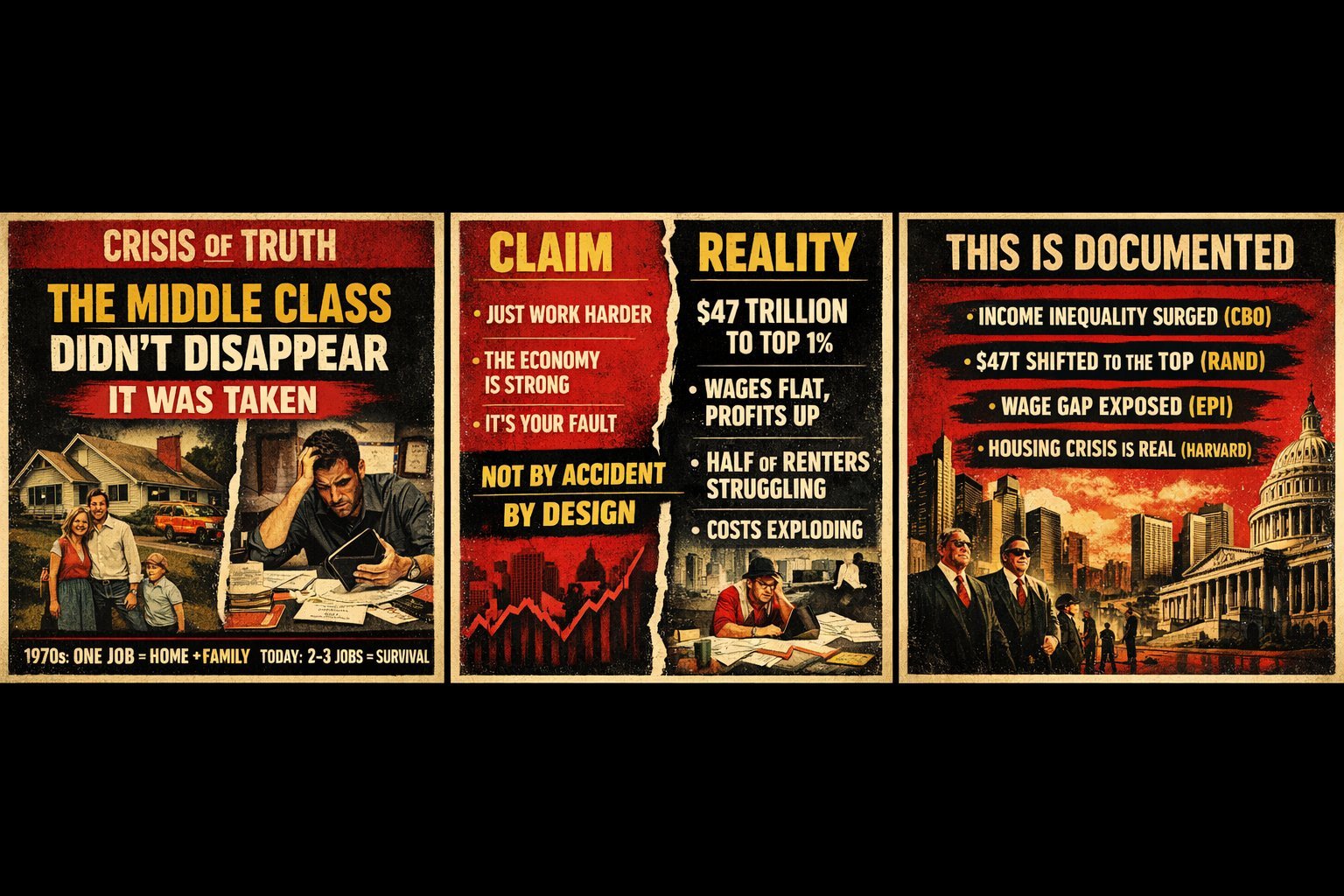
Sources cited in image: Congressional Budget Office · RAND Corporation · Economic Policy Institute · Harvard Joint Center for Housing Studies
In 1971, a corporate lawyer on the board of Philip Morris wrote a 34-page memo to the U.S. Chamber of Commerce. It became the blueprint for a half-century campaign — funded by hundreds of millions of dollars — to make American government serve the wealthy instead of the people who elect it. Every step is documented. None of this was an accident.
Sources cited in image: Congressional Budget Office · RAND Corporation · Economic Policy Institute · Harvard Joint Center for Housing Studies
We keep hearing that our politics are broken, that the system doesn't work for working people, that our government has been captured by special interests. And we keep hearing it framed as some kind of mystery — as if no one can explain why nurses work double shifts and still can't afford their insulin while billionaires pay a lower tax rate than their secretaries.
It's not a mystery. It's a plan. A documented, funded, 65-year plan with receipts in federal archives, university libraries, corporate filings, and congressional records. It started with a single memo in 1971, and it built — step by deliberate step — the political infrastructure that made Donald Trump not just possible but inevitable.
This isn't a conspiracy theory. Conspiracy theories don't come with tax-exempt filings, published donor lists, and Senate floor speeches laying out the evidence. This is the documented history of how a small group of extraordinarily wealthy Americans decided that democracy was bad for business, and spent more money than most of us will ever see to make sure our government answered to them instead of to us.
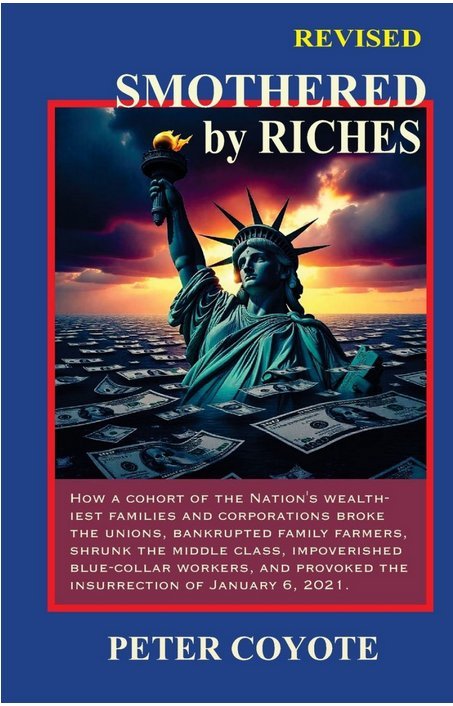
The complete documented history of how a 1971 corporate memo became a 65-year, multi-hundred-million-dollar campaign to dismantle American democracy — and how it produced Donald Trump. Written by two-time Emmy winner Peter Coyote, who narrated Ken Burns' greatest documentaries and helped ignite the 1960s student protest movement. This is the book that connects every dot on this page. Everything we investigate at CrisisOfTruth.org — the think tanks, the media consolidation, the tax heists, the dark money — Coyote documents it all in one place, with receipts.
There is also a companion documentary film narrated by Coyote, produced with the Observatory and the Independent Media Institute, available free on YouTube.
Lewis F. Powell Jr. was a corporate attorney in Richmond, Virginia — a board member at Philip Morris and eleven other corporations. He was well-settled in what one authorized biography described as the white male social and corporate elite of Richmond. The turbulence of the 1960s horrified him: civil rights workers demanding equal treatment, students protesting the Vietnam War, environmentalists challenging industrial pollution, Ralph Nader exposing unsafe automobiles.
On August 23, 1971, Powell sent a confidential memo to his friend Eugene Sydnor Jr., chairman of the education committee at the U.S. Chamber of Commerce. The memo was titled "Attack on American Free Enterprise System." It was a 34-page battle plan for American corporations to seize control of universities, the media, the courts, and the political process itself.
Powell's memo called for "careful long-range planning and implementation, in consistency of action over an indefinite period of years, in the scale of financing available only through joint effort, and in the political power available only through united action and national organizations."
Source: Lewis F. Powell Jr. Archives, Washington and Lee University School of Law — the most requested document in the Powell Papers
Two months later — on October 22, 1971 — President Richard Nixon nominated Powell to the United States Supreme Court. The memo was not disclosed to the Senate during his confirmation. Powell was confirmed 89–1.
The memo was eventually leaked to journalist Jack Anderson, who published its contents. But by then, the plan was already in motion. The U.S. Chamber of Commerce's board of directors formed a task force of 40 business executives — from U.S. Steel, General Electric, ABC, General Motors, CBS, 3M, Phillips Petroleum, Amway, and others — to review Powell's memo and draft specific proposals to implement it. That task force reported its recommendations on November 8, 1973.
What followed was the most disciplined, best-funded political campaign in American history — and most Americans have never heard of it.
The Powell Memo didn't just inspire vague political activity. It spawned a specific, coordinated infrastructure of organizations designed to do exactly what Powell prescribed: reshape how Americans think about government, regulation, and the proper relationship between corporate power and democratic accountability.
A 1997 study by the National Committee for Responsive Philanthropy identified twelve foundations with key influence on American public policy since the 1960s via their support for Heritage, AEI, and Cato. Three of the twelve are Koch Family Foundations. Foundations tied to Richard Mellon Scaife — the Mellon banking heir — bankrolled the Manhattan Institute, AEI, Heritage, Hoover Institution, Cato, and CSIS. The DeVos family (Amway fortune) funded AEI, Heritage, and Cato.
Sources: FAIR: Who Pays for Think Tanks? | OpenSecrets: Koch Network Strategy
The function of these organizations was not academic. They produced language, concepts, and policy frameworks designed to make deregulation and tax cuts sound like common sense. Phrases we now hear every day — "government is the problem," "job creators," "individual freedom," "free markets" — were focus-grouped, tested, and distributed by this network. Powell himself had recommended creating "a staff of eminent scholars, writers, and speakers who will do the thinking, the analysis, the writing, and the speaking."
That's exactly what they built. And we're living inside the result.
Jane Mayer's Dark Money (2016) documents how Richard Mellon Scaife gave $23 million over 23 years to the Heritage Foundation alone, after having been the largest single donor to AEI. The Olin Foundation spent nearly $200 million promoting free-market ideology on college campuses, bankrolling a new approach to jurisprudence called "law and economics" — giving $10 million to Harvard, $7 million to Yale and Chicago, and over $2 million each to Columbia, Cornell, Georgetown, and the University of Virginia. Mayer's reporting traces how these investments created the intellectual infrastructure that produced Citizens United, the Federalist Society's capture of the federal judiciary, and the policy framework behind Project 2025.
Source: Jane Mayer, Dark Money (Penguin Random House, 2016) — New Yorker staff writer, investigative reporting
For nearly four decades, a simple rule governed American broadcasting: if you used the public airwaves — which belong to every American — you had to present controversial issues honestly and give a fair hearing to opposing views. It was called the Fairness Doctrine.
The principle dates back to the Radio Act of 1927, which established that the airwaves are public property. The FCC formally adopted the Fairness Doctrine as policy in 1949. In 1959, Congress wrote it into the Communications Act. In 1969, the Supreme Court unanimously upheld it, noting that broadcasters have no constitutional right to monopolize a public frequency.
It worked. For decades, Americans could turn on the news and hear multiple perspectives on the issues that affected their lives. Not perfect, but functional. Broadcasters had a duty to serve the public interest — because they were using the public's property to do it.
The Powell Memo network wanted it gone.
In 1985, under FCC Chairman Mark S. Fowler — a communications attorney who had served on Ronald Reagan's presidential campaign in both 1976 and 1980 — the FCC released a report declaring that the Fairness Doctrine "hurt the public interest." In 1987, the FCC abolished it with a 4–0 vote. When Congress passed a bill to write the Doctrine into law, President Reagan vetoed it. When Congress tried again in 1991, President George H.W. Bush threatened another veto.
Sources: Reagan Presidential Library: Fairness Doctrine Topic Guide | Britannica: Fairness Doctrine
What happened next was not subtle. Within a year of the repeal, a radio executive named Ed McLaughlin signed Rush Limbaugh to a nationwide syndication deal — offered free to stations, who only had to give up four minutes per hour for national ads. One-sided political talk radio exploded. Sinclair Broadcasting built a network of local stations with centralized conservative messaging. Christian nationalist broadcasting expanded with no obligation to present alternative viewpoints.
The airwaves that belong to the American people became a one-way megaphone for the politics of the wealthy — and we lost the right to hear the other side.
Peter Coyote dates the Fairness Doctrine's origin to "1929." The underlying principle comes from the Radio Act of 1927, but the formal Fairness Doctrine was adopted as FCC policy in 1949 and codified into law in 1959. The documented timeline is actually more damning: it means this protection of the public interest survived for 38 years before Reagan's appointees destroyed it.
With the Fairness Doctrine dead, the next step was consolidation. If you can't force broadcasters to tell the truth, make sure the broadcasters are all owned by people who benefit from the same lies.
On February 8, 1996, President Bill Clinton signed the Telecommunications Act of 1996 — the first major overhaul of telecommunications law since 1934. The stated goal was to "let anyone enter any communications business." The actual result was the opposite.
The Act eliminated the national ownership cap on commercial radio stations. Clear Channel (now iHeartMedia) went on to acquire over 800 stations. By 2002, ten companies controlled two-thirds of the radio audience. Despite promises by major media companies to increase news programming, news staffs shrank by 44% and part-time staff by 71%. About 90% of the country's major media companies are now owned by six corporations.
Sources: Truthout / BillMoyers.com: 20 Years of Media Consolidation | Background: Telecommunications Act of 1996 (Pub.L. 104–104)
The bandwidth of political ideas Americans are exposed to shrank dramatically. As Peter Coyote puts it: we entered the World Series of Poker, and everybody else got decks with 50 cards. Americans got 40. We never hear the terms by which Finland built the best school systems in Europe, or why no Asian country funds schools by zip code, or how every Western European democracy decided that healthcare, education, and utilities shouldn't be run for profit — and left a whole economy for entrepreneurs to get wealthy in while giving every citizen a floor.
We can't have those conversations because the companies that own our news platforms have no obligation — and no incentive — to let us hear them.
Peter Coyote states media ownership went "from 50 diverse media corporations to three" within two years. The documented reality: ownership consolidated to approximately six major corporations controlling about 90% of American media, and it happened over roughly a decade, not two years. The corrected fact is still devastating — and it's bulletproof.
There was a time — within living memory — when the wealthiest Americans paid their share. And that shared investment built the country we inherited.
The top income tax rate peaked at 94% in 1944–45 and stood at 91% or 92% in every year from 1951 through 1963. (It dipped to 82–86% in the immediate postwar years, 1946–50.) The rate applied to income above $200,000, equivalent to approximately $2.4 million today. This was the era that funded the interstate highway system, the space program, public universities, and the world's most advanced research infrastructure. Beginning in 1964 the rate was cut to 77%, then to 70% in 1965, then under Reagan to 50% (1982) and 28% (1988).
Sources: Wolters Kluwer: Historical Income Tax Rates | Background: History of Taxation in the United States
Here's the part we're not supposed to notice: the wealth that evaporated from public investment didn't disappear. It was transferred — through tax cuts, deregulation, and the elimination of public services — into the accounts of the people who funded the think tanks, who funded the campaigns, who wrote the memos. The money that used to build airports now builds second yachts. The money that used to fund public universities now funds think tanks that argue against public universities.
And the shortfall? We make it up with sales taxes, property taxes, use taxes, and fees — the regressive taxes that hit working families hardest. We pay more so they can pay less. That's not a bug. That's the design.
The effective tax rate — what the wealthy actually paid after deductions and loopholes — was lower than the statutory rate. In the 1950s, the top 1% paid an effective rate of about 42% across all taxes, and about 16.9% in income taxes specifically. Today's effective rates are only somewhat lower. But the statutory rate matters too: it set the ceiling on accumulation and signaled a social contract — that extreme wealth carried extreme responsibility.
The RAND Corporation — a nonpartisan research institution — calculated that had income for the bottom 90% of Americans grown at the same rate as the overall economy since 1975, those workers would have collectively earned $2.5 trillion more in 2018 alone. Over the 43-year period from 1975 to 2018, the cumulative gap totals $47 trillion. A 2025 update extending the analysis through 2023 put the cumulative gap at $79 trillion in 2023 dollars, with the bottom 90% earning $3.9 trillion less in 2023 alone. (The two totals are stated in different base-year dollars and are not directly comparable.) A worker at the 25th percentile earned $33,000 in 2018 but would have earned $61,000 if growth had been shared equitably. Workers at the 99th percentile, by contrast, saw their income grow to $761,000 — far above the $560,000 that equitable growth would have produced.
Sources: RAND: Trends in Income From 1975 to 2018 (WR-A516-1) | RAND: 2025 Update — Gap Grows to $79 Trillion (WR-A516-2)
From 1948 to the late 1970s, worker pay and productivity rose together. Then they split. From late 1979 through early 2026, net productivity grew 93.2% while hourly compensation for the typical worker (production and nonsupervisory workers, roughly 80% of the workforce) grew just 33.7% — productivity rising 2.8 times as fast as pay. If the median worker's compensation had kept pace with productivity, they would be making roughly $9 more per hour today. EPI's analysis attributes this directly to policy choices: weakened unions, deregulation, eroded minimum wage, corporate globalization, and tax cuts for high earners.
Sources: EPI: The Productivity–Pay Gap | EPI: Growing Inequalities, Growing Employer Power
The Congressional Budget Office has consistently documented rising income concentration at the top of the distribution since the late 1970s. CBO data tracks after-tax income growth by quintile and shows that the top 1% of households have seen income growth far exceeding all other groups, while the bottom 20% and middle quintiles have seen dramatically smaller gains — even as the overall economy expanded significantly.
Half of all renters in the United States are now "cost-burdened" — spending more than 30% of their income on housing. Housing unaffordability reached new highs in 2024, according to Harvard's Joint Center for Housing Studies. This is not a lifestyle choice or a personal failure. It is the direct, measurable consequence of 50 years of policy decisions that shifted income upward while the costs of basic necessities — housing, healthcare, education — continued to rise.
Source: Harvard Joint Center for Housing Studies: Housing Unaffordability Soared to New Highs (2024)
The EPI productivity-pay gap analysis has methodological critics who argue that using different inflation measures for productivity and pay overstates the divergence. Even adjusted for these critiques, the core finding holds: labor's share of national income has declined since the 1970s, and wage inequality within the workforce has grown dramatically. The RAND study uses an independent methodology and reaches the same conclusion: growth was shared equitably until the mid-1970s, then it stopped being shared. We include the critics' point because documenting what's contested — alongside what's proven — is how you build trust with readers who've been lied to before.
The think tanks provided the ideas. The media consolidation controlled the megaphone. The tax cuts provided the incentive. But the votes had to come from somewhere. And that required what may be the most cynical bargain in American political history.
The deal was simple: corporate wealth would fund the campaigns and organizational infrastructure of the Christian evangelical movement. In return, evangelical leaders would deliver their voters to candidates who served corporate interests — candidates who would cut taxes on the wealthy, deregulate industries, and weaken the government's ability to protect working people. Each side got what it wanted. The billionaires got policy. The evangelical leaders got power. Working Americans got neither.
Peter Coyote describes it plainly: "Reagan's great movement — 'I'll make you as rich as Croesus, you give me your voters.'"
Peter Coyote doesn't just diagnose the disease. He prescribes specific, actionable demands — the kind of demands we should be making of every candidate who asks for our money or our vote.
Before we send a dollar, we ask:
And beyond the ballot box, Coyote makes the connection between our daily spending and the power of the people who are dismantling our democracy. Every purchase on Amazon, every hour on Facebook or Instagram or TikTok, sends money into the infrastructure of the billionaires who fund this system. If the millions who showed up on No Kings Day — organizers counted more than 8 million; independent crowd-science estimates put it at 5 to 6.5 million — redirected their spending away from five companies, the earnings compression would be published in quarterly reports, and shareholders would demand change.
That doesn't require a revolution. It requires what Coyote calls "a little long-term thinking and a little consistency."
"We can't get the ideas on the floor to say: if we want the legislators to work for us, we should pay them. They work for who pays them. No fault, no blame. But if we want to change that and we're not talking about money — and we're not talking about who gives it and who owns it and who owns the Supreme Court — we're not really addressing the problem."
Peter Coyote is not a pundit. He is not a political operative. He is an actor now in his mid-eighties, author, and ordained Zen Buddhist priest who has spent his life engaged with the questions of wealth, power, and freedom that define this moment.
In 1961, as a student at Grinnell College in Iowa, Coyote was one of 14 students who drove to Washington, D.C., fasted for three days in front of the White House, and demanded an end to nuclear weapons testing. Kennedy read about them in the papers and sent an aide, Marcus Raskin, to their hostel with an invitation to the White House; the students were received inside, in the Fish Room, by national security adviser McGeorge Bundy. Their action sparked a year of continuous student vigils and contributed to the Partial Nuclear Test Ban Treaty of 1963. Tom Hayden, a founder of Students for a Democratic Society, traced the beginning of the modern student peace movement to the Grinnell 14’s Washington trip.
He spent ten years in the 1960s and '70s counterculture, living on communes, never earning more than $2,500 a year. He was a member of the Diggers, a San Francisco anarchist collective that ran free stores and fed 600 people a day — their only requirement was that you step through a six-foot yellow square called "the Free Frame of Reference," their theater piece asking Americans: Why do you want to be an employee to make the money to be a consumer? What do you really want to do?
He began his film career at 39 and has since appeared in over 160 films and worked with Spielberg, Polanski, Almodóvar, and others. He narrated Ken Burns documentaries including The West, The National Parks, The Roosevelts, Vietnam, and The Dust Bowl, and won two Emmy Awards. He was ordained as a Zen Buddhist priest in 2011 and received transmission in 2015, making him an independent Zen teacher. He lives on a farm in Northern California with 40 fruit trees and a 1952 Dodge Power-Wagon he calls his longest-lasting addiction.
Coyote grew up watching his wealthy father — president of a railroad, oil company, and stock brokerage — destroyed by the very system he championed. His father's metaphor for life was three men in a lifeboat with food for two: capitalism demanded the strong kill the weak. Peter chose differently. He has spent his life on the other side of that line — with what he calls "people in the depths generating light and heat."
The book traces the complete history from the Powell Memo through every major institution the billionaire network built — Heritage Foundation, Cato Institute, ALEC, the Federalist Society — and documents how each piece served the larger strategy of dismantling the New Deal and making American government serve wealth rather than working people. It covers the Fairness Doctrine repeal, media consolidation, the tax shift, the evangelical alliance, Citizens United, and the road to Trump. Coyote wrote it because, as he says: "Trump is not an accident."
The book also has a companion documentary available free, produced with the Observatory and the Independent Media Institute, and the full essay is published under Creative Commons at observatory.wiki.
Everything on this page is documented fact. Now pick up the phone and tell the people who represent you that you know — and that you expect them to act.
(202) 224-3121"Hi, my name is [your name] and I'm a constituent from [your city/state]. I'm calling because I want to know: what are you doing about the influence of billionaire money in our political system? Will you support full federal funding of elections? Will you support transparency requirements for Supreme Court justices? Will you vote to end the billionaire tax cuts? I'm paying attention, and I'll be watching your vote. Thank you."
A phone call takes 90 seconds. They work for us. Call them.
Every claim on this page is sourced to federal records, university archives, congressional testimony, or the organizations' own published materials. We link to them because we believe working Americans deserve to see the evidence with their own eyes.