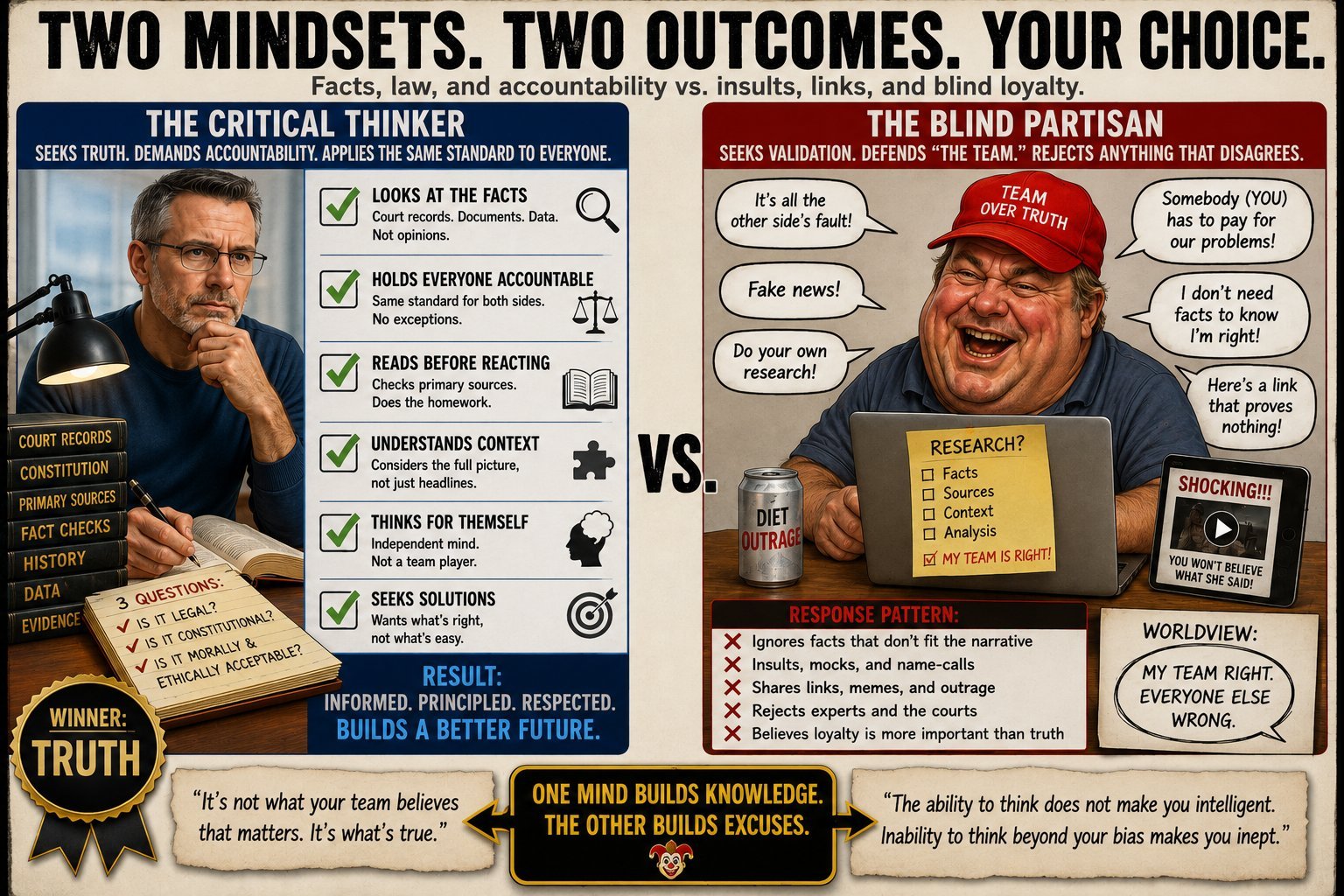
Two people watch the same news story about government corruption. The first one asks: What does the evidence show? The second one asks: Which team does this hurt? They will both walk away with opinions. They will both state those opinions with total confidence. And they are doing two completely different things — one of them is analyzing, and the other is cheering.
This page is about learning to tell the difference — in the media you consume, in the people who lecture you at dinner, and, hardest of all, in yourself. Because the most dangerous propaganda in your life isn't coming from a government ministry. It's coming from your own reluctance to check whether the thing you're confident about is actually true.
The tell: where does the standard bend?
Here is the fastest diagnostic ever devised for separating a principled person from a partisan one, and it takes ten seconds:
Ask them to name something serious their own side did wrong. Not a throwaway. Something real, recent, and costly. Then watch what happens.
A person with a standard can answer immediately, because a standard is a measuring stick — it produces the same reading no matter whose conduct you hold it against. A person with a jersey cannot answer, because a jersey isn't a measuring instrument at all. It's an allegiance. Every fact that arrives gets sorted first by whether it helps or hurts the team, and only the helpful ones are allowed to be true.
The public record makes this test easy to run on yourself. Over the last thirty years, members of both major parties have been convicted of bribery, fraud, racketeering, and corruption — governors, House speakers at both the state and federal level, sitting members of Congress, a president's inner circle, a president's son, and a president himself. Those convictions are not opinions. They are jury verdicts and guilty pleas, sitting in courthouse records anyone can read. A person who can recite the sins of one party and draws a blank on the other hasn't done research. They've done team laundry.
One question, honestly answered
"What is the most serious wrong committed by the political side I generally support — and did I condemn it at the time, with the same energy I'd use against the other side?"
If your honest answer is "nothing comes to mind," you haven't found an innocent team. You've found the edge of your own research. Corruption is bipartisan; it always has been. Prosecutors of both parties have proven it in court, over and over, for decades. The only thing that isn't bipartisan is your attention.
Three questions that don't care about your team
Loyalty asks one question: Is this good for us? Analysis asks three, and none of them contains the word "us."
Not "did my side get away with it." What do the statutes say, what did the courts rule, and what does the actual court record — indictments, verdicts, pleas — establish?
Not "does it feel American." What does the document actually say, and what have judges — including judges appointed by the side that benefits — ruled about it?
The question that survives even when something is technically legal. Would you accept this exact conduct from the other side? If not, you may not accept it from yours.
Notice what these three questions do: they make the identity of the actor irrelevant. A bribe is a bribe whether the hand taking it is red or blue. An unconstitutional order is unconstitutional no matter whose signature is on it. A pardon sold for money, loyalty, or political support is corrupt regardless of which president signs it — and presidents of both parties have disgraced that power to protect their friends, their donors, and their own families. Condemning only half of that record isn't a viewpoint. It's a blind spot wearing a viewpoint's clothes.
Credentials are not the point. Homework is.
Here's a trap worth avoiding: the idea that political opinions belong only to lawyers, historians, and political scientists. That's wrong, and it's also a dodge. Most citizens aren't credentialed in constitutional law — and citizenship doesn't require it. What it requires is proportion: the confidence of your opinion should never exceed the depth of your research.
An engineer who has read the court filings knows more about a case than a law-school graduate who has only read the headlines. A retired tradesman who reads primary sources outranks a pundit who reads talking points. The degree was never the qualification. The homework is. And the reverse is equally true: no career, no income, and no self-regard entitles anyone to a strong opinion about documents they have never opened and rulings they have never read.
You are entitled to your own opinion. You are not entitled to confidence you haven't earned.