Medicaid is middle-class insurance. It just doesn't say so on the label.
Roughly 70 percent of older adults will need significant long-term care — 90 days or more — at some point in their lives. Medicare, the program most retirees assume covers them, generally does not pay for long-term custodial nursing home care. Private long-term-care insurance is rare and expensive. So the standard American path is this: a family pays out of pocket until savings are exhausted, then Medicaid takes over.
That is why Medicaid — a program many people picture as "welfare for someone else" — is the primary payer for nearly two out of three nursing home residents, and paid 44 percent of the nation's long-term institutional care bill in 2023. If you have a parent in a nursing home, or expect to be in one someday, Medicaid is very likely part of your family's story whether you know it yet or not.
Medicaid is the primary payer for 63% of nursing home residents and covered 44% of long-term institutional care in 2023.
Source: KFF Health News analysis of Nursing Home Compare and CASPER data (see Sources, #4)What the law actually did — the chain, link by link
Link 1: It cut roughly a trillion dollars from Medicaid over a decade.
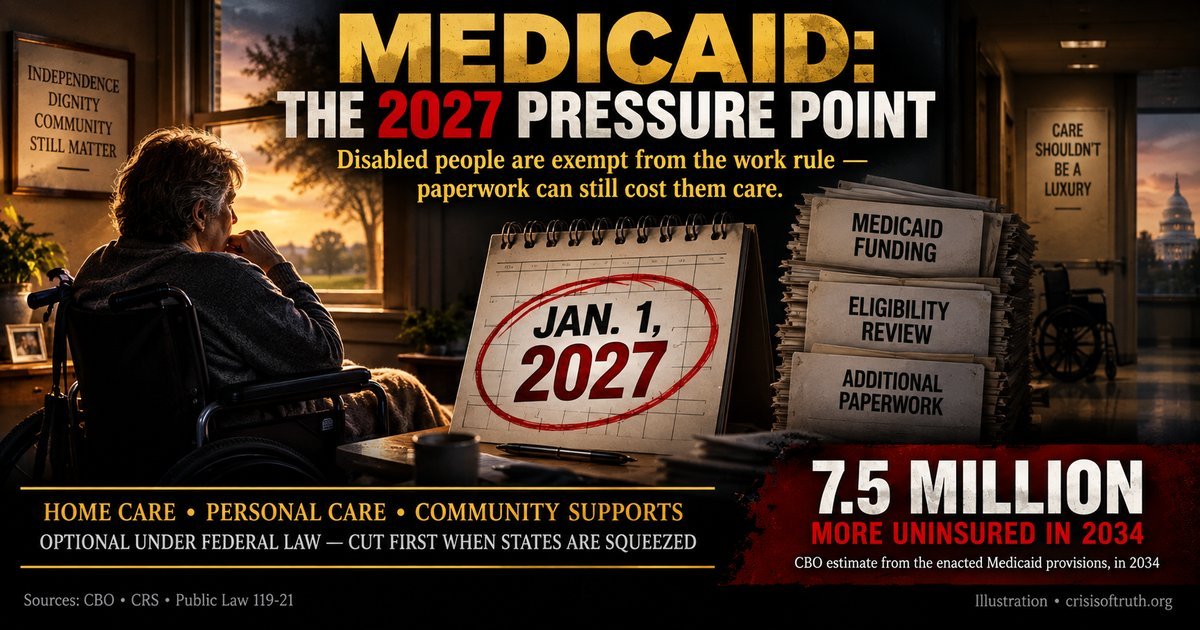
The Congressional Budget Office — Congress's own nonpartisan scorekeeper — estimates the enacted law adds $3.4 trillion to federal deficits through 2034 while cutting deeply into Medicaid and marketplace coverage. CBO projects 10 million more people uninsured in 2034, about 7.5 million of them from the Medicaid provisions alone. Those are the official numbers, not a pundit's.
Link 2: It froze the tool states use to fund nursing home payments.
States pay their share of Medicaid partly through "provider taxes" — assessments on health care providers that draw down federal matching funds. The new law prohibits states from enacting new provider taxes or increasing existing ones on nursing homes, and phases down provider taxes elsewhere in the system. Medicaid payment rates already fall short of the actual cost of nursing home care in most states. The law locks that shortfall in place while federal money shrinks — and squeezed states have to find the difference somewhere.
Link 3: It shelved the nursing home staffing rule for a decade.
A federal rule finalized in 2024 would have required minimum nursing hours per resident and a registered nurse on site 24/7. The law imposes a moratorium blocking enforcement of the staffing rule until October 2034. Analysts had estimated the rule could save roughly 13,000 lives a year by improving care quality. Understaffing is the single most consistent predictor of neglect in nursing facilities — and the floor that was about to be built under it has been removed for ten years.
Link 4: The money that keeps people OUT of nursing homes gets cut first.
Home and community-based services — the aides, personal care, and support that let people stay in their own homes — are optional under federal Medicaid law. Nursing home coverage is mandatory. When federal funding drops, history shows states cut optional benefits first. A 2021 AARP survey found 77 percent of adults 50 and older want to remain in their homes long-term. The services that make that possible are precisely the ones on the chopping block.
Link 5: Closures, especially rural.
Nursing homes running on thin margins with Medicaid as their largest payer face falling revenue, no new state funding mechanism, and a workforce squeezed further by the law's immigration enforcement funding — immigrants made up about 21 percent of skilled nursing facility workers in 2023. When a facility closes, residents don't stop needing care. They get transferred farther from family, or the burden lands on adult children.
Labeled honestly: An industry survey cited at a July 2025 press event claimed 27% of nursing homes may be forced to close and 58% expect staff reductions. That is a provider survey, not a CBO projection. We include it for what it is — the industry's own forecast — and weight it accordingly.
The delayed fuse: why you haven't felt it yet
If this law is so damaging, why hasn't the damage arrived? Because it was written not to arrive yet. The absence of pain today is not evidence the warnings were wrong — the clock simply hasn't run out. What to watch, and when:
- July 2025Law signed. Provider tax freeze on nursing homes takes effect; states begin rewriting budgets around future cuts.
- 2026States adjust Medicaid payment rates and trim optional services ahead of federal reductions. Facility operators make staffing and closure decisions based on what's coming.
- January 2027Medicaid work requirements and more frequent eligibility checks begin — after the November 2026 midterm elections.
- 2027–2030Provider tax phasedowns deepen; cost-shifts to states compound; CBO's coverage-loss projections accumulate year by year.
- October 2034Staffing rule moratorium finally expires — ten years of the old floor.
Draw your own conclusion about why the most painful provisions were scheduled to begin the January after a national election. The dates are in the statute; the motive is a question every voter can answer for themselves.
Meanwhile, at the other end of the income scale
CBO's distributional analysis of the law found that household resources decline for families at the bottom of the income distribution and increase for households in the middle and toward the top. In plain terms: the savings extracted from the long-term care system help finance tax cuts whose benefits concentrate upward. You don't have to take our word for the direction of the transfer — it's in CBO's own report, linked below.
The three questions
Every Crisis of Truth investigation applies the same test:
- Is it legal?
- Yes. It passed both chambers and was signed into law. Legality was never the issue.
- Is it constitutional?
- Nothing here appears to violate the Constitution. Congress has the power to tax and spend — and to stop spending.
- Is it morally and ethically acceptable?
- That one is yours to answer. The facts: a trillion dollars out of the program that pays for two-thirds of nursing home residents; the staffing floor shelved for a decade; the stay-at-home services first in line for cuts; the benefits flowing upward; the pain scheduled for after the election. Read the sources. Then decide.
What you can actually do
- If you have a parent or spouse receiving Medicaid long-term care: watch your mail. Eligibility re-verification is where coverage gets lost — often for paperwork reasons, not eligibility reasons. Respond to every notice, keep copies, and ask the facility's social worker or your Area Agency on Aging for help.
- If you expect to need care someday: that's most of us. Understand your state's Medicaid long-term care rules before a crisis, not during one.
- If you vote: your representatives' votes on this law are public record. Ask them, on the record, how they expect nursing home care in your county to be funded in 2028.
Don't believe us. Don't believe the industry. Don't believe the White House.
Every claim on this page traces to a primary source below — CBO reports, the statute, federal data. Read them yourself. That's the whole point of this site.
Sources
- Congressional Budget Office, Estimated Budgetary Effects of Public Law 119-21, the One Big Beautiful Bill Act (enacted-law estimate: deficits, revenue, outlays) — cbo.gov/publication/61570
- Congressional Budget Office, distributional analysis of household resources under the law — cbo.gov/publication/61367
- Congressional Budget Office, health coverage effects (uninsured projections, Medicaid provisions) — cbo.gov/publication/61837
- KFF Health News analysis of nursing home payer mix, staffing hours, and OBBBA reimbursement impacts (Nursing Home Compare / CASPER data), as reported by Skilled Nursing News — skillednursingnews.com
- Congressional Research Service, Health Coverage Provisions in the One Big Beautiful Bill Act (H.R. 1), R48569 — congress.gov/crs-product/R48569
- National Committee to Preserve Social Security & Medicare, analysis of OBBBA Medicaid provisions, HCBS, and the staffing rule moratorium — ncpssm.org
- ASTHO, One Big Beautiful Bill Law Summary (provision-by-provision, including the staffing-standards moratorium to Oct. 2034) — astho.org
- FactCheck.org, One Big Beautiful Bill Not (Yet) Driving ACA, Medicaid Declines (July 2026 — the delayed-fuse timeline) — factcheck.org
- Skilled Nursing News, LeadingAge / Sen. Sanders press conference on OBBBA nursing home impacts (industry survey figures, labeled as such above) — skillednursingnews.com
- Public Health Post, Shifting the Costs of Nursing Home Care (long-term care need statistics, filial responsibility risk) — publichealthpost.org