The Propaganda
What manipulation looks like in the wild
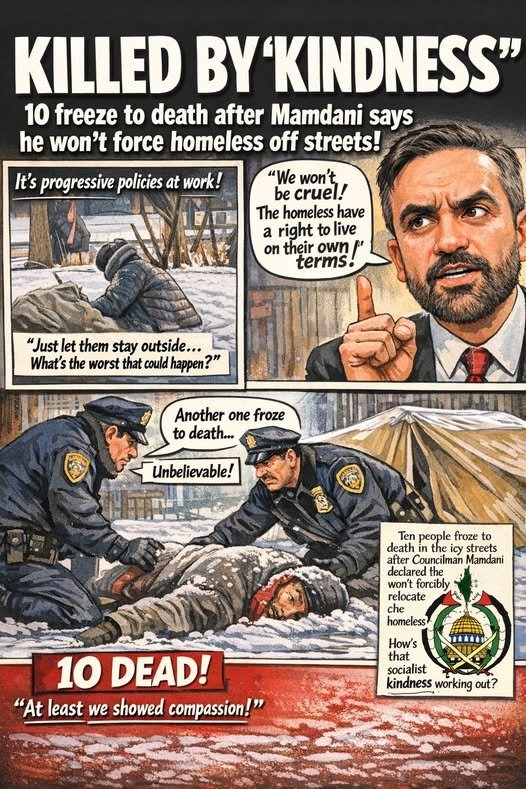
What This Image Is Trying to Do
This is what propagandists call a "fear comic"—a visual designed to trigger an emotional response so fast that your brain never gets a chance to ask questions. Before you even finish looking at it, it wants you to feel: anger at a specific politician, contempt for "progressive" policies, and certainty that compassion equals death.
Notice how it uses the comic book format. This isn't an accident. Comics bypass critical thinking and go straight to emotion. We process them the way we process stories about heroes and villains—not the way we process evidence and arguments.
The goal isn't to help you understand homelessness policy. The goal is to make you angry at a predetermined target before you can think.
The Core Deception
This image wants you to believe: "Progressive politician refuses to help homeless → homeless people die → therefore progressive policies kill people."
But this chain of logic contains multiple hidden assumptions that are never examined, never sourced, and in many cases, demonstrably false.
The Manipulation Techniques
Seven propaganda methods used in a single image
False Cause (Post Hoc Fallacy)
Claiming that because B happened after A, A must have caused B.
The image implies: "Politician won't force removal → therefore people froze to death."
Straw Man Distortion
Misrepresenting an opponent's position to make it easier to attack.
The image pretends the policy is: "Just let them stay outside... what's the worst that could happen?"
Loaded Language & Emotional Hijacking
Using phrases designed to trigger emotions rather than communicate facts.
Notice the phrases: "Killed by kindness," "10 DEAD!", "At least we showed compassion!"
Dehumanization
Presenting certain groups as less than human to make harsh treatment seem acceptable.
Notice who gets to speak in this comic: The politician speaks. The police speak. But the homeless person? Silent. Nameless. Faceless. A prop.
Fake Numbers Without Sources
Presenting statistics without context or verification to create false authority.
"10 DEAD!" is shouted in large red text. But where did this number come from?
Scapegoating
Blaming a complex systemic problem on a single person or group.
The image reduces decades of housing policy, mental health funding cuts, economic inequality, and urban planning failures to: "One politician said something."
In-Group/Out-Group Division
Creating "us vs. them" mentality to prevent nuanced thinking.
The image codes "progressive" and "socialist" as the out-group, creating tribal allegiance before any facts are considered.
What the Propaganda Hides
The context that would destroy the narrative
What It Shows
- One politician's statement
- Deaths presented as direct result
- Implication that forced removal saves lives
- Compassion framed as the problem
- Simple villain/victim narrative
What It Hides
- Cities with aggressive sweeps still have deaths
- Police-forced displacement often increases mortality
- Many avoid shelters due to assault, theft, or medical neglect
- Budget cuts to housing and mental health caused the crisis
- Deaths occur under all political administrations
The Real Question to Ask
Whenever you encounter content like this, ask: "What would I need to see to know if this is actually true?"
In this case, you'd need: comparative death rates across different policies, shelter bed availability data, actual policy details (not cartoon summaries), and information about what happens when cities do use forced removal. The propaganda doesn't want you asking these questions.
The Counter: Same Format, Actual Information
Using visual communication for education instead of manipulation
How Truth Can Use the Same Tools
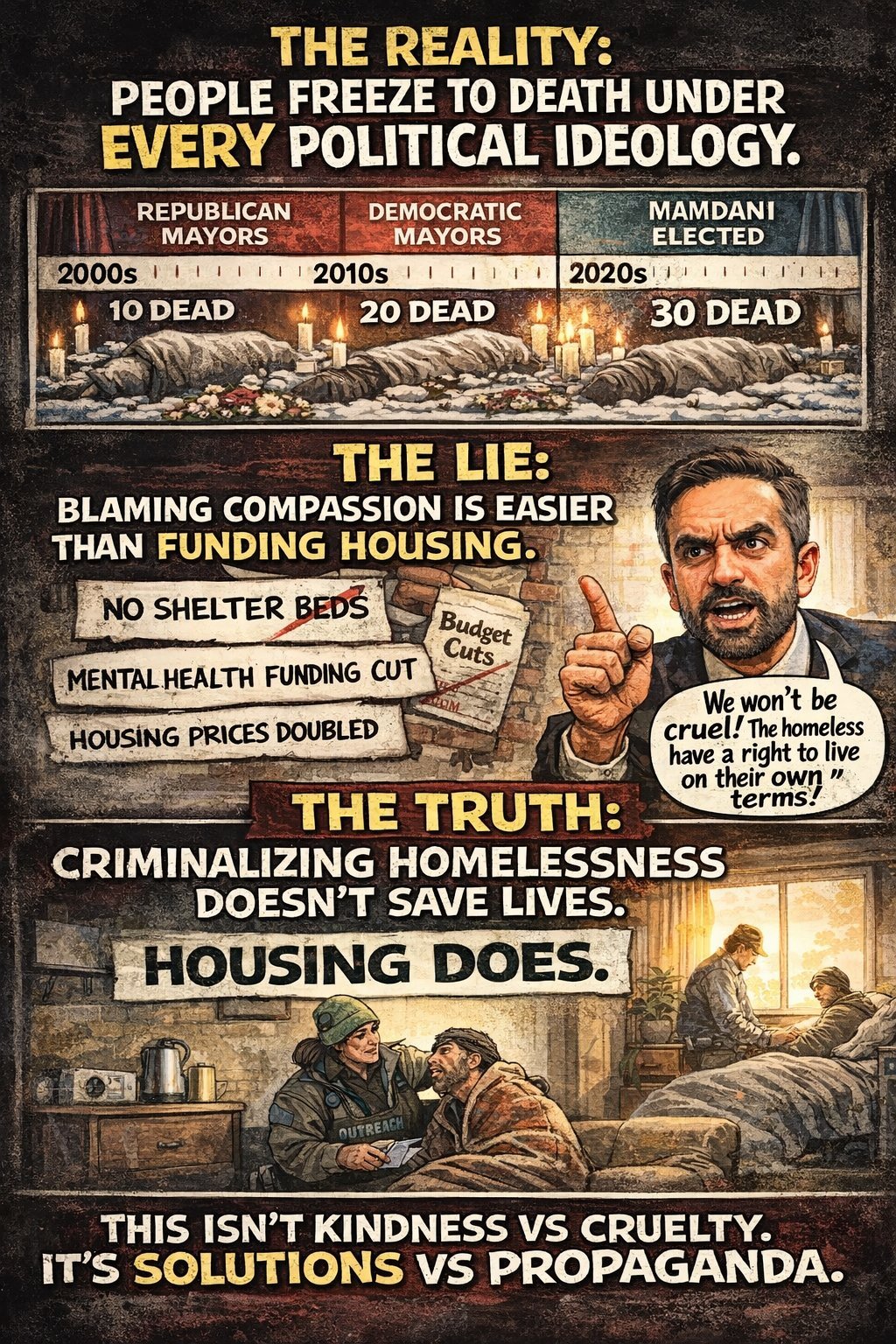
The same visual format that spreads lies can spread information. The counter-image uses the comic style to present what the propaganda left out: context, comparison, and actual solutions.
Notice the key differences: Instead of blaming one person, it shows that deaths occur under every political administration. Instead of pretending the only options are "forced removal" or "letting people die," it acknowledges the systemic factors: no shelter beds, mental health funding cuts, housing prices doubling.
Most importantly, it ends with a real solution: "Housing does." The propaganda offered no solution except punishment. The counter offers an evidence-based answer that has been shown to work.
Provides Context
Shows that the problem existed before this politician and exists across all political ideologies—removing the scapegoat narrative.
Identifies Real Causes
Points to actual systemic factors: shelter availability, mental health funding, and housing costs—information the propaganda intentionally hid.
Offers Evidence-Based Solutions
Instead of just attacking, it presents what actually works: housing-first policies, outreach, and medical care.
Reframes the Debate
"This isn't kindness vs cruelty. It's solutions vs propaganda." This exposes the false choice the original presented.
🔍 Quick Reference: Spotting These Techniques
Ask: "What's missing?"
Propaganda works by hiding context. What data, comparisons, or alternative explanations aren't shown?
Ask: "Who benefits?"
Who gains if you believe this without questioning it? Follow the motivation.
Ask: "Is this a straw man?"
Is the "enemy" position being fairly represented, or is it a cartoonish distortion?
Ask: "Where are the sources?"
Real information comes with citations. Propaganda comes with confident assertions.
Notice: Emotional intensity
The more something tries to make you feel before you think, the more suspicious you should be.
Notice: Simple villains
Complex problems with simple villains is a red flag. Reality is messier than propaganda admits.
Why Propaganda Works
Understanding manipulation helps us resist it
We're not weak or stupid because propaganda affects us. Our brains evolved to make quick judgments based on stories and emotions—that was survival-critical for most of human history. Propagandists exploit these cognitive shortcuts.
The Emotional Shortcut
Research shows that when we experience strong emotions, our analytical thinking decreases. Propaganda deliberately triggers anger, fear, or contempt first so that the claims that follow bypass our critical evaluation.
This is why the comic format is so effective: we process visual narratives emotionally before logically. By the time your rational brain catches up, you've already absorbed the message.
The solution isn't to become emotionless—it's to slow down. When you feel a strong reaction to political content, that's the moment to pause and ask: "Is this designed to inform me, or to manipulate me?"
Propaganda Without a Face
When the messenger is invented too
The comic above is at least honest about one thing: it looks like a political cartoon, so you know someone made it to persuade you. The most effective propaganda hides even that. It arrives from someone who looks like your neighbor.
In 2016, a Russian troll farm ran two Facebook pages: "Heart of Texas" and "United Muslims of America." Each called a rally at the same Houston Islamic center at the same hour on May 21. Real Texans showed up on both sides and faced off in the street. Senate Intelligence Committee Chairman Richard Burr, a Republican, said the whole stunt cost Russia about $200. Nobody from either "group" attended. They were in St. Petersburg.
Technique Eight: The Borrowed Identity
Every technique on this page works better when it seems to come from one of your own: a fellow Christian, a fellow veteran, a fellow Texan. Foreign operations build those identities on purpose, spending months posting harmless content to earn trust before introducing the divisive message. In 2024 the Justice Department disrupted a Russian bot farm that used AI to mass-produce such personas, including a supposed Minneapolis resident posting Putin videos.
So add one question to the list above: "Who actually made this?" Not who shared it with you, but where it started.
And the Opposite Trap
"That's a Russian bot" is not a rebuttal. Most American division is homegrown, and calling a real person a bot because you disagree with them does the propagandists' work for them. Check the claim, not the person. In October 2026, a viral claim that Ukrainian drone strikes had wiped out Russia's pro-Trump bots turned out to rest on a misread chart. Wanting something to be true is exactly when to check it hardest.
Full record, with every court filing linked: Russian Bot Farms: What's Proven, What Isn't →
The Bottom Line
Propaganda collapses when exposed to structure and facts. The image at the top of this page has power only if you don't look closely. Once you see the techniques, you can't unsee them.
This isn't about left vs. right. Both sides use these techniques. The skill of recognizing manipulation protects you from being used as a weapon in someone else's agenda—regardless of who's wielding it.
Primary sources first. Opinions second.