Crisis of Truth  ·  Investigation

The White House Is for sale.

Not as a metaphor. As a marketplace — with fixers on retainer, price points in public lobbying filings, and receipts sitting in federal court dockets. We pulled the receipts. Here they are.
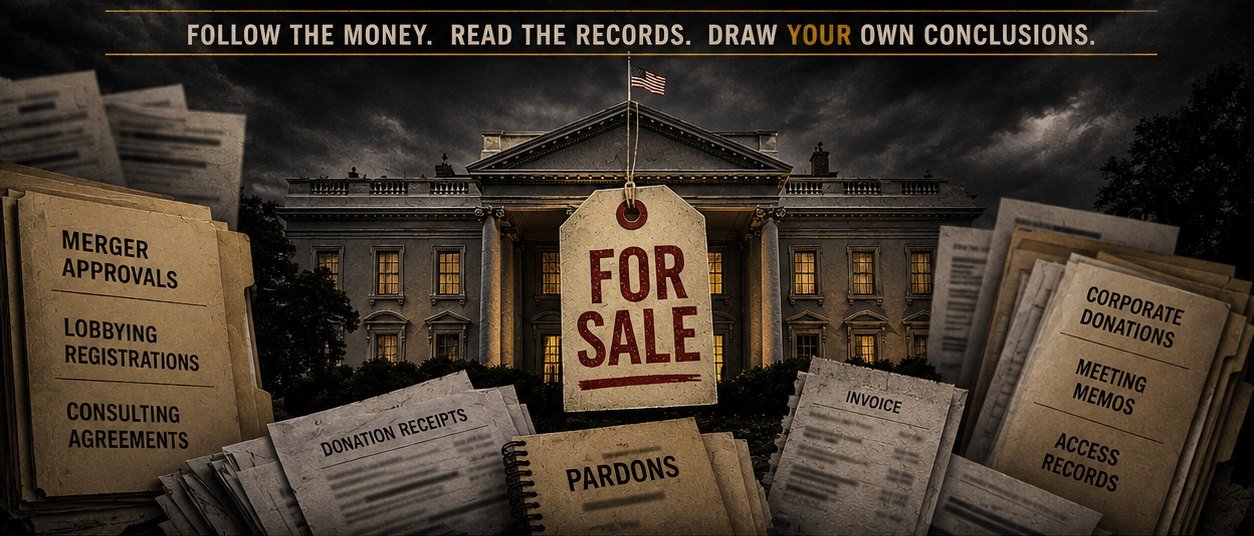
The White House at night with a FOR SALE tag hanging from the portico, surrounded by piles of documents labeled merger approvals, lobbying registrations, donation receipts, and pardons
$1.72
Overcharge per concert ticket, per federal jury — April 15, 2026
$300,000/mo
One fixer's reported retainer from a merging corporation, per fired DOJ official Roger Alford
$280M
DOJ's mid-trial Ticketmaster settlement — roughly four days of Live Nation revenue
33 + DC
States that refused the deal, finished the trial alone — and won on every count
$1.3B
Restitution owed to fraud victims, erased by presidential pardons
0 → 10
Registered pardon lobbyists: first year of every prior presidency vs. this one

Part One

We're already paying for this. We just never see the invoice.

It's in the ticket that cost twice what it should. The rent that jumped again. The "junk fees" stapled to buying a home. The hospital bill that makes no sense because one company now owns the insurer, the pharmacy benefit manager, and the clinic.

When a corporation buys its biggest competitor, we don't get a vote. We get the bill. Federal antitrust law exists for exactly one reason: to stop that bill from being written. And for a brief moment — rare in modern American history — both parties actually agreed it should be enforced.

Then the enforcers started getting fired. This page documents who fired them, who paid, and what it's costing us. Don't take our word for any of it. Every case below has a docket number, a public filing, or a named official speaking on the record. Check them.

Part Two

Both parties built the showroom.

Let's be honest about the history first, because this is not a story about one man or one party.

For roughly forty years, administrations of both parties waved corporate mergers through. The result: fewer airlines, fewer grocers, fewer hospitals, fewer employers competing for our labor — and prices set by companies that no longer have to care.

And selling access is not new either. In January 2001, President Bill Clinton pardoned fugitive financier Marc Rich — after Rich's ex-wife had donated $450,000 to the Clinton presidential library and more than $1 million to the Democratic Party and its candidates. Congress investigated. It was a scandal then. It should still be a scandal now.

What's remarkable is what happened next. In the last several years, something genuinely shifted. The first Trump administration filed landmark monopoly cases against Google and Facebook. The Biden administration kept those cases alive and filed dozens more — against Ticketmaster, against RealPage's rent-pricing software, against the largest supermarket merger in U.S. history. When Gail Slater was nominated to run the DOJ Antitrust Division in the second Trump term, she was confirmed 78–19 — Republicans and Democrats together — precisely because she represented that new consensus.

A bipartisan machine was finally being built to protect us. This page is about the people who paid to break it.

"Vigorous antitrust enforcement is a bipartisan issue. This is not a left-right issue."
Roger Alford — former Deputy Assistant Attorney General, DOJ Antitrust Division, fired July 2025

Part Three

The play runs the same way every time.

Strip away the names and the same four-step sequence appears in case after case. Watch for it as you read the receipts below.

Get sued — or get reviewed.

A merger draws an antitrust challenge, or an investigation opens. On the legal merits, the company is in trouble.

Hire a fixer.

Not an antitrust lawyer. A person whose product is proximity to the president — hired weeks after the election, paid monthly retainers plus success fees.

The deal gets waved through.

Career staff are overruled, cut out, or never asked. A settlement written by the company's own lawyers appears. The stock jumps.

Whoever objected gets fired.

The officials who insisted on deciding cases on the merits are terminated. The next official learns the lesson.

That's the whole product. Now here are two documented purchases.

Receipt No. 1

Hewlett Packard Enterprise buys Juniper — and a green light.

In January 2025, the Department of Justice sued to block Hewlett Packard Enterprise's $14 billion purchase of Juniper Networks. It was a three-competitors-into-two merger in networking equipment — the classic red flag — and DOJ argued it would raise prices for hospitals, universities, and other customers. The trial team was ready to go.

Then, according to Roger Alford — the Deputy Assistant Attorney General on the case, speaking on the record after his firing — a fixer named Mike Davis called Assistant Attorney General Gail Slater and threatened to destroy her career. Davis, a longtime Trump ally who had recommended Slater for her job, had begun collecting corporate checks shortly after the election. Alford puts Davis's retainer from merging companies at $300,000 a month, plus a contingency fee of over $1 million per successful merger. Davis denies making the threatening call.

What happened next is documented by DOJ sources in the Wall Street Journal: weeks after the call, Slater's boss placed a settlement on her desk — drafted by Hewlett Packard Enterprise's own lawyers. When she asked what would happen if she refused to sign, she was told she was too difficult to fire, but her deputies weren't. She signed in June 2025. Her deputies, including Alford, were fired in July anyway. HPE's stock jumped on the news of the green light.

Itemized

United States v. Hewlett Packard Enterprise Co.

DocketNo. 3:25-cv-00951 (N.D. Cal., filed Jan. 30, 2025)
Deal size$14,000,000,000
Fixer retainer (per Alford)$300,000 / month + $1M+ success fee
SettlementJune 2025 — drafted by HPE's counsel, per WSJ sourcing
Officials firedTwo senior antitrust officials, July 2025
StatusUnder Tunney Act review; court granted intervention Oct. 14, 2025
"I thought we were going to be focused on the average American."
Roger Alford — on why he joined the Department of Justice

Receipt No. 2

Ticketmaster runs the same play. The states refuse to fold.

In May 2024, the Department of Justice and a bipartisan coalition of state attorneys general sued Live Nation–Ticketmaster, seeking to break up the company that controls ticketing, promotion, and venues for American live music. The evidence included internal messages in which employees joked about customers — "Robbing them blind, baby."

Ticketmaster's parent ran the playbook — and then some. It donated $500,000 to the president's inaugural fund. It appointed Trump ally Ric Grenell to its board of directors. Per multiple reports, its lobbying team included former Trump campaign manager Kellyanne Conway — and, per Wall Street Journal reporting from August 2025, the same fixer from the HPE deal: Mike Davis. According to Alford, when Slater kept insisting on deciding the case on the merits, Davis lobbied the president directly to remove her.

On February 12, 2026, Slater was out — she called it a resignation; Fox Business, citing multiple administration sources, reported the president fired her. Live Nation's stock rose on the news. The trial began March 2 in the Southern District of New York. One week in, on March 9, the DOJ announced a surprise settlement in open court. The term sheet had been signed four days earlier — the Wall Street Journal reported the deal was reached at the White House on March 5, with the president personally involved — yet Judge Arun Subramanian wasn't shown it until the morning it was announced. From the bench, he said the conduct showed "absolute disrespect for the court, for the jury." Live Nation would pay $280 million and keep Ticketmaster. At Live Nation's roughly $25 billion in annual revenue, that's about four days of sales.

And here is where the story turns. Thirty-three states and the District of Columbia refused to sign. Republican and Democratic attorneys general — Tennessee and Colorado, New Hampshire and New York — kept the case in front of the jury without the federal government. On April 15, 2026, the jury found Live Nation and Ticketmaster liable on every antitrust count submitted, federal and state, and found they had overcharged fans $1.72 on every ticket. The states are now seeking the breakup the DOJ abandoned.

Itemized

United States (then the States) v. Live Nation Entertainment

FiledMay 2024 — DOJ + bipartisan state coalition, S.D.N.Y.
Inaugural fund donation$500,000 (FEC filings)
Enforcement chief removedFeb. 12, 2026
DOJ settles mid-trialMar. 9, 2026 — $280M, no Ticketmaster divestiture
Settlement in context≈ 4 days of Live Nation revenue
States that kept fighting33 + District of Columbia
Jury verdictApr. 15, 2026 — liable on all counts; $1.72/ticket overcharge
StatusPost-trial motions and remedies pending; states seek structural breakup
"Every company that thinks it can skate on antitrust… really has to account for the states now."
Jonathan Skrmetti — Attorney General of Tennessee (Republican)

Part Four

The play keeps running.

Two cases could be coincidence. Here is the rest of the pattern — each one checkable.

Nexstar–Tegna: the largest local-TV empire in history

The DOJ and FCC approved the $6.2 billion merger of Nexstar and Tegna — a combination creating the largest broadcast station group in the country, over 250 local stations reaching 80 percent of American households — after the president publicly posted that the deal should go through. In March 2026, a coalition of states sued to block it anyway, and on April 17, 2026, a federal court granted a preliminary injunction halting the merger. The coalition has since grown to 13 states, including Republican attorneys general from Indiana, Kansas, and Pennsylvania. Pennsylvania's Republican AG put it in kitchen-table terms: rising TV subscription costs are already stretching household budgets, and this merger would make it worse.

Compass–Anywhere: junk fees meet the housing crisis

When the country's largest real-estate brokerage moved to buy its rival Anywhere, the DOJ opened no investigation at all — in a housing market where fees and commissions already price working families out. Compass hired the same fixer as HPE and Live Nation: Mike Davis. State attorneys general are challenging the deal in court.

Paramount–Warner Bros.: a donor's family buys the newsroom

On June 12, 2026, the DOJ closed its review of Paramount Skydance's roughly $110 billion acquisition of Warner Bros. Discovery — CNN, CBS, HBO, and two major film studios — with no divestitures and no conditions. Per Wall Street Journal reporting, the career attorneys who spent eight months investigating the deal were leaning toward recommending a lawsuit to block it and were never asked; they learned leadership had cleared the deal after the fact, and had no role in writing the DOJ's public statement endorsing it. The buyer is led by the son of one of the president's biggest donors. A year earlier, in July 2025, Paramount paid $16 million to settle the president's personal lawsuit over a 60 Minutes interview; the FCC approved Paramount's own merger with Skydance about three weeks later. The dates are public. Draw your own line — or decline to. A multistate coalition led by California says the Warner deal "is not done" and remains under state investigation. And the deal still needs Europe: Paramount submitted concessions to the European Commission on June 30, 2026, pushing Brussels' decision deadline to July 22 — while a separate EU review examines the deal's financing from Middle Eastern sovereign wealth funds.

If those last two entries sound familiar, they should: media consolidation is not a separate story from the one this site tells about who is allowed to lie to you and who owns the microphone. When the price of a favorable merger review is friendliness to power, the newsroom is part of the purchase price.

Part Five

Mergers are one product line. Pardons are another.

The same machine — no process, fixers monetizing proximity, objectors fired — is now visible in presidential clemency, and much of the evidence sits in a database anyone can search: federal lobbying disclosures.

Since lobbying registration began, no president's first year had ever produced a single registration to lobby for pardons or clemency. This term produced ten lobbyists registered for nine convicted clients. Lobbying firms reported millions in 2025 payments from clemency-seekers — roughly eight times what was disclosed the year before. One nursing-home executive convicted in a $38 million tax fraud paid lobbying firms nearly $1.1 million for what their own congressional filings called "federal presidential pardon advocacy." He was pardoned in November 2025. One of his pardon brokers was later criminally charged with extortion over collecting his fee — a court record, not a rumor.

The class dimension is the point. A pardon doesn't just open a cell door — it erases unpaid restitution. The people pardoned in this wave owed their victims an estimated $1.3 billion that will now never be paid. Those victims are defrauded retirees, patients, and investors — people like us. And a June 2026 Reuters review found 96 percent of this term's clemency grants failed the Justice Department's own longstanding standards. The DOJ's career pardon attorney, Liz Oyer, was fired in March 2025 after refusing to go along — the second named official in this story terminated for saying no.

Coming to Crisis of Truth

The full pardons investigation — the donors, the brokers, the erased restitution, case by case with lobbying-disclosure receipts — is in progress. This section is the preview.

Part Six

The lawyer's objection — the strongest case against this page.

Before anyone raises these, we will.

Objection 1

"Settlements aren't corruption. Litigation is risky and slow; the DOJ says its Ticketmaster deal delivered benefits sooner and avoided appeal risk."

That is the DOJ's actual argument in its Tunney Act filing, and it deserves a straight answer. Here it is: the states took exactly that litigation risk, with fewer resources, and won on every count five weeks later. The risk the DOJ said it couldn't bear was borne — successfully — by Tennessee and New Hampshire.

Objection 2

"Slater wasn't fired for enforcing the law — administration sources say she wasn't aggressive enough on affordability."

That is the administration's stated position, and we report it. Weigh it against the sequence: the officials removed were the ones litigating against Live Nation, HPE, and other merging companies — and each removal was followed within weeks by a settlement or clearance those companies wanted. If the complaint was insufficient aggression, the cure was surrender.

Objection 3

"Timelines don't prove quid pro quo. Donation-then-favor is proximity, not proof."

Correct — and this page never claims a proven legal exchange where none has been adjudicated. What's documented: the payments, the hires, the dates, the firings, the reversals. We put them side by side. You decide what they add up to. That's the only honest way to do this.

Objection 4

"Every president pardons allies. Clinton did Marc Rich."

Yes — we opened with Marc Rich, and it was corrupt then too. The difference now is scale and structure: a registered, priced, disclosed industry of pardon brokerage that did not exist in the first year of any prior presidency of either party. When a scandal becomes a market, it's a different problem.

Part Seven

What's confirmed. What's disputed. We label the difference.

Confirmed

A federal jury found Live Nation and Ticketmaster liable on all antitrust counts, with a $1.72-per-ticket overcharge.

Verdict returned April 15, 2026, S.D.N.Y., after 33 states and DC continued the case the DOJ settled out of. Post-trial motions and remedies are pending.

Confirmed

DOJ career antitrust staff were overruled or cut out on HPE–Juniper, Live Nation, and Paramount–Warner Bros.

Documented via Wall Street Journal reporting, DOJ sources, the department's own filings, and named on-record former officials.

Confirmed

Pardon lobbying went from zero first-year registrations under every prior president to ten registered lobbyists this term.

Source: Lobbying Disclosure Act database — searchable by anyone at disclosurespreview.house.gov.

Nuanced

"Gail Slater was fired."

Slater publicly framed her February 12, 2026 departure as a resignation. Fox Business, citing multiple administration sources, reported the president fired her over the affordability agenda. Both accounts are on the record; the departure and its timing are undisputed.

Disputed

Mike Davis threatened to destroy Gail Slater in a phone call.

This is Roger Alford's on-record account, consistent with DOJ sourcing reported in the press. Davis denies making the call. His corporate retainers and the outcomes of the mergers he was hired on are not disputed.

Nuanced

"Companies bought their pardons and merger approvals."

No court has adjudicated a quid pro quo. The payments, hires, firings, and reversals are individually documented; the causal line between them is inference. We present the timeline and leave the inference to you.

Part Eight

Verify this yourself.

This site has one rule: never believe us. Here is where everything above lives.

Primary sources — court records & filings

  • U.S. v. Hewlett Packard Enterprise Co., No. 3:25-cv-00951, N.D. Cal. (complaint, settlement, Tunney Act docket) — PACER / CourtListener
  • U.S. & Plaintiff States v. Live Nation Entertainment, S.D.N.Y. (2024 complaint; Mar. 2026 settlement; Apr. 15, 2026 jury verdict) — PACER / CourtListener
  • States v. Nexstar/Tegna, E.D. Cal. (preliminary injunction, Apr. 17, 2026; Ninth Circuit appeal pending)
  • Lobbying Disclosure Act database — search "pardon" and "clemency" registrations: disclosurespreview.house.gov
  • FEC.gov — inaugural fund and super-PAC donor filings
  • DOJ Antitrust Division statements — justice.gov/atr (HPE settlement; Live Nation settlement; Paramount–WBD closing statement, June 2026)

On-record officials & reporting

  • Roger Alford — former Deputy AAG, Antitrust Division; public remarks and interviews after his July 2025 firing
  • Liz Oyer — former DOJ Pardon Attorney; congressional testimony and public statements after her March 2025 firing
  • State AG press releases — New York, Tennessee, New Hampshire, California, Oregon (Live Nation verdict; Nexstar injunction)
  • Wall Street Journal — HPE settlement sourcing; Live Nation mid-trial settlement; Paramount–WBD staff-overruled reporting (June 2026)
  • Reuters — June 2026 systematic review: 96% of clemency grants failed DOJ's own standards
  • Forbes / NOTUS / Campaign Legal Center — pardon-lobbying payment tallies built from LDA filings

If you find an error on this page, tell us. We correct in public — we've done it before.

The Bottom Line

We don't need you to believe us.
We need you to check.

Pull one docket. Search the lobbying database once. Read one state AG press release. If what you find doesn't match what powerful people told you — ask why they told you something different.

Crisis of Truth is not about us. It's about the future for our children.

Link copied