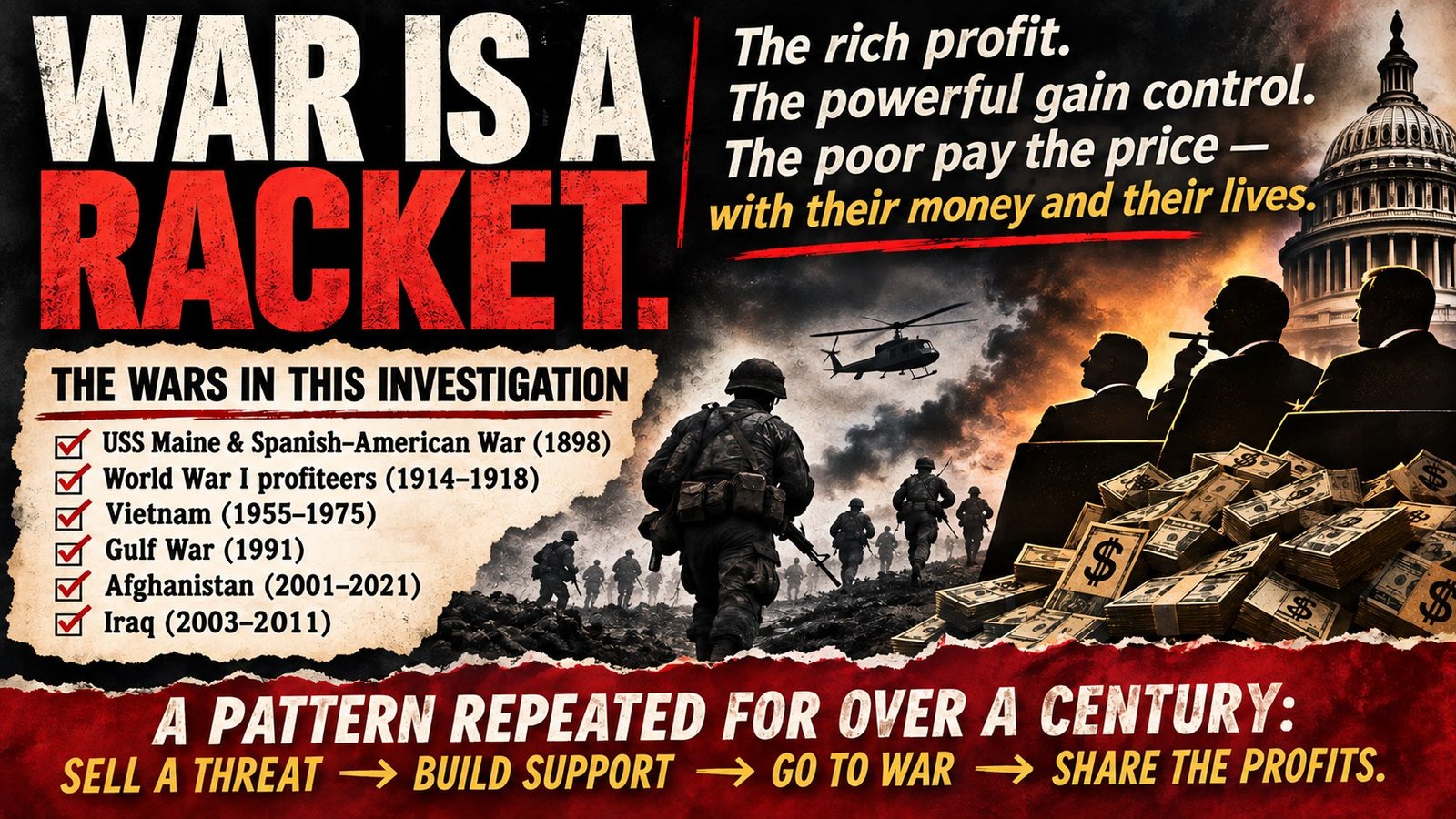
The Witness
The General Who Told the Truth
Smedley Darlington Butler spent more than three decades in the Marine Corps fighting America's wars. Then he spent the rest of his life telling Americans who those wars were really for.
VerifiedMedal of Honor · Veracruz, Mexico, 1914 · Medal of Honor · Fort Rivière, Haiti, 1915
Butler was one of only two Marines ever to receive two Medals of Honor for separate acts of heroism. [3] Nobody can call him a coward or a peacenik who never served.
VerifiedAfter retiring in October 1931, he toured the country giving a speech called "War Is a Racket." It drew such a response that he expanded it into a short book, published in 1935. [1]
"War is a racket. It always has been."Maj. Gen. Smedley D. Butler, War Is a Racket, 1935 [2]
He named the customers
VerifiedIn the November 1935 issue of the magazine Common Sense, Butler described his own career as muscle for Wall Street and the banks. [5] He listed the jobs one by one:
- Nicaragua, 1909–12, for the international banking house of Brown Brothers.
- Haiti and Cuba, made safe for the National City Bank to collect revenues.
- Honduras, 1903, made "right" for American fruit companies.
- The Dominican Republic, 1916, for American sugar interests.
- Mexico, 1914, especially Tampico, for American oil interests. [4]
"In short, I was a racketeer, a gangster for capitalism."Butler, Common Sense, Vol. 4, No. 11, November 1935 [5]
AttributedThe places he occupied remember him differently. Journalist Jonathan M. Katz, who retraced Butler's path, reports that in Haiti he was known simply as "The Devil." [11]
He stopped a coup and nobody went to jail
VerifiedIn November 1934 Butler testified under oath before the House committee known as the McCormack–Dickstein Committee. He said wealthy businessmen had tried to recruit him to lead a fascist movement against President Franklin Roosevelt. The men he named all denied it. [6] Newspapers began mocking his account almost immediately. [8]
VerifiedThe committee's February 1935 report said it had obtained evidence that certain persons had attempted to establish a fascist organization in the country. [7] No one was ever prosecuted. [6]
His fix: take the profit out
VerifiedButler's book ends with a plan to "smash" the racket. The first step was to make war unprofitable. [1] He proposed conscripting capital and industry, and holding their pay to a soldier's wage, before a single young man was drafted. He wanted any declaration of war put to a vote of the people who would actually have to fight, and he wanted the military limited to defending American soil. [2]
Congress looked, then looked away
VerifiedButler was not alone. From 1934 to 1936 the Senate's Special Committee on Investigation of the Munitions Industry, led by Sen. Gerald Nye (R-N.D.), investigated the "merchants of death" who profited from World War I. It found the arms industry had engaged in price-fixing and held excessive influence over foreign policy before and during that war. [10]
VerifiedThe investigation ended abruptly. The Senate cut off its funding after Nye attacked the late President Woodrow Wilson for withholding information from Congress before it declared war. The hearings did produce three neutrality acts. [9]
Read Butler yourself
- War Is a Racket (Round Table Press, 1935). The full text is free on the Internet Archive. [2]
- "America's Armed Forces," Common Sense, November 1935, the "gangster for capitalism" article. [5]
- His 1934 McCormack–Dickstein testimony, reproduced in full by the Cato Institute's Libertarianism.org. [8]
- Gangsters of Capitalism by Jonathan M. Katz, which follows Butler from Cuba to the Philippines to Nicaragua to Haiti. [11]
- Old Gimlet Eye by Lowell Thomas (1933), his life story as told at the time. [1]
Butler's test
Butler's argument comes down to three questions you can ask of any war. Who told the public why we were going? Who made money? Who did the dying? The rest of this page asks those three questions of five wars. The pattern is hard to miss.
Count One · 1898
Remember the Maine
The pattern is older than any living American. The first modern American war began with an explosion, a headline, and a villain picked before anyone looked.
VerifiedThe battleship USS Maine blew up in Havana harbor in February 1898. American newspapers blamed Spain, and "Remember the Maine!" became the battle cry of the Spanish-American War. [12]
VerifiedSpain's own inquiry at the time concluded that a spontaneous fire in a coal bunker next to a magazine caused the blast. Two U.S. Navy boards disagreed. [12]
DisputedIn 1976, Adm. Hyman Rickover's study found no technical evidence that an outside explosion started the destruction. It concluded the most likely cause was heat from a coal-bunker fire next to a magazine, while noting this could not be proven. [13] A 1998 National Geographic study reopened the question and could not rule out a mine. [13]
Either way, the country went to war on a blame nobody had established. Smedley Butler was 16 when it started. He joined the Marines for it.
The Centerpiece · Vietnam, 1880s–1975
Who Ran the Show
Most Americans know the end of this story: the wall in Washington, the helicopters on the roof. The decisions that put 58,220 names on that wall were made decades earlier, in offices, by men who left a paper trail.
Count Two · The Colony
Rubber, Blood and Michelin
VerifiedFrance ruled Vietnam as part of French Indochina from the late 1800s. Rubber plantations in the south fed the booming French auto and tire industry. The largest Michelin plantation was Phu Rieng. [15]
VerifiedIn 1927, Tran Tu Binh was one of 17,606 laborers brought to work at Phu Rieng. His memoir, The Red Earth, is a firsthand account of what happened there. [14] Official colonial records showed 17 percent of Phu Rieng workers died in 1927 alone. That figure may be low, because the plantation's own supervisors had reason to hide losses. [15]
VerifiedOn February 3, 1930, more than 5,000 workers rose up, held the plantation for four days, and forced the French supervisor to agree to better conditions before the revolt was crushed. Binh was sent to the prison island of Con Dao. [15]
VerifiedThe plantation also gave birth to the opposition. The first Communist Party cell in southeastern Vietnam was founded at Phu Rieng in October 1929. [16] The colony built its own enemy.
Count Three · 1945–1950
The Ally They Dropped
The first Americans to fight in Vietnam fought on Ho Chi Minh's side.
VerifiedIn July 1945, the Office of Strategic Services, the forerunner of the CIA, sent an eight-man team under Maj. Allison K. Thomas into northern Indochina to work with Ho's Viet Minh against the Japanese. [18][17] The team's medic, Paul Hoagland, treated a seriously ill Ho. Thomas later said he had no idea at the time that Ho was a Communist. [19]
VerifiedOn September 2, 1945, Ho declared Vietnam's independence. He deliberately opened with words from the American Declaration of Independence. [20]
- VerifiedPresident Franklin Roosevelt puts his opposition to continued French rule of Vietnam in writing. [21]
- VerifiedHo sends letters and telegrams to President Truman asking for American support. Truman does not reply. [21] The U.S. adopts a neutral policy as France goes to war to retake Vietnam. [20]
- VerifiedTruman approves $10 million in military aid for the French war in Indochina, announced May 8. [22] An additional $5 million follows on June 27. [24]
- VerifiedU.S. aid reaches $1,063 million, covering 78 percent of the cost of France's war. [23]
By the end, American taxpayers were paying most of the bill for a European power to reconquer its colony. The man who had quoted Jefferson was getting his weapons from Moscow and Beijing.
Count Four · 1954–1956
The Election That Never Came
VerifiedFrance lost at Dien Bien Phu in 1954. The Geneva Accords split Vietnam temporarily and called for national elections in 1956.
VerifiedPresident Eisenhower later wrote that, had elections been held during the fighting, "possibly 80 per cent of the population" would have voted for Ho over the French-backed chief of state, Bao Dai. [25][74]
VerifiedConvinced that Ho and his followers would win a free election, the Eisenhower administration installed Ngo Dinh Diem to lead South Vietnam and backed his refusal to hold the national vote. [26]
DisputedEisenhower's 80 percent figure described a vote against Bao Dai during the war, not against Diem in 1956. Historians still argue over how a 1956 vote would have gone. What is not disputed is that Washington backed blocking it.
For a country that sells itself to the world as democracy's defender, that is a hard sentence to read. The United States helped cancel an election because it expected to lose it.
Count Five · August 1964
The Attack That Never Happened
The legal basis for the Vietnam War was a resolution written months before the incident it was supposedly answering.
- VerifiedAdministration lawyers draft a congressional resolution authorizing force in Southeast Asia, months before any attack in the Gulf of Tonkin. [27]
- VerifiedSouth Vietnamese commando raids on the North Vietnamese coast, planned under a U.S. program called OPLAN 34A, are under way. The destroyer USS Maddox is patrolling nearby collecting signals intelligence. [33]
- VerifiedNorth Vietnamese torpedo boats attack the Maddox. This first clash was real. [27]
- VerifiedThe Maddox and USS Turner Joy report a second attack on a stormy night. The NSA's own historian later concluded the evidence did not support it. [31]
- VerifiedAfter 40 minutes of discussion, the House passes the resolution 416 to 0. The Senate passes it 88 to 2. [27]
What they told Congress
VerifiedAccording to the Pentagon's own Vietnam War 50th Anniversary history, Defense Secretary Robert McNamara lied to reporters on August 6 when he denied knowing the nature of the 34A raids. His own department ran them. Three days earlier he had told the President that some of the raids had led to the August 2 attack. [29]
VerifiedThe White House tapes show both Johnson and McNamara knew from the start that the Maddox mission was linked to the raids. [33][32]
"Hell, those damn, stupid sailors were just shooting at flying fish."President Lyndon Johnson, privately, after the resolution passed [28]
What the NSA found
VerifiedNSA historian Robert Hanyok reviewed 122 relevant signals-intelligence products. He found that the overwhelming portion of the evidence about August 4, nearly 90 percent, was kept out of the agency's post-attack summaries and its October 1964 final report. [30]
AttributedHanyok did not find a "smoking gun" proving a cover-up. He said the evidence suggested an active effort to make the intelligence fit the claim of an attack. [31] His study was written in 2001 and kept secret until its release in 2005.
VerifiedCongress repealed the Gulf of Tonkin Resolution in 1970. [33] By then the war had been running on it for six years.
Count Six · 1964–1968
What They Said When They Thought No One Was Listening
The President
VerifiedOn May 27, 1964, more than two months before Tonkin, Johnson spoke with his national security adviser, McGeorge Bundy, on a call recorded by the White House taping system. [35]
"I don't think that it's worth fighting for."President Lyndon Johnson on Vietnam, recorded May 27, 1964 [34]
In the same call he worried aloud about a sergeant on his staff with six children, and asked what in the world he would be sending such men there for. Then he sent more than half a million of them.
The Pentagon's real reasons
VerifiedIn a 1965 memo, Assistant Secretary of Defense John McNaughton weighted America's aims in Vietnam. [36]
Seventy percent of the reason was saving face. The reason given to the American public came last.
The secret history
VerifiedMcNamara ordered a secret internal history of the war, later known as the Pentagon Papers. Daniel Ellsberg leaked it in 1971. The government kept the complete study, about 7,000 pages, classified until June 2011. [37]
The candidate
AttributedIn October 1968, Johnson was trying to start peace talks. On October 22, Nixon aide H.R. Haldeman took notes on a call with candidate Richard Nixon. They record an order to keep Anna Chennault "working on" South Vietnam, and under the heading of the bombing halt, this question: [38][39]
"Any other way to monkey wrench it?"Haldeman's notes of a call with Richard Nixon, October 22, 1968 [38]
DisputedNixon denied interfering for the rest of his life. His foundation argues the note referred to political maneuvering against Johnson, not diplomatic sabotage, and that no deal was within reach. [40] See For the Record.
Count Seven · Follow the Money
Who Got Paid
VerifiedA four-company consortium known as RMK-BRJ built the bases, ports and airfields for the American war. Its final contract value was $1.865 billion, not counting government-supplied materials and shipping. [41] At the time it was the largest construction project in the world. [43]
VerifiedOne of the four partners was Texas-based Brown & Root, a major backer of Lyndon Johnson's political career. [43] Biographer Robert Caro wrote that "Brown & Root became an industrial colossus thanks to Lyndon Johnson." [42]
AttributedIn 1966 a young Republican congressman, Donald Rumsfeld, condemned the Johnson administration on the House floor over the consortium. He said it was beyond him why such a huge contract was not being properly audited. [44] Brown & Root later became part of Halliburton. Its descendant, KBR, would become the top contractor of the Iraq war that Rumsfeld ran as Defense Secretary (see Count Nine).
VerifiedBetween 1962 and 1971, the Air Force sprayed about 19 million gallons of herbicide over Vietnam. About 11 million gallons were Agent Orange, made by companies including Dow Chemical and Monsanto. [46] In 1984, seven chemical companies including Dow and Monsanto agreed to pay $180 million to settle claims by exposed American veterans. [45] No Vietnamese victim has ever been compensated by those companies. [47]
The men who made the decisions
Left Ho's letters unanswered and began funding France's war in 1950. [21][22]
Installed Diem and backed blocking the 1956 vote he believed Ho would win. [26]
Privately doubted the war was worth fighting, then used Tonkin to escalate it. [34][27]
Misled the press and Congress about the 34A raids behind Tonkin. [29]
Recorded asking how to "monkey wrench" Johnson's peace effort. [38]
The bill
Verified58,220 U.S. service members died. [48] The U.S. troop presence peaked at 536,100 in 1968. [43]
DisputedVietnamese deaths are contested. A 1995 demographic study put total Vietnamese war deaths at roughly 1 million. [49] Vietnam's government estimated more than 3 million, including 2 million civilians. [50]
Behind every one of the 58,220 names is a family that got a telegram. Many of them were somebody's older brother.
The Playbook Repeats
Different Wars, Same Script
Vietnam was supposed to be the lesson. In 1961, before the big escalation, a departing president who had commanded the largest invasion in history went on television and warned the country.
VerifiedOn January 17, 1961, in his farewell address, President Eisenhower warned against the "military-industrial complex." [68] The warning did not take.
Count Eight · 1990
The Girl Who Wasn't a Nurse
VerifiedOn October 10, 1990, a 15-year-old Kuwaiti girl identified only as "Nayirah" told the Congressional Human Rights Caucus that she had watched Iraqi soldiers take babies out of hospital incubators and leave them to die. [53]
VerifiedIn January 1992 it came out that she had never been a nurse. She was the daughter of Kuwait's ambassador to the United States. Her testimony was part of a public relations campaign that the Kuwaiti government-in-exile ran through a group called Citizens for a Free Kuwait, together with the American PR firm Hill & Knowlton. [51]
VerifiedPresident George H.W. Bush cited the incubator story as proof the war was necessary. Hill & Knowlton has denied wrongdoing. [52]
DisputedIraq really did invade Kuwait, and the war had other grounds. But the most emotional piece of the public case was staged. See For the Record.
Count Nine · 2002–2011
The Weapons That Weren't There
- VerifiedMinutes of a meeting in British Prime Minister Tony Blair's office record the head of British intelligence reporting back from Washington: "the intelligence and facts were being fixed around the policy." [54]
- VerifiedSecretary of State Colin Powell makes the case for war at the United Nations. On biological weapons, his main source is an informant code-named CURVEBALL. [57]
- The invasion begins.
- VerifiedThe chief U.S. weapons inspector, Charles Duelfer, reports that Saddam Hussein did not have weapons of mass destruction when the war began. [58]
- VerifiedA bipartisan majority of the Senate Intelligence Committee, 10 to 5, releases a report on whether officials' public statements about Iraq were backed by intelligence. [60] It finds the administration's claims that Iraq had a partnership with al-Qaeda were not supported. [59][61]
AttributedPowell later called the speech a "blot" on his record. In 2016 he said the President had already decided on military action by the time he spoke. [56]
Who got paid
VerifiedA Financial Times analysis found contractors received at least $138 billion for work tied to the Iraq war. At the top was KBR, formerly Kellogg Brown & Root, once run by Vice President Dick Cheney, with at least $39.5 billion. [62]
The bill
VerifiedAbout 4,500 U.S. service members died in Iraq. Iraq Body Count had recorded more than 114,000 civilian deaths by the end of 2011. [65]
VerifiedBrown University's Costs of War Project estimates the post-9/11 wars cost the U.S. more than $8 trillion through 2021, largely borrowed. It counts more than 900,000 people killed directly and an estimated 3.6 to 3.8 million indirect deaths in the war zones. [63][64]
Count Ten · 2001–2021
The Afghanistan Papers
VerifiedIn December 2019, the Washington Post published more than 2,000 pages of confidential government interviews about the war in Afghanistan. [67] The documents show high-ranking officials generally believed the war was unwinnable and kept that view hidden from the public. [66]
VerifiedThe Post reported that senior officials across three administrations made optimistic statements they knew were false and hid evidence the war had become unwinnable. [67]
Johnson's tapes, McNaughton's memo, and the Afghanistan Papers tell the same story fifty years apart. In private, they knew. In public, they said the opposite. Others did the dying.
Count Eleven · The Machinery
How They Sell It
No war on this page started because the public demanded it. Each one was sold. The sales method barely changes, and it works on people of every party.
Step 1: Hand the public one vivid story
A ship explodes. Torpedo boats attack in the dark. Babies are pulled from incubators. A vial of anthrax is held up at the United Nations. Each story was simple, emotional and presented as certain. Each one was wrong, staged or unproven (Counts One, Five, Eight and Nine).
Step 2: Control who explains it on TV
VerifiedIn 2008 the New York Times revealed that the Pentagon had recruited retired military officers who appeared on television as independent analysts of the Iraq war. The Pentagon gave them talking points and private briefings, and many had business ties to defense contractors. Viewers were not told. [78] Reporter David Barstow won a Pulitzer Prize for the investigation. [79]
Step 3: Repeat it until it feels true
VerifiedIn a September 2003 Washington Post poll, 69 percent of Americans said it was likely that Saddam Hussein was personally involved in the September 11 attacks. [80] There was no evidence for it. That same month, President Bush himself said there was no evidence Saddam was involved. [81] Nobody had to say the false thing outright. Saying "Saddam" and "9/11" in the same breath, again and again, was enough. [86]
Step 4: Make doubt look like disloyalty
Questioning the war becomes failing to "support the troops." That is how a resolution passes the House 416 to 0 after 40 minutes (Count Five). The only two senators who voted no on Tonkin, Wayne Morse and Ernest Gruening, turned out to be right. Both were out of the Senate after the 1968 election.
Step 5: Keep the people who decide far from the people who die
VerifiedGeorge Orwell fought in the Spanish Civil War and was shot through the throat. Afterward he wrote that the war propaganda and the hatred come invariably from people who are not fighting.
[76]
VerifiedOn March 18, 2003, the day before the Iraq invasion began, former First Lady Barbara Bush, mother of the President, was asked on Good Morning America about television coverage of the coming war. She said she would not watch it, and asked about the talk of body bags and deaths: [75]
"Why should I waste my beautiful mind on something like that?"Barbara Bush, ABC's Good Morning America, March 18, 2003 [75]
Nearly 4,500 Americans did not get to look away from it (Count Nine).
Step 6: Put it on the credit card
VerifiedThe post-9/11 wars were paid for largely by borrowing. Brown University's Costs of War Project calls them "credit card wars." [63] No war tax was raised, so most families never felt the bill. They pay it anyway, twice: once in the taxes that cover the spending, and again in the interest on the debt, for decades.
Step 7: Never let it end
AttributedIn 1984, Orwell imagined a state at permanent war, where the real target is the population at home. In the novel, the object of the war is not to make or prevent conquests of territory
but to keep the structure of society intact. [77] It is a novel, not a report. But a 20-year war in Afghanistan that officials privately called unwinnable (Count Ten) would not have surprised him.
Analysis · It works on everybody
It is tempting to say only the other side falls for this. The record says otherwise. Tonkin passed under a Democratic president with a unanimous House. The Iraq war was authorized with large majorities of both parties. The 69 percent who believed the Saddam–9/11 story came from across the spectrum.
The defense is the same for everyone. When the next war is being sold, ask Butler's three questions: Who is telling us why? Who makes money? Who does the dying? Then ask one more: what is the evidence, and who has seen it?
More on Crisis of Truth
- The Business Plot of 1933: the full case file on Butler's coup testimony.
- Selling War to Make More Money: the profiteering ledger from World War I to Iraq.
- The Propaganda Playbook: the techniques behind Count Eleven.
- Iran Nuclear Threat: Fact or Fear Campaign?: the same questions, asked of the current war.
The Evidence of a Pattern
The Racket, Step by Step
Analysis · Five wars, one script
- The pretext comes first. A ship explodes, an attack that never happened, a coached witness, weapons that weren't there. Each was presented as certain before anyone checked.
- Congress signs the blank check. 416 to 0 after 40 minutes in 1964. The power to declare war is handed over in a rush and taken back years later, if ever.
- The doubts stay private. Johnson told Bundy the war wasn't worth it. McNaughton weighted face-saving at 70 percent. Afghanistan's officials called it unwinnable in interviews they assumed would stay secret.
- The contractors get paid either way. Brown & Root in 1966, KBR in 2003. The same corporate family, the same no-questions money.
- The truth arrives after the funerals. The Rickover study, 78 years after the Maine. Hanyok's study, 41 years after Tonkin. The full Pentagon Papers, 47 years after the Tonkin vote.
This does not require a conspiracy. It requires only what Butler described: a system where the people who profit from war have more say over it than the people who fight it. Nothing on this page needed a secret meeting. Most of it happened in the open, on the record, with a vote.
Commentary · The Publisher's Verdict
Who Answers for It?
This section is opinion, and it is labeled that way. Crisis of Truth puts every case through three questions.
1 · Is it legal?
Mostly, and that is the problem. Congress voted for the Tonkin Resolution. Congress voted for the Iraq war. The contracts were awarded under the law. The PR campaign was legal. The clearest exception is McNamara's false statement about the 34A raids, and no one was ever charged for it. If Haldeman's notes mean what Nixon's critics say, a private citizen interfered with the government's peace effort in wartime. No one was charged for that either.
2 · Is it constitutional?
It strains the Constitution past recognition. Article I gives Congress the power to declare war. Congress has not formally declared a war since 1942. Instead it signs open-ended authorizations, often on information the executive branch knows to be shaky. A power that can be handed away on 40 minutes of debate, based on an attack that didn't happen, is not functioning the way the framers designed it. The Constitution assumes Congress gets the truth before it votes. On Tonkin, it did not.
3 · Is it morally and ethically acceptable?
No. A president said on tape that the war wasn't worth fighting, then sent more than half a million men to fight it. A defense official ranked saving face above the lives of the people the war was supposedly for. A secretary of defense misled Congress about the raids that set off the incident. A candidate, by the notes of his own aide, looked for ways to wreck a peace effort while men were dying. Thirty-nine years later, a war was sold on weapons that didn't exist, and the company with the deepest political ties collected the most money.
Smedley Butler earned two Medals of Honor and then spent his last years warning Americans that their sons were being spent for someone else's profit. The record since 1935 has not proved him wrong once.
The people who made these decisions mostly died rich and honored. The people who paid for them are on a black granite wall in Washington, in cemeteries across Vietnam and Iraq, and in VA hospitals today. Remembering that is the least we owe them. Asking Butler's three questions before the next war is the most.
Disagree? The strongest case against this verdict is in For the Record, and you should read it.
These claims circulate widely, several of them in the video at the top of this page. We could not confirm them against a primary source, or we found that the record says something different. We list them so readers can see what we left out and why.
For the Record
The Strongest Case Against This Page
Crisis of Truth publishes the best counterarguments on every case file. A critique that cannot survive these is not worth reading.
Sources
The Record
- Wikipedia, "War Is a Racket" (speech tour, 1935 publication, Butler's three steps). wikipedia.org
- Smedley D. Butler, War Is a Racket (1935), full text, Internet Archive. archive.org
- U.S. Marine Corps History Division, "Maj Smedley Darlington Butler," Medal of Honor recipients. usmcu.edu
- Wikipedia, "Common Sense (American magazine)" (Butler's 1935 statement). wikipedia.org · Philosophical Society, Butler excerpt. philosophicalsociety.com
- Smedley D. Butler, "America's Armed Forces," Common Sense, Vol. 4, No. 11 (Nov. 1935), via Montclair State University. montclair.edu
- Wikipedia, "Business Plot." wikipedia.org
- Saturday Evening Post, "Considering History: The 1933 Business Plot to Overthrow America" (2023); New England Historical Society, committee report. saturdayeveningpost.com · newenglandhistoricalsociety.com
- Libertarianism.org (Cato Institute), "Smedley Butler & the 'Business Plot,' Part I" (includes testimony). libertarianism.org
- U.S. Senate, "Merchants of Death" (Nye Committee). senate.gov
- Wikipedia, "Nye Committee." wikipedia.org
- History News Network, review of Jonathan M. Katz, Gangsters of Capitalism. historynewsnetwork.org
- Naval History and Heritage Command, H-Gram 015-3, "Remember the Maine! To Hell with Spain!" history.navy.mil
- U.S. Naval Institute, Naval History, "What Really Sank the Maine?" (April 1998). usni.org
- Tran Tu Binh, The Red Earth: A Vietnamese Memoir of Life on a Colonial Rubber Plantation (Ohio University). mitpressbookstore.mit.edu
- Wikipedia (2007 archive), "Phu Rieng Do" (citing Tran Tu Binh and colonial records). classicistranieri.com
- Binh Phuoc Province Tourism, Phu Rieng Party cell national historical relic. binhphuoc.gov.vn
- National WWII Museum, "The OSS in Vietnam, 1945: A War of Missed Opportunities." nationalww2museum.org
- Military.com, "America's Secret WWII OSS Mission in Vietnam to Arm Ho Chi Minh Against Japan" (Oct. 2025). military.com
- HistoryNet, "How American Operatives Saved the Man Who Started the Vietnam War." historynet.com
- National Archives, DocsTeach, Letter from Ho Chi Minh to President Truman, Jan. 18, 1946. docsteach.org
- National Archives, "Episode 1: Truman Sides With France." archives.gov
- Pentagon Papers, Part IV.A.2, "Aid for France in Indochina, 1950–1954," Summary. wikisource.org · Document index. wikisource.org
- Pentagon Papers, Part II, p. 43 (aid reached $1,063 million, 78% of French costs). wikisource.org
- Foreign Relations of the United States, 1950, Vol. VI, Doc. 533. history.state.gov
- Dwight D. Eisenhower, Mandate for Change, p. 372, via Montclair State University. montclair.edu
- Hewitt & Lawson, Exploring American Histories, "Early U.S. Intervention in Vietnam" (Macmillan). macmillanusa.com
- Council on Foreign Relations, "The 1964 Gulf of Tonkin Resolution." cfr.org
- Council on Foreign Relations, "Ten Worst Decisions: Gulf of Tonkin Resolution." cfr.org
- U.S. Department of Defense, Vietnam War 50th Anniversary Commemoration, "Aftermath of the Gulf of Tonkin Incident." vietnamwar50th.com
- Robert J. Hanyok, NSA, "Skunks, Bogies, Silent Hounds, and the Flying Fish: The Gulf of Tonkin Mystery," via Navy Department Library. history.navy.mil
- National Security Archive, "Tonkin Gulf Intelligence 'Skewed'" (Dec. 1, 2005). nsarchive.gwu.edu · History News Network. hnn.us
- National Security Archive, LBJ tapes on the Gulf of Tonkin. nsarchive.gwu.edu
- The American Legion Magazine, John Prados, "The Mysteries of Tonkin Gulf" (Feb. 2013). legion.org
- Bill Moyers Journal, "Listening to History," transcript of LBJ–Bundy call (2007). billmoyers.com
- Not Even Past (University of Texas), on the May 27, 1964 recording (Johnson Library Tape 64.28). notevenpast.org
- Famous Trials, Pentagon Papers excerpts (McNaughton weighting). famous-trials.com · Museo Reina Sofía, full 70/20/10 text. museoreinasofia.es
- NPR, "After 40 Years, Pentagon Papers Declassified In Full" (June 13, 2011). npr.org
- National Archives, DocsTeach, "H. R. Haldeman's Notes," Oct. 22, 1968. docsteach.org
- Smithsonian Magazine, "Notes Indicate Nixon Interfered With 1968 Peace Talks." smithsonianmag.com
- Richard Nixon Foundation, Jack Torry, "Did Nixon deliberately prolong Vietnam War?" nixonfoundation.org
- Wikipedia, "RMK-BRJ" (final contract value). wikipedia.org
- NPR via History News Network, Brown & Root and Lyndon Johnson (quoting Robert Caro). historynewsnetwork.org
- JSTOR Daily, "The Logistics That Powered the Vietnam War." daily.jstor.org
- CorpWatch, "US: Perpetual Wars Deliver Poor Returns for America" (Rumsfeld on RMK-BRJ). corpwatch.org
- History.com, "Vietnam veterans exposed to Agent Orange win $180 million settlement." history.com
- Arizona State University, Embryo Project, "In re Agent Orange Product Liability Litigation." asu.edu
- The Nation, Vietnamese Agent Orange claims dismissed. thenation.com
- National Archives, "Vietnam War U.S. Military Fatal Casualty Statistics." archives.gov
- Merli (2000), citing Hirschman et al. (1995), Vietnamese war mortality estimate, UC Berkeley. berkeley.edu · Wikipedia, "Vietnam War casualties." wikipedia.org
- Bill Moyers, excerpt from Nick Turse, Kill Anything That Moves (Vietnamese government estimate). billmoyers.com
- Wikipedia, "Nayirah testimony." wikipedia.org
- MERIP, "The News Industry" (1992). merip.org
- Democracy Now!, interview with John R. MacArthur (2018). democracynow.org
- Wikipedia, "Downing Street memo." wikipedia.org
- Slate, Fred Kaplan, on reading the Downing Street memo. slate.com
- Wikipedia, "Colin Powell's presentation to the United Nations Security Council." wikipedia.org
- National Security Archive, Electronic Briefing Book 234, CURVEBALL. nsarchive.gwu.edu
- CNN, "Report: No WMD stockpiles in Iraq" (Oct. 6, 2004). cnn.com
- U.S. Senate Select Committee on Intelligence, "Senate Intelligence Committee Unveils Final Phase II Reports on Prewar Iraq Intelligence" (June 5, 2008). intelligence.senate.gov
- U.S. Government Publishing Office, Senate Report 110-345. gpo.gov
- NBC News, "Senate report puts Iraq intel back in spotlight" (2008). nbcnews.com
- Iraq Business News, "Contractors Get $138bn from Iraq War" (Financial Times research, March 2013). iraq-businessnews.com
- Brown University, Costs of War Project, "Overview: The True Costs of the Post-9/11 Wars." brown.edu
- Brown University, "Costs of the 20-year war on terror: $8 trillion and 900,000 deaths" (Sept. 1, 2021). brown.edu
- Dawn (AFP), Iraq Body Count end-of-2011 tally. dawn.com
- Wikipedia, "Afghanistan Papers." wikipedia.org
- Voice of America, "Washington Post: Government Study Shows US Officials Misled Public on Afghan War" (Dec. 2019). voanews.com
- National Archives, "President Dwight D. Eisenhower's Farewell Address (1961)." archives.gov
- Cambridge University Press, chapter on Ho Chi Minh and the origins of Vietnamese communism. cambridge.org
- Wilson Center, Brett Reilly, "The Myth of the Wilsonian Moment." wilsoncenter.org
- Foreign Relations of the United States, 1964–68, Vol. XXVI, Doc. 284, Rusk to Johnson on Lee Kuan Yew. history.state.gov
- YouTube, "The True Origin of the Vietnam War: What Historians Get Wrong." youtube.com
- Inside Story, Graeme Dobell, "Domino days" (review of Fibiger on the "buying time" thesis). insidestory.org.au
- Texas Observer (1967), full Eisenhower quotation including "rather than chief of state Bao Dai." texasobserver.org
- Snopes, Barbara Bush "beautiful mind" quote (Good Morning America, March 18, 2003). snopes.com
- George Orwell, "Looking Back on the Spanish War" (1943), via libcom.org. libcom.org
- George Orwell, Nineteen Eighty-Four (1949), Part Two, Chapter 9; quotation collection. goodreads.com
- Wikipedia, "Pentagon military analyst program" (New York Times, April 2008). wikipedia.org
- Pulitzer Prizes, David Barstow of The New York Times. pulitzer.org
- Arab News (AP), "69% of Americans Believe Saddam Linked to 9/11: Poll" (Sept. 2003). arabnews.com
- CBS News, "Bush: No Saddam Links To 9/11" (Sept. 2003). cbsnews.com
- PolitiFact, "No, Werner Herzog didn't say that about America and Germany" (2019). politifact.com
- Snopes, "Did Werner Herzog Tweet America is 'Waking Up, As Germany Once Did'?" snopes.com
- The Guardian via History News Network, "How Bush's grandfather helped Hitler's rise to power" (2004). historynewsnetwork.org
- Mail & Guardian, "Bush and the Hitler connection" (Sept. 2004). mg.co.za
- Pew Research Center, "A Look Back at How Fear and False Beliefs Bolstered U.S. Public Support for War in Iraq." pewresearch.org
Found an error? It goes in the public corrections ledger.