
The Short Version
Read This If Nothing Else
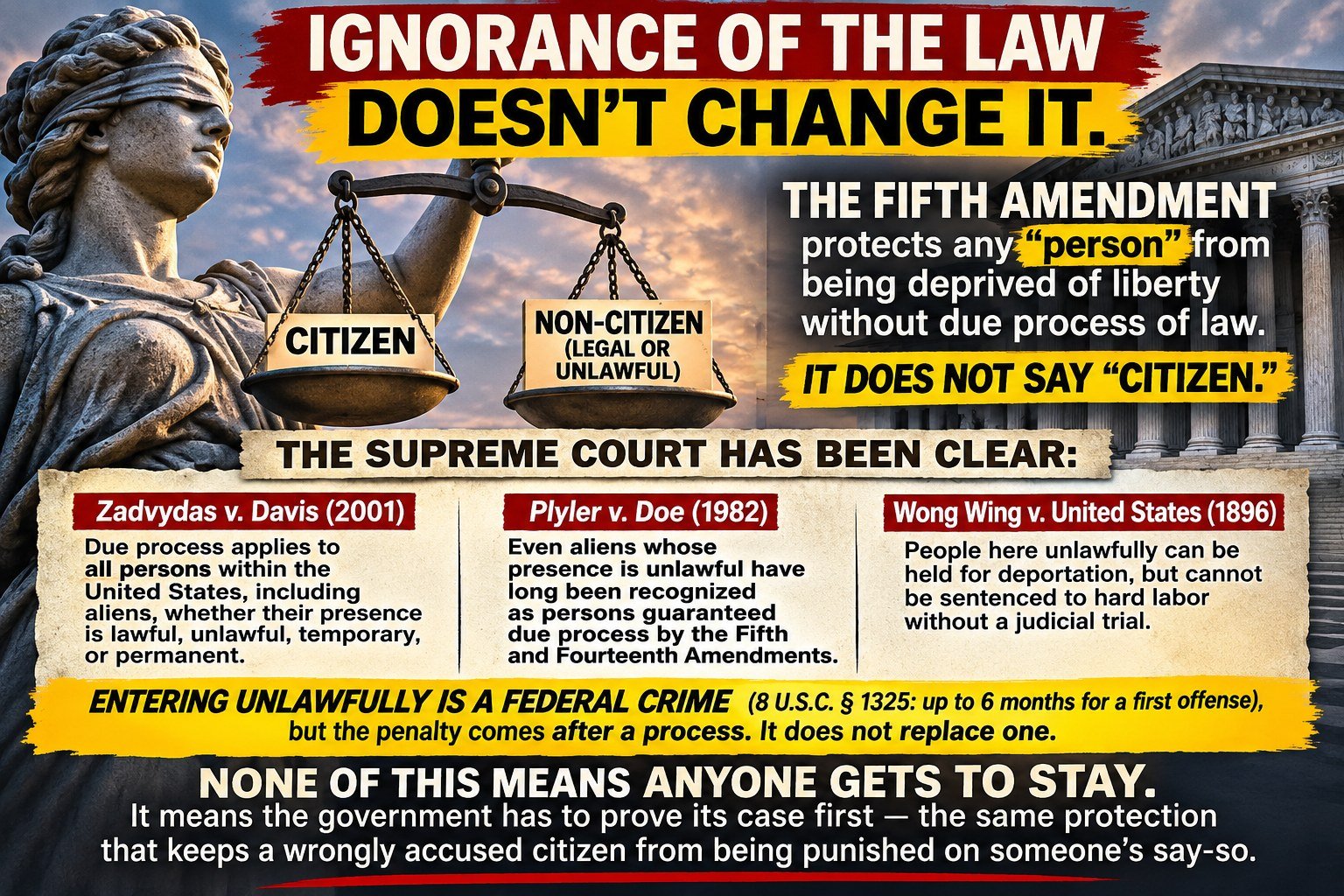
The Constitution protects "persons" from losing liberty without due process of law. The Supreme Court has held that this covers people in the United States whether their presence is lawful or not. It does not mean noncitizens have every right a citizen has, and it does not mean anyone gets to stay.
Three things this page does and does not say
- It says: due process applies to persons, and the Court has applied it to people here unlawfully.
- It does not say: noncitizens have the same rights as citizens. They do not. See The Limits.
- It does not say: anyone is entitled to remain. Due process decides how the government proves its case, not whether it can.
The Words
What the Text Says
VerifiedThe Fifth Amendment says no person shall "be deprived of life, liberty, or property, without due process of law." [1] The Fourteenth Amendment says no state shall "deprive any person of life, liberty, or property, without due process of law" or "deny to any person within its jurisdiction the equal protection of the laws." [2]
VerifiedThe drafters used the word "citizen" where they meant it. A Representative must have been "seven Years a Citizen of the United States" and a Senator "nine Years a Citizen." [3] The Fourteenth Amendment protects the "privileges or immunities of citizens" and, separately, the due process and equal protection of "any person." [2] The Fifteenth Amendment protects the right of citizens to vote. [4]
AnalysisSame document, two words, used on purpose. Voting, holding federal office and the privileges of citizenship go to citizens. Due process and equal protection go to persons. A reader who wants a different reading has to explain why the drafters wrote "person" in those clauses.
The Court
140 Years, In Order
Each entry gives the date, the holding in plain words, and a link to the opinion. Short quotations are exact. Everything else is paraphrase.
VerifiedSan Francisco enforced laundry rules against Chinese applicants while approving others. The Court held this violated the Fourteenth Amendment and said its provisions are "universal in their application, to all persons within the territorial jurisdiction." [5]
VerifiedThe Court held that people here unlawfully may be detained to enforce deportation, but may not be sentenced to hard labor without a judicial trial. It said "all persons within the territory of the United States are entitled to the protection" of the Fifth and Sixth Amendments. [6]
VerifiedThe Court wrote: "Even one whose presence in this country is unlawful, involuntary, or transitory is entitled to that constitutional protection." It also upheld Medicare eligibility rules that treat citizens and noncitizens differently. Both halves matter. [7]
VerifiedTexas argued that people in the country illegally are not "within its jurisdiction." The Court rejected that and held that illegal aliens are "persons" protected by the Due Process Clauses of the Fifth and Fourteenth Amendments and can claim equal protection. It struck down a Texas law that withheld funds for undocumented children and allowed schools to refuse to enroll them. [8]
VerifiedThe Court held that once an alien enters the country, "the Due Process Clause applies to all 'persons' within the United States, including aliens, whether their presence here is lawful, unlawful, temporary, or permanent." It also said Congress's immigration power is subject to "important constitutional limitations." [9]
VerifiedThe Court said that people held under the Alien Enemies Act are entitled to notice and an opportunity to be heard before removal, and that challenges must be filed in the district where they are held. The vote was 5-4. It was an emergency-docket ruling, and it went against the detainees on where to sue. [10][10b]
VerifiedThe Court blocked removals of a class of Venezuelan detainees under the Alien Enemies Act. It held that about 24 hours' notice, with no information on how to contest removal, was not constitutionally adequate. It did not decide whether the Act was lawfully invoked. Justice Kavanaugh concurred and Justice Alito dissented. [11]
The Objection
"They Broke the Law"
This is the most common reply, and the Court answered it in 1896. Breaking the law brings a penalty. It does not remove the process that decides whether the law was broken.
VerifiedEntering the country at the wrong time or place, or avoiding inspection, is a federal crime. The first offense carries a fine or up to 6 months in prison, or both. A later offense carries up to 2 years. [12] That is a penalty set by Congress, and it is imposed after a prosecution.
VerifiedIn Wong Wing, the government could hold the appellants for deportation but could not impose a prison sentence without a trial. [6]
AnalysisThe reply also runs in a circle. "They violated the law, so they get no process" assumes the violation has already been proven, and proving it is the process. The same step protects a citizen who is wrongly accused.
The Limits
What This Does Not Mean
Read before you share this page
- Noncitizens do not have the same rights as citizens. They cannot vote or hold federal office. In Mathews v. Diaz the Court said Congress may distinguish between citizens and aliens, and among aliens. [7]
- Nobody is entitled to stay because of due process. Removal after a fair process is lawful.
- The protection is weakest at the border. In DHS v. Thuraissigiam (June 25, 2020), a man stopped about 25 yards inside the border was held to have only the process Congress provides by statute. The Court said an alien detained shortly after unlawful entry cannot be said to have "effected an entry." [13] The Zadvydas rule above covers people who have entered, and the line between the two is contested.
- Removal proceedings are not criminal trials. The process the Court described is notice and an opportunity to be heard "appropriate to the nature of the case." [10]
When Citizens Get Caught
The Louisiana Cases, 2025
This section reports what named sources said. It does not assert a disputed fact as settled.
The two-year-old, V.M.L.
AttributedAccording to the court petition, V.M.L. was born in Baton Rouge on January 4, 2023, and was taken into ICE custody on April 22, 2025 with her mother and 11-year-old sister during a routine check-in. [15] She was flown to Honduras with her mother on April 25. [14]
AttributedU.S. District Judge Terry Doughty, a 2017 Trump appointee, ordered a hearing, writing that he had a "strong suspicion that the Government just deported a U.S. citizen with no meaningful process." [14] He also wrote: "It is illegal and unconstitutional to deport, detain for deportation, or recommend deportation of a U.S. citizen." [15]
AttributedThe government's position: DHS said the parent "made the decision to take the child with them to Honduras." [14] Border czar Tom Homan said "no U.S. citizen child" had been deported. [18] Government lawyers cited a handwritten Spanish note from the mother. The judge wrote: "But the Court doesn't know that." [14]
AttributedThe family's position: the mother's lawyer said ICE was mischaracterizing her wishes and that she was held in an undisclosed hotel. [14] The father had petitioned the court to keep the child in the U.S. [15]
AttributedOn May 10, 2025, the immigration groups involved asked a judge to dismiss the lawsuit, and DHS said the mother chose to bring her child. [16] This page found no court ruling deciding whether the removal was lawful.
The four-year-old and seven-year-old
AttributedLawyers said two other U.S.-citizen children, a 4-year-old boy receiving treatment for stage 4 cancer and his 7-year-old sister, were sent to Honduras with their mother on the same day. [17] A federal lawsuit alleges the family was deported "without even a semblance of due process." That is an allegation. This page has not verified the outcome of that suit. [17]
Why this is on a page about noncitizens
AnalysisThe question in these cases is whether anyone checked. A government that can skip the check for people it labels "illegal" can make a mistake about a citizen, and no one is required to catch it. The judge's words matter because he was appointed by the same president whose administration carried out the removal.
Commentary · The Publisher's Verdict
Three Questions
This section is opinion, and it is labeled that way. The question: is it acceptable to deny due process to people the government says are here unlawfully?
1 · Is it legal?
No, as a general rule. Under Zadvydas, due process applies to people inside the country, with the border exception described in The Limits.
2 · Is it constitutional?
The text and the Court's rulings point the same way. The Fifth and Fourteenth Amendments say "person," and the Court has applied them to people here unlawfully.
3 · Is it morally and ethically acceptable?
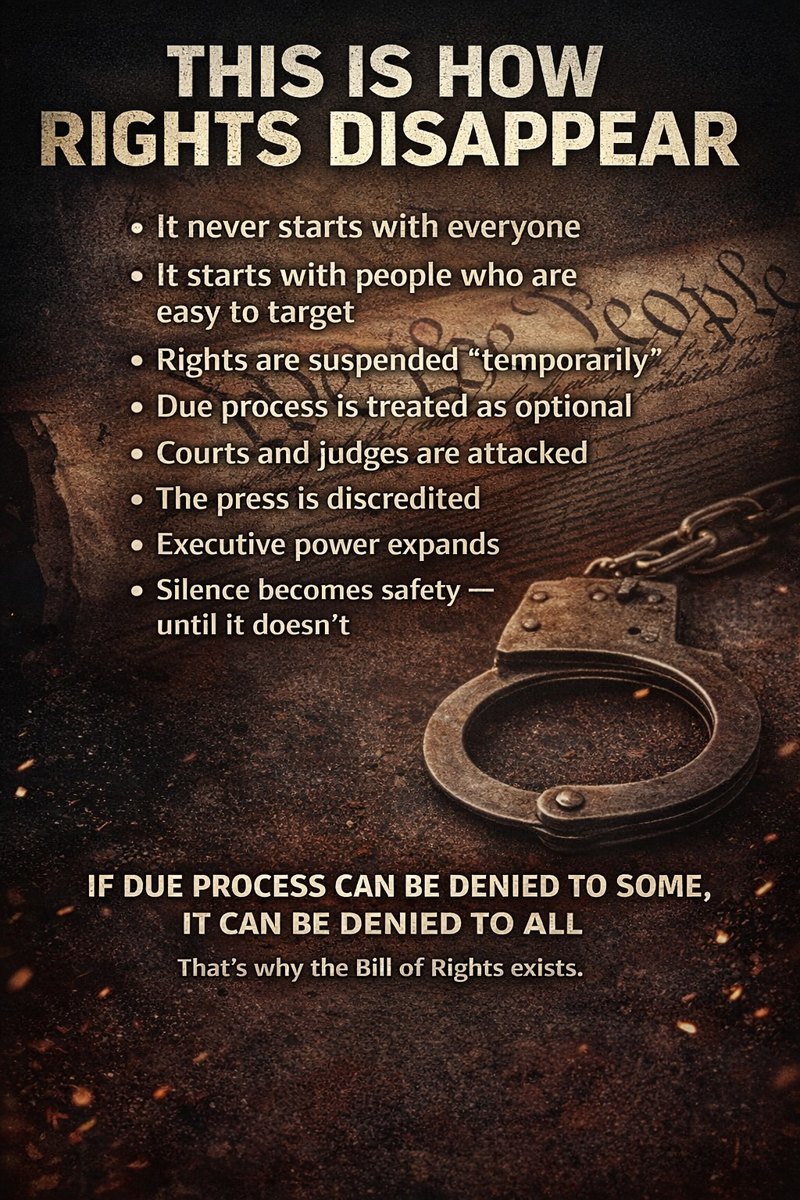
No. A fair process is how a society finds out who is guilty and who was wrongly accused. Skipping it for one group leaves nothing to stop it being skipped for the next. A person does not need to like anyone on the list to see that.
Claims we considered and left out, so readers can see what the page does not assert.
For the Record
The Strongest Case Against This Page
Crisis of Truth publishes the best counterarguments on every page.
Related
More on Crisis of Truth
- The ICE abuse page: interior checkpoints and the 100-mile border zone, a separate Fourth Amendment question.
- Referee, Not a Fan: why every claim here gets the same test no matter who made it.
Sources
The Record
- U.S. Constitution, Fifth Amendment. law.cornell.edu
- U.S. Constitution, Fourteenth Amendment, Section 1. law.cornell.edu
- U.S. Constitution, Article I, Sections 2 and 3 (qualifications). law.cornell.edu
- U.S. Constitution, Fifteenth Amendment. law.cornell.edu
- Yick Wo v. Hopkins, 118 U.S. 356 (1886). law.cornell.edu
- Wong Wing v. United States, 163 U.S. 228 (1896). justia.com
- Mathews v. Diaz, 426 U.S. 67 (1976). law.cornell.edu
- Plyler v. Doe, 457 U.S. 202 (1982). law.cornell.edu
- Zadvydas v. Davis, 533 U.S. 678 (2001). law.cornell.edu
- Trump v. J.G.G., 604 U.S. 670 (2025) (per curiam). justia.com
- SCOTUSblog, case page for Trump v. J.G.G. (5-4 vote). scotusblog.com
- A.A.R.P. v. Trump, No. 24A1007 (May 16, 2025) (per curiam), supremecourt.gov; Justia listing with concurrence and dissent. supremecourt.gov · justia.com
- 8 U.S.C. § 1325, Improper entry by alien (U.S. Code, 2024 Edition). govinfo.gov
- DHS v. Thuraissigiam, 591 U.S. 103 (2020). supremecourt.gov
- Ballotpedia, DHS v. Thuraissigiam (7-2 vote). Secondary source. ballotpedia.org
- NBC News, "2-year-old U.S. citizen apparently deported 'with no meaningful process,' judge says" (DHS statement and the mother's lawyer's response). nbcnews.com
- CNN, "Federal judge says 2-year-old US citizen was deported with mother to Honduras" (April 25, 2025; carried by KRDO). krdo.com
- The Washington Times, May 10, 2025, on the request to dismiss the lawsuit. washingtontimes.com
- NBC News, "ICE sent 3 U.S. citizen children, including boy with cancer, to Honduras with their deported moms." yahoo.com
- Law&Crime, "'No US citizen child was deported': Trump officials insist they're following the law." lawandcrime.com
Found an error? It goes in the public corrections ledger. Court rulings after November 2026 are not covered.