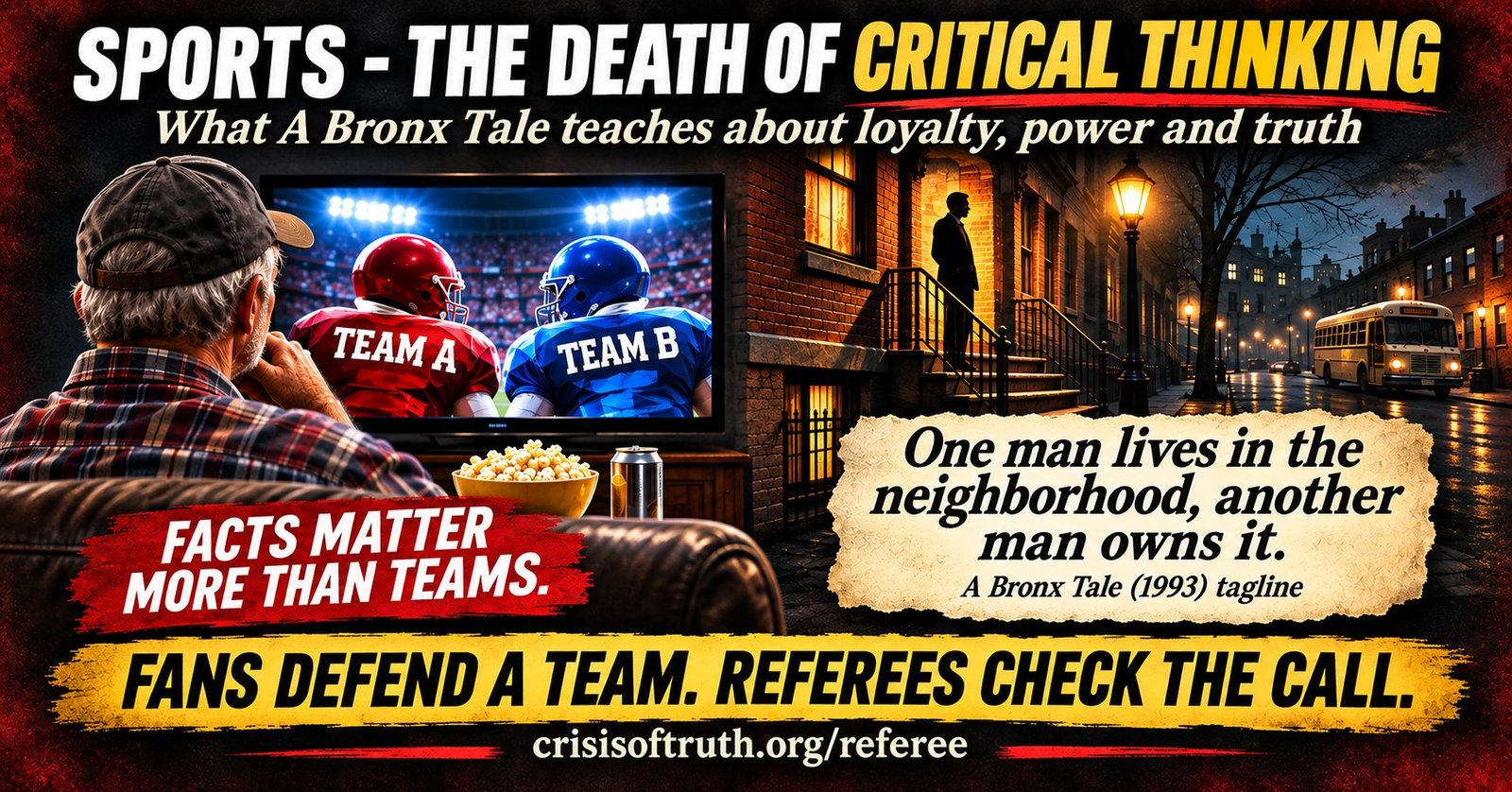
The Referee Rule
I Am Not a Fan
When I comment on a post, my only goal is to determine whether it is true or not. I am not a spectator or a sports fan cheering for a team. I approach it like a referee, focused on the facts and nothing else.
Too often politics is treated like a game. People defend their side no matter what, ignore evidence that challenges them, and attack the other team instead of examining the claim.
Which team made this claim? Then decides whether it is true.
Is this claim true? Whoever made it.
My approach
- Judge the claim, not the party.
- Determine whether it is true.
- Focus on the facts.
- Be the referee, not the fan.
- The swap test: would I accept this claim if the other team had made it?
The Film
A Bronx Tale
VerifiedA Bronx Tale (1993) was Robert De Niro's directorial debut, adapted from Chazz Palminteri's 1989 play of the same name. [2][3] Palminteri wrote the play drawing on his own childhood in the Bronx. [5]
VerifiedCalogero is a boy in the 1960s Bronx who grows up between two men. His father Lorenzo, a bus driver played by De Niro, wants him away from the mob. Sonny, the neighborhood's crime boss, played by Palminteri, takes an interest in him. [2][6]
One man lives in the neighborhood, another man owns it.
The film's promotional tagline, not a line of dialogue [4]
That is the whole argument of this page in one line. Power and loyalty are not the same thing as truth. The six lessons below are my reading of the film, not a claim about what the filmmakers intended.
Six lessons for people who argue online
Why Sports
The Scoreboard Problem
A game has a scoreboard. It tells you instantly who is winning, and cheering for your side is the whole point. Truth has no scoreboard. When people carry the scoreboard habit into politics, every claim gets scored as a point for one team or the other, and the question "is it true?" never gets asked.
The study of a football game
AttributedIn November 1951, after a rough football game between Dartmouth and Princeton, students from both schools watched film of the game and counted rule infractions. Princeton students counted more than twice as many infractions by Dartmouth as by their own team. [9][10][11] Same film, different counts. The 1954 report, by psychologists Albert Hastorf and Hadley Cantril, is titled "They Saw a Game." [9][10]
The same pattern in politics
VerifiedIn 2006, Charles Taber and Milton Lodge reported two experiments, on affirmative action and gun control. Arguments that matched participants' existing attitudes were judged stronger than arguments that conflicted with them. [12]
VerifiedA four-study paper published in 2003 found that participants' attitudes toward a social policy followed the position of their political party, outweighing both the policy's content and their own ideology. Participants denied that their party had influenced them, while believing that others, especially ideological opponents, were influenced that way. [13]
AnalysisThis is a claim about a habit of mind, not about sports. Nothing on this page says that watching or enjoying sports lowers anyone's ability to think. See For the Record.
Commentary · The Publisher's Verdict
Three Questions
This section is opinion, and it is labeled that way. The question: is treating politics like a team sport acceptable?
1 · Is it legal?
Yes, entirely. No one should be penalized for loyalty to a party, a candidate or a team. Nothing here argues otherwise.
2 · Is it constitutional?
Yes. Free speech and free association protect partisan loyalty, including loyalty that ignores evidence. The remedy for bad reasoning is better reasoning, not a law.
3 · Is it morally and ethically acceptable?
It fails a basic fairness test. Demanding proof from the other side's claims while waving through your own is a double standard. Nobody is forced to apply the swap test. But anyone who says they care about the truth has taken on the duty to.
Watch and Read
Go Deeper
- Sports - The Death of Critical Thinking, the video above.
- A Bronx Tale: You Never Know Who You're Messing With, the motorcycle bar scene.
- A Bronx Tale: twenty dollars and a lesson in friends.
- Chazz Palminteri "A Bronx Tale" Sit Down | Michael Franzese, an interview with the writer and star.
- 13 Lessons A Bronx Tale Can Teach You, one site's list of takeaways. Many are about dating. Read it as that author's opinion.
Claims we considered and left out, so readers can see what the page does not assert.
For the Record
The Strongest Case Against This Page
Crisis of Truth publishes the best counterarguments on every page.
Related
More on Crisis of Truth
- The Rage-Bait Economy: outrage as a business model, with named companies and documented payout rates.
- Willful Ignorance: The Documented Case: videos, transcripts and verified data on why people stop checking.
- A Bronx Tale: 13 Life Lessons: the earlier film page on this site.
Sources
The Record
- YouTube, "Sports - The Death of Critical Thinking." youtube.com
- Wikipedia, "A Bronx Tale" (1993 film; directed by Robert De Niro, his directorial debut; adapted from Chazz Palminteri's 1989 play). wikipedia.org
- American Film Institute Catalog, "A Bronx Tale" (Palminteri's 1989 stage version). afi.com
- Metacritic, "A Bronx Tale," film details (tagline). metacritic.com
- Rolling Stone, review of "A Bronx Tale" (the play drew on Palminteri's childhood). rollingstone.com
- Bands About Movies, "A Bronx Tale (1993)" (Lorenzo's "wasted talent" line). bandsaboutmovies.com
- The Movie Buff, review of "A Bronx Tale" (plot and Lorenzo's line); TV Tropes, "A Bronx Tale" (the "nobody cares" catchphrase). themoviebuff.net · tvtropes.org
- AllRites, "A Bronx Tale" synopsis (Calogero witnesses Sonny kill a man and refuses to talk to police). Single-source detail; confirm against the film. allrites.com
- Hastorf, A. H. & Cantril, H., "They saw a game: a case study," Journal of Abnormal and Social Psychology 49(1), 129-134 (1954); bibliographic record, DOI 10.1037/h0057880. scilit.com
- Psychology Today, "Selective Perception and Attention at the World Cup" (June 2014), describing the 1951 Dartmouth-Princeton study and the infraction counts. Secondary source. psychologytoday.com
- Human Journey, "They Saw a Game" (describes the study; Princeton students saw over twice as many Dartmouth infractions as Princeton infractions). Secondary source. humanjourney.us
- Charles S. Taber & Milton Lodge, "Motivated Skepticism in the Evaluation of Political Beliefs," American Journal of Political Science 50(3), 755-769 (2006); abstract. ideas.repec.org
- "Party over policy: The dominating impact of group influence on political beliefs," Journal of Personality and Social Psychology 85(5), 808-822 (2003); abstract. pubmed.ncbi.nlm.nih.gov
Found an error? It goes in the public corrections ledger.