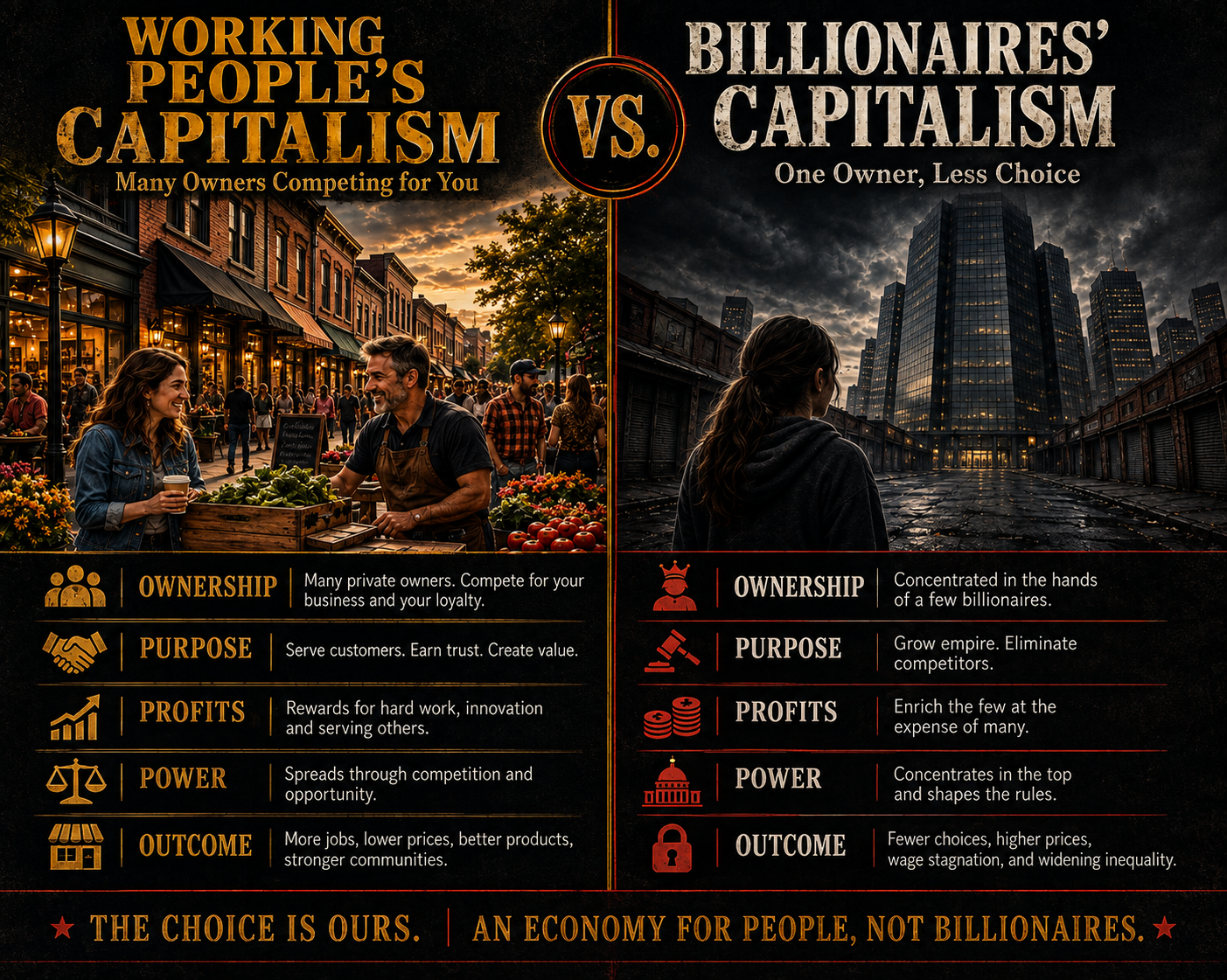
Two capitalisms, side by side. Neither one is socialism — see why, below.
Both are capitalism. Only one of them was designed to work for you. You've seen the movie: George Bailey's Building & Loan versus Mr. Potter's bank. What almost nobody knows is that America ran that exact experiment for real, starting in 1970 — on paper, on the record, in public. Here's who picked Potter's version, and how they made it legal.
The moral of It's a Wonderful Life is that communities are strongest when people help each other — instead of allowing wealth and power to become concentrated in the hands of a few.
Mr. Potter represents a type of power that profits from fear, desperation, and dependency. He doesn't create opportunity — he acquires control. When people panic, he sees a chance to buy what others are forced to sell. His goal was never to build a better town. It was to own more of it.
— the moral of the story, in plain terms
Quick refresher, because the whole rest of this page hangs on it.
He lends to people the big bank calls too risky, because he sees a factory worker's family as worth investing in, not just a credit score. When the town panics, he spends his own honeymoon money keeping neighbors from losing everything. He doesn't get rich. The town survives.
He isn't a criminal. He never once breaks the law. He just waits for the moment people are desperate enough to sell cheap, and buys. A panic isn't a tragedy to Potter — it's a clearance sale. His goal was never a better town. It was a bigger share of this one.
Frank Capra put Mr. Potter on screen in 1946. What almost nobody realizes is that twenty-four years later, an economist gave Potter's exact worldview a name, a theory, and a New York Times headline — and a network of the country's most powerful CEOs voted to adopt it as official policy. This isn't a metaphor anymore. It's a documented paper trail.
The film fell into the public domain decades ago, which is part of why it's so widely available — no studio has ever had to gatekeep it for you to see it for free.
Not a feeling. A measurement — the same one you'd use to check a real ledger.
Economist Milton Friedman argued a company's only real job is making as much money as it can, legally and honestly. He was more careful than the popular version of this argument gets credit for — he named two constraints, not one:
"...so long as it stays within the rules of the game." — Friedman, 1970. In full: open competition, without deception or fraud, and conforming to both law and ethical custom.
Two constraints were written down: the law, and ethical custom. Here's what actually happened to them over the next fifty years — one is enforced by a judge. The other depends entirely on whether anyone in the room still feels shame. Boardrooms kept the one a court could punish. The other became optional the first time it cost a quarter's earnings.
A year after Friedman's essay, corporate attorney Lewis Powell — weeks from a Supreme Court nomination — sent a confidential memo to the Chamber of Commerce. His argument: business was under attack from regulators, consumer advocates, and universities, and needed to fight back — not with a single lawsuit, but by funding a long-term presence inside the institutions that decide what regular people believe is simply "common sense": universities, publishing, television, the courts.
"The American economic system is under broad attack." — Powell Memo, opening line
The memo leaked in 1972 and is widely credited with helping seed the modern network of business-aligned think tanks and legal foundations that still shape economic policy debate today.
The Business Roundtable — the association of America's largest-company CEOs — declares a corporation's "paramount duty" is to its stockholders. Every other stakeholder's interest is officially "derivative" of that duty. It holds this position for 22 years.
181 CEOs sign a new statement pledging to lead "for the benefit of all stakeholders" — customers, employees, suppliers, communities, shareholders. On paper, Bailey wins.
Harvard Business School's own five-year review found the 2019 pledge helped stakeholder thinking gain acceptance — but fell far short of replacing shareholder primacy as how these companies are actually run. The statement changed. The bonus formulas, buyback programs, and quarterly targets underneath mostly didn't.
This exact sequence isn't unique to one company or one drug price. It's a template — and once you can see it here, you'll start noticing it applied to other industries, other decades, other Bedford Falls.
Turn a moral question into a technical one. "Should a company gouge people?" becomes "should a firm be efficient?" — an easy question that isn't the same question.
Invoke a name people already respect — Adam Smith, a founding document — while quietly swapping in a narrower version of what they actually argued.
Fund the think tank, the journal, the campus program, the media segment, before the public debate even starts.
Commit publicly to two constraints — one enforceable, one that depends on shame. Let the second one lapse quietly.
When criticism builds, issue a statement that sounds like change. Let the statement do the work the incentive structure never has to do.
When caught, don't defend the act — change the subject to jurisdiction. "We broke no laws" answers a question nobody asked, and ends the conversation anyway.
Call anyone questioning concentrated power "socialist" or "communist," so people flinch away from the question before they ever check whether it's actually about the government owning anything at all.
A story only holds up if it survives someone arguing the other half. Here's the honest version.
Even George Bailey needed the bank to survive — Building & Loans aren't charities, they lend at interest and have to stay solvent. The real dividing line in the movie was never "profit vs. no profit." It was whether people were the reason the bank existed, or the raw material it consumed to grow. The ledger above suggests which version won — reasonable people can still disagree about how much of that was a plan versus a drift nobody fully intended.
Who funded the reframing? Trace the study or campaign back to who paid for it — not to dismiss it automatically, but to know what you're reading.
What trusted name is being borrowed? When an idea leans on a founder, a scripture, a scientist — go check what that person actually said.
Which constraint is enforceable, and which is just a promise? Notice when only the one a judge can punish survives a bad quarter.
What did the receipts show five years later? A statement is not a result. Check the follow-up data before crediting the press release.
None of this is hidden, exactly — the memo, the essay, the votes are all public record, cited above with links. But none of it is taught in a civics class either, and it doesn't fit in a headline. It's not a secret. It's just work to find, unless someone hands you the paper trail. That's the only thing this page is trying to do.
If this argument feels new, it isn't — American storytellers have been making this exact case for eighty years. Here's the same thesis, four different decades.
Banks foreclose on Dust Bowl tenant farmers and send tractors to level their houses — not out of malice, but because no single person can be blamed once profit is the only rule left standing. John Ford's film, based on Steinbeck's novel, remains one of the starkest portraits of what happens when "just business" replaces every other obligation.
Covered in full above — George Bailey's Building & Loan versus Mr. Potter's bank. The clearest, most direct version of this page's entire argument, in one film.
Gordon Gekko's "greed, for lack of a better word, is good" speech to Teldar Paper's shareholders is the Friedman doctrine performed as theater — profit as the only virtue, everything else negotiable. Oliver Stone wrote Gekko as a warning. A generation of real traders memorized the speech as a mission statement anyway.
Two Texas brothers rob the branches of the exact bank foreclosing on their family ranch — a modern, unglamorous echo of the Joads. The film's quiet thesis: the bank isn't a villain twirling a mustache, it's "faceless greed" doing exactly what it's built to do, legally, to whoever's left holding the debt.
Movies got the concentrated-power part across. Two more things almost nobody's handed before they need them: the math that runs every bank account you'll ever have, and the habit of mind that catches all of this in the first place.
Divide 72 by an interest rate, and you get roughly how many years it takes money to double at that rate — money you're growing, or money you owe. It's taught in some finance electives, almost never in required K–12 math.
It also explains why extra principal payments early in a loan matter so much — less interest has compounded yet, so each dollar you pay down early does more work than the same dollar paid down later. Exactly how much you save depends on your rate and balance, so run your own numbers before assuming a specific outcome — but the direction is always the same: earlier is worth more than later.
Not "think for yourself" as a slogan — a specific, learnable set of habits: check the source, look for what's missing, notice when a conclusion arrived before the evidence did. It's the actual tool every section on this page is asking you to use.
Free, credible places to actually build the habit — not just read about it:
Before any of this was a webpage, George Carlin said it from a stage — that an unequal system runs better on an under-informed population, and that keeping people distracted beats keeping them convinced.
"They don't want a population of citizens capable of critical thinking."
It's a comedy routine, not a citation — treat it as the thesis stated plainly, not as evidence in itself. The evidence is everything above it on this page.