Start Here · Why This Is About You
Your Family's Ledger
Most people think private equity is something that happens to other people's companies. Look at this list and count how many touch your house.
The nation's largest single-family landlord, built by Blackstone, paid $48 million to settle federal charges of hidden fees and withheld deposits. [40]
Private equity owned 816 physician practices in 2012 and 5,779 by 2021. Prices rose after the purchases. [34]
A bipartisan Senate investigation, led by a Republican and a Democrat, found investors paid while care suffered. [23]
Short-term Medicare patients were about 10 percent more likely to die after a private equity buyout. [4]
Why the word "killer"
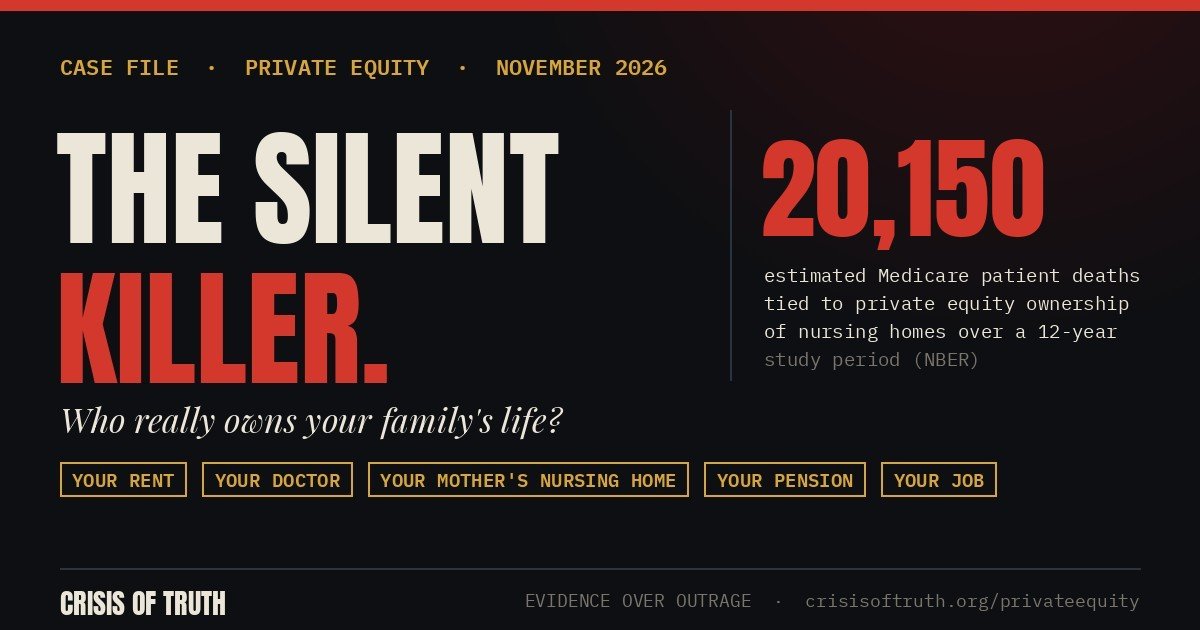
That is a strong word, and it is the publisher's, not a scientist's. We use it because of one finding: researchers at the University of Chicago, NYU and the University of Pennsylvania estimated that private equity ownership of nursing homes cost about 20,150 Medicare patients their lives over their study period. [4] "Silent" because almost none of those families knew who owned the building. The rest of this page lets you judge whether the word fits. The strongest case that it does not is in For the Record.
Part One · How the Machine Works
Other People's Money
The video gets the basic machinery right. Here it is, checked against the record.
Count One · The Players
Who Puts Up the Money
AttributedPrivate equity firms managed about $8.6 trillion worldwide at the end of 2024, according to the data firm Preqin. [2] Another tracker, Ocorian, put private equity fund assets near $9.9 trillion in 2025. [3] The video's "over $8 trillion" is in the right range.
VerifiedNearly all private equity funds are limited partnerships. The private equity firm acts as the general partner and makes the decisions. Large institutions and wealthy individuals, the limited partners, put up the bulk of the money. [11] Those institutions are mostly pension funds and endowments: the retirement savings of teachers, police officers, nurses and state workers.
VerifiedThe firm charges an annual management fee, typically around 2 percent, and takes carried interest, a share of the profits that is typically 20 percent. [10]
Analysis · Follow the risk
Notice who is on which side. Your pension supplies the money. The firm makes the decisions and collects the fees. The company it buys carries the debt. When it works, the firm takes 20 percent of the profit. When it fails, the losses land on the pension, the lenders, the workers and the town. That is the machine in one paragraph.
Count Two · The Fees
Paid Win or Lose
VerifiedYale and Wharton economists Andrew Metrick and Ayako Yasuda studied 238 funds and found that roughly 60 percent to two-thirds of the revenue fund managers could expect came from fixed fees that do not depend on performance, not from the profit share. [10][11] In plain terms: the firm gets paid whether your pension makes money or not.
VerifiedFirms also bill the companies they buy. In 2015 Blackstone paid nearly $39 million to settle SEC charges that it failed to tell its fund investors it was "accelerating" monitoring fees, collecting years of future advisory fees in lump sums when companies were sold or went public. [12] The SEC said those payments reduced the companies' value before sale, and in some cases covered periods after Blackstone no longer owned them. [12][13] Blackstone neither admitted nor denied the findings and called it a common industry practice. [13]
VerifiedThat same year KKR paid $30 million to settle SEC charges that it improperly allocated more than $17 million in "broken deal" expenses. [14]
AttributedPension funds pushed back. Their trade group, ILPA, says every dollar of these company fees should be credited against the management fee. [15] Industry studies now describe a full credit on transaction fees as the norm for institutional buyout funds. [16] But the credit goes to the investors. The company still pays the bill.
Count Three · The Debt
The Company Pays for Its Own Purchase
This is the heart of it. The firm borrows most of the price, and the loan is placed on the company it just bought.
VerifiedThe video's example: a company with $20 million a year in operating profit is bought for $100 million, $30 million in cash and $70 million borrowed. Five years later it sells for $180 million. After the remaining $30 million of debt is repaid, $150 million comes back. [1] We checked that arithmetic, and it is right. The percentage the video puts on it is not; see Corrections.
The deal, run correctly
| Cash put in (from investors, mostly pensions) | $30.0M |
| Cash back at sale, after paying off the debt | $150.0M |
| Profit | $120.0M |
| Investors' 8% yearly hurdle, compounded for 5 years | $14.1M |
| Profit left above the hurdle | $105.9M |
| Firm's 20% of that, if there is no "catch-up" | $21.2M |
| Firm's 20% of all profit, under the usual "catch-up" clause | $24.0M |
Our arithmetic, using the video's own numbers. Most funds pair the hurdle with a catch-up that lets the firm receive its full 20 percent once investors clear the hurdle. [10] The video says $16 million. It is $21 million to $24 million.
When the debt wins
VerifiedEconomists Brian Ayash and Mahdi Rastad tracked 484 large buyouts of public companies from 1980 to 2006. About 20 percent went bankrupt within ten years, compared with 2 percent of similar companies that stayed public. They conclude the buyouts raised the risk of bankruptcy roughly tenfold. Retail was hit hardest. [6]
VerifiedIn 2005 KKR, Bain Capital and the real estate firm Vornado bought Toys "R" Us for $6.6 billion, putting up about 20 percent and borrowing the rest. [17] When it filed for bankruptcy in 2017, it was carrying about $5 billion in debt and spending about $400 million a year just to service it. [18] In 2018 it liquidated, and roughly 33,000 workers lost their jobs. [17]
AttributedThe Private Equity Stakeholder Project, an advocacy group, totaled $464 million in fees and interest the three owners collected from Toys "R" Us over the years, including $185 million in "advisory" fees. [18] Marketplace reported that the funds' investors did not make money on the deal, but that Bain and KKR each took home at least $15 million in fees. [17]
The dividend recap
VerifiedIn a dividend recapitalization, the company the firm owns takes on new debt and uses it to pay a dividend to its owners. [21] The video calls it the most controversial move in the playbook. The Senate record shows why.
VerifiedA bipartisan Senate Budget Committee investigation found that hospital operator Prospect Medical Holdings paid out $645 million in dividends and preferred stock redemptions while it was majority-owned by private equity firm Leonard Green, and $424 million of that went to Leonard Green. To pay those distributions, Prospect took on hundreds of millions of dollars in debt, ran out of cash and defaulted on its loans. [23]
Count Four · The Taxes
A Lower Rate Than Your Paycheck
VerifiedThe firm's 20 percent profit share, carried interest, is taxed at long-term capital gains rates, not as wages, as long as the investment was held more than three years. That three-year rule was added by the 2017 tax law. [27] The top federal capital gains rate is 20 percent. The top rate on wages is 37 percent. The video's comparison is right.
VerifiedRaising taxes on carried interest was one of President Trump's stated priorities in 2025. [29] The One Big Beautiful Bill Act, signed July 4, 2025, did not change it. [28]
A teacher pays the higher rate on her salary. The fund manager investing her pension pays the lower one on his share of the profits. For more on how this works, see Why the Rich Don't Pay Taxes.
Part Two · What It Costs Your Family
Who Pays the Bill
The video ends by asking whether private equity is "pure business genius or corporate greed." It never shows who is on the other side of the deal. These are the people.
Count Five · The Case Study
Steward: The Whole Playbook in One Hospital Chain
- AttributedPrivate equity firm Cerberus Capital Management buys six Massachusetts hospitals from the Catholic nonprofit Caritas Christi in a leveraged buyout and renames the system Steward Health Care. [24]
- AttributedSteward sells the land and buildings under its Massachusetts hospitals to landlord Medical Properties Trust in a $1.2 billion deal. The hospitals now pay rent on buildings they used to own. Cerberus uses the proceeds to fund a $484 million dividend to one of its funds. [24]
- AttributedCerberus exits, reportedly having made about $800 million over its decade of ownership. [24]
- VerifiedSteward files for bankruptcy, beginning the largest health care provider restructuring in decades and a scramble to sell its 31 hospitals. [26]
- VerifiedThe Senate health committee subpoenas Steward's CEO, Ralph de la Torre, its first subpoena since 1981. [59] He defies it, and the Senate holds him in contempt. [26]
- VerifiedOne year in, five Steward hospitals have closed for good and about 2,400 workers have been laid off. A Senate report estimates Cerberus and de la Torre took about $1.3 billion out of Steward. [26]
VerifiedSen. Ed Markey's report counts eight Steward hospital closures across four states from 2014 to 2024: at least 1,533 beds and 4,431 jobs. [25]
Debt on the company. The building sold out from under it. A dividend paid to the owner. The owner gone before the collapse. Every tool the video describes as clever is in this timeline. So is the cost.
Count Six · Your Rent
The Landlord You've Never Met
VerifiedAfter the 2008 foreclosure crisis, Blackstone built Invitation Homes into the largest single-family landlord in the country. [42] Blackstone began selling its stake in 2019 [62]; Invitation Homes is now a publicly traded company. [61]
VerifiedIn September 2024 Invitation Homes agreed to pay $48 million to settle Federal Trade Commission charges. The FTC alleged it advertised rents that left out mandatory fees totaling more than $1,700 a year, and systematically kept tenants' security deposits by charging them for normal wear and tear, pre-existing damage and even renovations. [40] The company admitted no wrongdoing. [61]
AttributedAccording to the FTC complaint, the company's CEO told a senior vice president overseeing fees to juice this hog.
[41]
VerifiedNationally, institutional investors own a small share of single-family homes. But the Government Accountability Office found large investors controlled more than 15 percent of the single-family market in Atlanta, Charlotte and Jacksonville, Florida, as of 2022. [43]
Washington finally moved
- VerifiedPresident Trump signs an executive order aimed at stopping large institutional investors from buying single-family homes, and asks Congress to write it into law. [44][45]
- VerifiedThe Senate passes the 21st Century ROAD to Housing Act 85 to 5. The House passes it 358 to 32. [63][65]
- VerifiedThe act becomes law without the President's signature. He declined to sign it because the Senate had not passed his SAVE America Act, but did not veto it. It bars "large institutional investors," those controlling 350 or more single-family homes, from buying more, with exceptions. [63][64]
- AttributedThe ban is scheduled to take effect, with civil penalties of up to $1 million per violation or three times the purchase price. [66]
A ban on future purchases does not lower anyone's rent this month, and the exceptions matter. But it is the rare case in this story where both parties voted to put families ahead of funds.
Count Seven · Your Doctor
Same Doctor, New Owner, Higher Bill
VerifiedPrivate equity-owned physician practices grew from 816 in 2012 to 5,779 in 2021, across 307 metro areas. In about a third of those areas, a single private equity firm held more than 30 percent of the market in a specialty. [34]
VerifiedAfter private equity bought dermatology, gastroenterology and eye practices, prices rose 11 percent and charges 20 percent compared with similar practices, according to a 2022 study in JAMA Health Forum. [34] At gastroenterology practices, prices rose 28.4 percent, about $92 a claim. [35]
VerifiedIn 2023 the FTC sued U.S. Anesthesia Partners, created by private equity firm Welsh Carson, alleging it bought up Texas anesthesia practices and used its size to drive up prices. [36] A judge dismissed Welsh Carson from the case because it had cut its stake to a 23 percent minority in 2017, but let the case against the company proceed. [37] In April 2026 the FTC reached an agreement in principle to settle; the company admits no fault. [68][69] A separate private lawsuit on behalf of Texas patients is set for trial in January 2028. [70]
The emergency room
AttributedKKR bought Envision Healthcare, the country's largest emergency room physician staffing company, for $9.9 billion in 2018. Economists Eileen Appelbaum and Rosemary Batt argue its plan to pay that debt relied on keeping ER doctors out of insurance networks and sending patients surprise bills. [39]
VerifiedCongress banned most surprise medical bills. Envision filed for bankruptcy in May 2023, citing $7.7 billion in debt, and blamed in part the "flawed" rollout of that ban. [38]
Why this is your business
You will not get a letter telling you your doctor's practice was sold. The name on the door often stays the same. What changes is who sets the prices, how many patients each doctor must see, and whether a surprise bill shows up after the worst night of your life.
Count Eight · Your Hospital
More Falls, More Infections
VerifiedHarvard researchers compared 51 hospitals bought by private equity with 259 similar hospitals that were not, using Medicare records from 2009 to 2019. After the purchases, patients suffered 25 percent more hospital-acquired conditions. Falls rose 27 percent. Bloodstream infections from central lines rose 38 percent, even though the hospitals placed fewer of those lines. The study was published in JAMA in December 2023. [7][33]
VerifiedIn January 2025 the Senate Budget Committee released "Profits Over Patients," a bipartisan staff report led by Sen. Chuck Grassley (R-Iowa) and Sen. Sheldon Whitehouse (D-R.I.) after reviewing more than a million pages of documents. [23]
- Apollo Global Management owns around 220 hospitals through Lifepoint Health, making it the largest private equity owner of hospitals in the country. [32] Lifepoint pays Apollo $9.2 million a year in management fees. [23]
- At Ottumwa Regional Health Center in Iowa, the committee found private equity-owned operators failed to keep seven promises made when the hospital was acquired, and that understaffing contributed to serious harm, including a nurse practitioner's assaults on sedated female patients. [23]
- Documents showed Leonard Green and Prospect spent board meetings on cost-cutting and labor expenses, with little or no discussion of patient outcomes. [23]
"Iowans deserve better."Sen. Chuck Grassley (R-Iowa), on Ottumwa Regional Health Center, January 7, 2025 [23]
Count Nine · Your Mother's Nursing Home
Fewer Aides, More Sedatives
If you have ever toured a nursing home for a parent, you asked about the food, the smell and the staff. You did not ask who owned the building. You should have.
VerifiedPrivate equity owned less than 1 percent of nursing homes in 2005 and about 9 percent by 2015. [5]
VerifiedUsing Medicare data on millions of patients, economists Atul Gupta, Sabrina Howell, Constantine Yannelis and Abhinav Gupta found that going to a private equity-owned nursing home raised a short-stay Medicare patient's chance of dying during the stay and the following 90 days by about 10 percent. Their estimate: about 20,150 lives lost over the 12-year sample. [4]
VerifiedWhat changed inside the building: [5]
- Hours from frontline caregivers, the aides and practical nurses who bathe, turn and feed residents, fell about 3 percent.
- Patients were 50 percent more likely to be put on antipsychotic drugs, which raise the risk of death in elderly patients with dementia. [30]
- Interest payments more than tripled. Where the building was sold and leased back, rent rose an average of 75 percent.
- The bill rose: taxpayer spending per patient stay was about 11 percent higher. [31]
Read that list again as a family member. Fewer hands. More sedation. More money going to lenders and landlords. And you, through Medicare, paying more for it.
Count Ten · Your Pension and 401(k)
Your Money, Their Fees
VerifiedThe country's largest public pension, CalPERS, could not say how much carried interest it had paid private equity firms until 2015, when a new reporting system finally tracked it. [50] The answer: $3.4 billion since 1990, $700 million of it in a single year. [51]
AttributedOxford professor Ludovic Phalippou found that private equity funds have returned about the same as public stock indexes since at least 2006, while investors paid an estimated $230 billion in performance fees on funds raised from 2006 to 2015. The number of private equity multibillionaires went from three to 22. [9][8] He calls it "money for nothing." [8] The industry disputes his analysis; see For the Record.
Next: your 401(k)
- VerifiedPresident Trump signs Executive Order 14330, "Democratizing Access to Alternative Assets for 401(k) Investors," aimed at opening workplace retirement plans to private equity and other alternatives. [46]
- VerifiedThe Labor Department rescinds its 2021 statement warning that most plan sponsors were not likely suited to evaluate private equity. [47]
- VerifiedThe Labor Department proposes a rule giving 401(k) sponsors legal cover to add alternative investments. [48]
- AttributedNo final rule has been published. [67][49]
Pension funds have professional staff, consultants and lawyers, and CalPERS still could not track what it paid for 25 years. A 401(k) saver has a website and a dropdown menu.
Count Eleven · Your Job
It Depends on the Deal
VerifiedThe largest study of private equity and jobs, by economists including Harvard's Josh Lerner using Census data on thousands of buyouts from 1980 to 2013, found that employment at publicly traded companies fell 13 percent in the two years after a buyout, compared with similar firms. When the buyout was of a division of a company, it fell 16 percent. Pay per worker fell 1.7 percent on average. [20]
VerifiedThe same study found employment rose 13 percent after buyouts of privately held companies, and productivity rose 8 percent on average. [20] Lerner's summary of who benefits: [52]
"Essentially all of the pie is going to the private equity group and their investors."Josh Lerner, Harvard Business School [52]
If you work at a company that just went private, you are in the 13 percent column. And remember Count Three: in the largest buyouts, one in five ended in bankruptcy within ten years. [6]
Corrections · The Source Video
What the Video Got Wrong
We recommend this video. That is exactly why its errors matter. Several are the kind an industry defender would use to wave away the whole thing.
Said vs. record
What the video leaves out
The video explains the machine from the driver's seat. It never turns around to look at who is under the wheels: the 33,000 Toys "R" Us workers, the Steward patients, the Invitation Homes tenants, the nursing home residents. It also never mentions who the "passive investors" really are. They are public pensions, which means the retirement money of ordinary workers is often financing the deals that cut those workers' jobs.
Commentary · The Publisher's Verdict
Three Questions
This section is opinion, and it is labeled that way.
1 · Is it legal?
Almost all of it, and that is the problem. Leveraged buyouts, management fees, sale-leasebacks and dividend recaps are all legal. The enforcement actions on this page, the SEC fee cases, the FTC cases against Invitation Homes and U.S. Anesthesia Partners, ended in settlements without admissions of wrongdoing. The Steward and Prospect collapses produced Senate reports and a contempt citation, not convictions. When the law permits a firm to load a hospital with debt, pay itself, and leave before the doors close, the law is the thing that needs examining.
2 · Is it constitutional?
Yes, but it tests the promise of equal treatment. Nothing in the Constitution forbids private ownership of a nursing home. But Congress writes the tax code, and it has chosen, across administrations of both parties, to tax a fund manager's profit share at a lower rate than a nurse's paycheck. Congress pays for Medicare, which is why taxpayers covered higher bills at private equity-owned nursing homes. Those are choices made in public, by elected officials, and they can be unmade the same way. The 2026 housing law shows it can happen.
3 · Is it morally and ethically acceptable?
Not in hospitals and nursing homes. Buying a struggling software company with borrowed money is a business bet. Doing the same to the place where your mother lives, when the evidence shows fewer aides, more sedatives and more deaths, is not a bet. It is a transfer of risk from people with money to people with no way out. A frail patient cannot switch nursing homes the way a shopper switches stores. A town cannot shop for a second hospital. When the people bearing the risk have no choice and no voice, and the people collecting the fees face no downside, the arrangement fails the most basic test of fairness we know.
Disagree? The strongest case against this verdict is in For the Record, and you should read it.
These claims come from the video or circulate widely about private equity. We could not confirm them against a primary source, or the record says something different. We list them so readers can see what we left out and why.
For the Record
The Strongest Case Against This Page
Crisis of Truth publishes the best counterarguments on every case file. A critique that cannot survive these is not worth reading.
Related
More on Crisis of Truth
- Why the Rich Don't Pay Taxes: carried interest and the rest of the second tax code.
- The Island and the Envoy: a private equity firm built on Gulf money, run by a U.S. envoy.
- War Is a Racket: who sold the wars, and who got paid.
Sources
The Record
- YouTube, Mr. Entrepreneur, "The Economics of Owning a Private Equity Firm" (Oct. 6, 2026). youtube.com · Channel: youtube.com/@Mr.Entrepreneuryt
- Walnut Invest, "Private Equity Statistics (2026)," citing Preqin. walnutinvest.com
- Wealth and Society, Ocorian analysis: private equity global assets $9.917 trillion. wealthandsociety.com
- Atul Gupta, Sabrina T. Howell, Constantine Yannelis & Abhinav Gupta, "Does Private Equity Investment in Healthcare Benefit Patients? Evidence from Nursing Homes," NBER Working Paper 28474 (2021). nber.org
- NBER Digest, "How Patients Fare When Private Equity Funds Acquire Nursing Homes" (April 2021). nber.org
- Institutional Investor, "LBOs Make More Companies Go Bankrupt, Research Shows" (Ayash & Rastad, later published in Finance Research Letters). institutionalinvestor.com
- National Institutes of Health, "Infections and falls increased in private equity-owned hospitals" (Jan. 23, 2024), on Kannan, Bruch & Song, JAMA 330(24):2365–2375. nih.gov
- Institutional Investor, "How Ludovic Phalippou Became the Bête Noire of Private Equity." institutionalinvestor.com
- Ludovic Phalippou, University of Oxford, "An Inconvenient Fact: Private Equity Returns & The Billionaire Factory" (2020), SSRN copy. pdf
- Andrew Metrick & Ayako Yasuda, "The Economics of Private Equity Funds," Review of Financial Studies 23(6), 2010. econpapers.repec.org
- Knowledge at Wharton, "Secrets of the Private Equity Trade." wharton.upenn.edu
- Private Funds CFO, "SEC slams Blackstone over monitoring fees" (Oct. 2015). privatefundscfo.com
- Fortune, "Blackstone Group settles with SEC over fees, will pay out $39 million" (Oct. 7, 2015). fortune.com
- CFO.com, "Blackstone Fined $39M Over Fee Practices" (KKR $30 million settlement). cfo.com
- Institutional Limited Partners Association, ILPA Principles 3.0, "Fee Income Beyond the Management Fee." ilpa.org
- Angel Investors Network, "Private Equity Hidden Costs," citing the Callan 2024 Private Equity Fees and Terms Study. angelinvestorsnetwork.com
- Marketplace, "Toys R Us and how the retail downturn is a story about debt" (March 14, 2018). marketplace.org
- Private Equity Stakeholder Project, "KKR, Bain Capital, Vornado repeatedly rewarded themselves for adding debt to Toys 'R' Us" (May 29, 2018). pestakeholder.org
- Bisnow, "Lawmakers Take Private Equity To Task Over Toys R Us Doom." bisnow.com
- NBER Digest, "The Economic Effects of Private Equity Buyouts" (Feb. 2020), on Davis, Haltiwanger, Handley, Lipsius, Lerner & Miranda, Working Paper 26371. nber.org
- RSM US, "Private equity dividend recapitalizations" (Oct. 22, 2025). rsmus.com
- PolicyRisk, "Corporate Distributions and Dividends," 26 U.S.C. §§ 301–317. policyrisk.com
- U.S. Senate Budget Committee, "Private Equity in Health Care Shown to Harm Patients, Degrade Care and Drive Hospital Closures" (Jan. 7, 2025), and the report "Profits Over Patients." budget.senate.gov · full report
- Private Equity Stakeholder Project, "PESP untangles Steward Health Care's long road to bankruptcy" (June 26, 2024). pestakeholder.org
- Office of Sen. Edward J. Markey, "The Steward Health Care Report: How Corporate Greed Hurt Patients, Health Workers, and Communities" (Sept. 2024). markey.senate.gov
- Healthcare Dive, "Steward Health Care bankruptcy, one year later" (May 2025). healthcaredive.com
- Frost Brown Todd, "How New IRC § 1061 Impacts Carried Interests." frostbrowntodd.com
- Haynes Boone, "Significant Tax Changes Resulting from the One Big Beautiful Bill" (carried interest not changed). haynesboone.com
- Washington Examiner, "What was left out of the House Republican tax bill" (May 2025). washingtonexaminer.com
- Chicago Booth Review, "When Private Equity Takes over Nursing Homes, Mortality Rates Jump." chicagobooth.edu
- California Health Care Foundation, "Higher Death Rates, Costs at Nursing Homes Owned by Private Equity." chcf.org
- Healthcare Finance News, "Senate report slams private equity's ownership of hospitals" (Jan. 2025). healthcarefinancenews.com
- AHRQ Patient Safety Network, summary of Kannan, Bruch & Song, JAMA 2023. psnet.ahrq.gov · Harvard Medical School, Department of Health Care Policy. hms.harvard.edu
- Zirui Song, MD, PhD, Harvard Medical School, testimony slides to the Vermont House Health Care Committee (Jan. 21, 2026), citing Abdelhadi et al., Health Affairs 2024, and Singh et al., JAMA Health Forum 2022. vermont.gov
- Johns Hopkins Hopkins Business of Health Initiative, abstract of Singh, Song, Polsky & Zhu, "Increases In Physician Professional Fees In Private Equity-Owned Gastroenterology Practices," Health Affairs 44(2), 2025. jhu.edu
- Stevens & Lee via JD Supra, "District Court Dismisses Welsh Carson While Allowing the FTC to Proceed Against U.S. Anesthesia Partners." jdsupra.com
- Weil Antitrust, on the dismissal of Welsh Carson (May 2024). weil.com
- Healthcare Dive, "Envision Healthcare files for Chapter 11 bankruptcy" (May 2023). healthcaredive.com
- The American Prospect, Eileen Appelbaum & Rosemary Batt, "Envision Healthcare Hits the Skids" (March 2022). prospect.org
- Federal Trade Commission, Invitation Homes settlement announcement (Sept. 24, 2024). ftc.gov
- CoStar, "Invitation Homes to pay $48 million settlement for what FTC calls 'deceptive tactics.'" costar.com
- Bloomberg via The Middle Market, "Blackstone bets $6B on shifting path to suburban homes" (2021). themiddlemarket.com
- CNN via ABC13, "Trump threatens to ban institutional investors from buying single-family homes" (Jan. 8, 2026), citing the GAO. abc13.com
- The White House, "Stopping Wall Street from Competing with Main Street Homebuyers" (Jan. 2026). whitehouse.gov
- Davis Polk, "Congress weighs sweeping ban on institutional investor ownership of single-family homes" (March 13, 2026). davispolk.com
- The White House, Executive Order 14330, "Democratizing Access to Alternative Assets for 401(k) Investors" (Aug. 7, 2025). whitehouse.gov
- U.S. Department of Labor, "US Department of Labor rescinds 2021 supplemental statement on alternative assets in 401(k) plans" (Aug. 12, 2025). dol.gov
- CNBC, "401(k)s may use alternative investments: Labor Department proposal" (March 30, 2026). cnbc.com
- The Money Overview, "A Labor Department rule to open 401(k)s to private equity and crypto is still only a proposal" (Sept. 21, 2026). themoneyoverview.com
- GlobeSt, "CalPERS Reveals Long-Awaited Carried Interest Fees" (Nov. 25, 2015). globest.com
- InvestmentNews, "CalPERS paid $3.4B in private equity fees since 1990; earned $24.4B in net gains" (2015). investmentnews.com
- Harvard Business School Working Knowledge, "Do Private Equity Buyouts Get a Bad Rap?" hbs.edu
- Brown University via EurekAlert, private equity acquisitions in primary care (Health Affairs, 2025). eurekalert.org
- Skilled Nursing News, on the NBER nursing home study (Feb. 2021). skillednursingnews.com
- InvestmentNews, "Private equity's positive impact on the US economy highlighted in new report" (American Investment Council). investmentnews.com
- Center for Economic and Policy Research, "Lobbying arm of private equity industry pays E&Y for misleading report." cepr.net
- The Evidence-Based Investor, on Phalippou's study and Carlyle's response. evidenceinvestor.com
- Center for Economic and Policy Research, Eileen Appelbaum, "Envision Bites the Dust." cepr.net
- Healthcare Finance News, "Steward closing two hospitals, laying off over 1,200 employees" (first HELP subpoena since 1981). healthcarefinancenews.com
- Private Equity Stakeholder Project, research summary submitted to the Maryland General Assembly (2023), citing Strömberg and others. maryland.gov
- CBS News, "Invitation Homes deceived renters and will refund $48 million, FTC says" (Sept. 2024). cbsnews.com
- CRE Tech (Wall Street Journal), "Blackstone starts selling out of home rental empire" (2019). cretech.com
- Mayer Brown, "Housing Legislation Imposing Limitations on Large Institutional Investors from Purchasing Single-Family Homes Becomes Law" (July 2026). mayerbrown.com
- Latham & Watkins, "21st Century ROAD to Housing Act Becomes Law" (July 14, 2026). lw.com
- NBC News, "Senate passes bill to lower housing costs and restrict Wall Street from buying homes" (June 2026). nbcnews.com
- myLawCLE, "The ROAD to Housing Act: The Single-Family Investor Ban and the Rulemaking Gap" (course description: effective date and penalties). mylawcle.com
- Crowdfunded Wealth, "DOL 401(k) Alternative Investments Rule: Where It Stands in 2026" (Federal Register check, Oct. 10, 2026). crowdfundedwealth.com · see also source 49.
- Insurance Journal (Reuters), "FTC Settles Case Against Anesthesia Company" (April 24, 2026). insurancejournal.com
- U.S. Anesthesia Partners, "USAP Reaches Agreement in Principle with Federal Trade Commission" (April 23, 2026). usap.com
- Becker's ASC Review, "Antitrust case against USAP paused amid settlement talks" (2026). beckersasc.com
Found an error? It goes in the public corrections ledger.