The Real Owners of America Are Not Names You Know.
They wield tremendous power. Most people don't even know they exist. They — not your elected officials — are the ones who own the show.
Filed: Crisis of TruthUpdated: May 2026Sources: NYT · Brennan Center · OpenSecrets · U.S. Right to Know · DOJ filings · Bayer disclosures
$1.9BDark Money Spent on the 2024 Election — a Record
5MU.S. Manufacturing Jobs Lost, 2000–2020
3.4%"True Tax Rate" of America's 25 Richest, per ProPublica
$11B+Bayer's Cancer Verdicts & Settlements to Date
I · The Wound
You're not paranoid. The game really is rigged.
Your wages haven't kept up with your rent. Your pension turned into a 401(k) and the 401(k) turned into a coin flip. Your healthcare deductible doubled while the insurer's profit tripled. Your kid can't afford the house you grew up in. And every four years, two parties in expensive suits insist they're going to fix it — and somehow nothing ever does.
If that's where you live, you're not crazy and you're not alone. You're paying attention.
This page exists because most political coverage gets the question wrong. It asks which team is winning. The harder question — the one almost nobody in mainstream media wants to sit with — is who actually owns the field, who set the rules, and who gets paid no matter who wins?
That's the question George Carlin was answering twenty years ago. And it's the question a single court case in Washington, D.C., is about to answer again — out loud, on the record, with documented receipts.
II · The Diagnosis
Three witnesses. One verdict.
You don't have to take a comedian's word for it. The same diagnosis — that America is governed by a ruling class whose existence is officially denied — has been delivered, across three different stages, by three of the most credible voices of their generations.
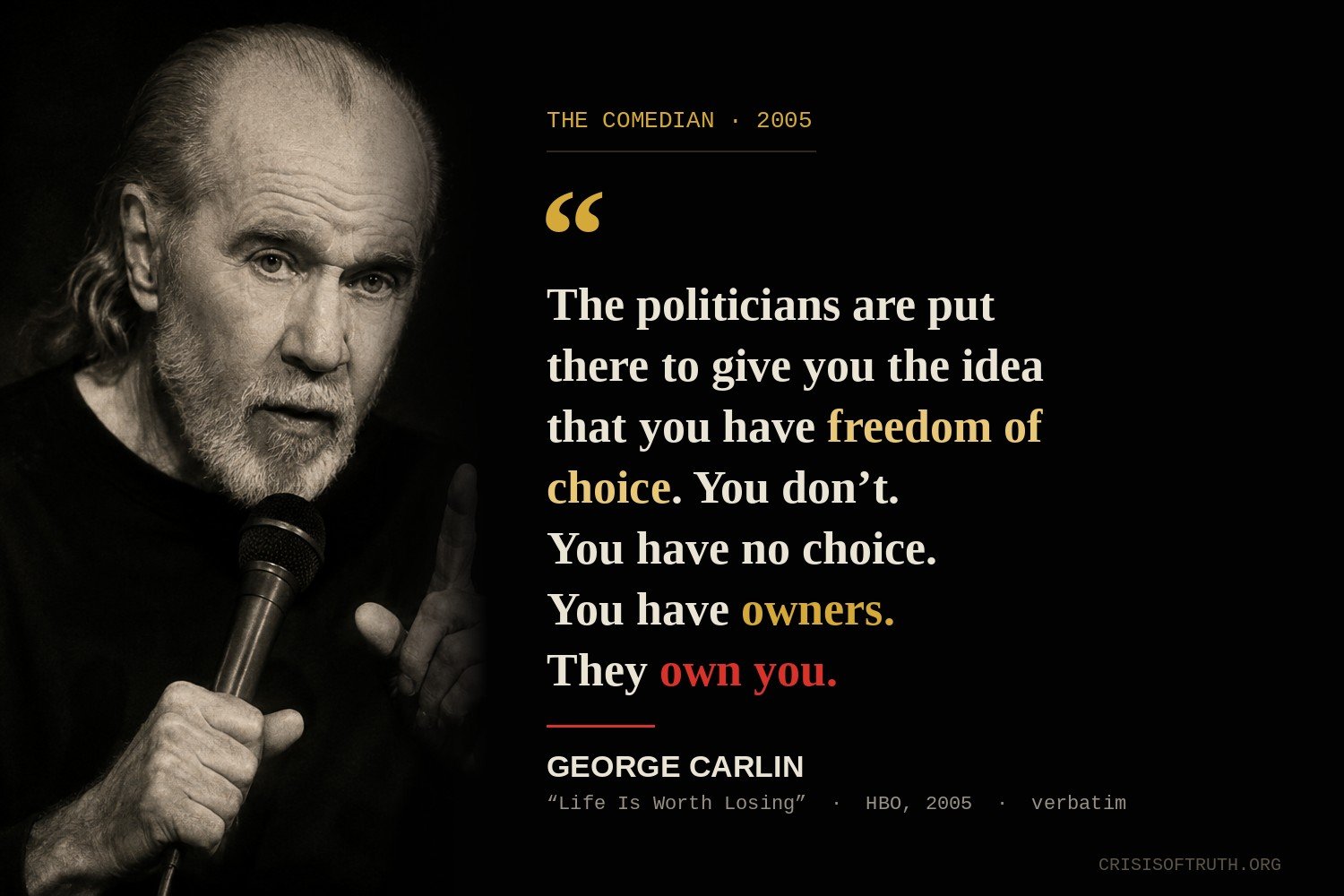
1. The Comedian — George Carlin (2005)
George Carlin, “Life Is Worth Losing” (HBO, 2005) — verbatim excerpt. Full segment below.
On a stage that has since been replayed more than thirty million times, the comedian George Carlin laid out a model of American power that almost no major news outlet would touch. He wasn't telling jokes. He was naming a structure.
His core argument, paraphrased and stripped of the profanity:
The people you vote for don't run the country. The people who own the country run the country. They own the land. They own the corporations. They own the press. They've bought the legislature, the courts, and the regulators. The politicians are there to give you the feeling you have a choice — so you stay invested in a contest whose outcome doesn't disturb the people on top.
What the owners don't want, Carlin said, is a population that can think clearly enough to look at their own lives and figure out exactly how the deal got worked. What they do want is workers just smart enough to run the machines and just compliant enough to accept disappearing pensions, vanishing benefits, and longer hours for less pay.
It sounds like a rant. It is, in fact, a structural description.
George Carlin, "Life Is Worth Losing" (2005) — the full segment
2. The Editor — Lewis Lapham (2005)
The same year as Carlin's bit, Lewis Lapham — for nearly thirty years the editor of Harper's Magazine, one of the oldest serious-journalism institutions in America — released a documentary called The American Ruling Class. The film follows two recent Yale graduates, one rich and one not, through the corridors of American power: Pentagon press briefings, the World Economic Forum, philanthropic foundations, the Council on Foreign Relations, Wall Street banks, and New York society dinners.
Lapham's thesis was direct: the country, he argued, is governed by what he called "a commercial oligarchy" — and the citizen who can't afford the luxury of a contrary opinion learns, of necessity, to dance the beggar's waltz. The "meritocracy" Americans are taught to believe in, Lapham said, is itself manufactured — a permeable enough structure to admit fresh money and new technology, but never permeable enough to disturb the underlying ownership.
The film's central provocation was its assertion that the ruling class's most effective protection is the cultural taboo against discussing its existence. The luminaries Lapham interviewed — including a former Secretary of State, a Treasury Secretary, the chairman of the New York Times, and the president of the New York Public Library — repeatedly denied being members of any ruling class even as they sat in offices that defined it. The American Ruling Class screened at the Tribeca Film Festival, briefly aired on the Sundance Channel, and effectively disappeared from public conversation. Most Americans have never heard of it.
3. The Anchor — Walter Cronkite (in Lapham's film)
And then there is the testimony of Walter Cronkite — for two decades the anchor of CBS Evening News and, by polling, the most trusted man in America for most of the late twentieth century. Cronkite appears in Lapham's documentary. The two young Yale men ask him, on camera, whether there is an American ruling class.
His answer was four words long: "I'm afraid there is."
He went on, in his own words, to describe a class of the rich who command American industry, commerce, and finance — and who, he said, are so able to manipulate American democracy that they effectively control it. This was Walter Cronkite. Not a podcaster. Not a polemicist. The man whose face was on the evening news the night Kennedy was shot, the night the moon was reached, the night Vietnam was lost. That Walter Cronkite. On camera. Saying the system is owned.
And almost no one heard him.
Verdict · Confirmed
"Carlin, Lapham, and Cronkite were describing the same real structure."
A comedian, a magazine editor, and the most trusted news anchor in American history — independently, on different stages, in different decades — described the same arrangement: a small, networked, hereditary-but-permeable class of owners whose power is denied even as it is exercised. Every concrete claim they made — concentrated media ownership, lobby-driven legislation, judicial capture, declining real wages, retirement insecurity, bipartisan policy capture — has been independently documented in academic and journalistic literature. What follows on this page is what that machinery actually does, day to day, to your kid's school, your job, your taxes, and your medicine.
"Is there an American ruling class?" "I'm afraid there is."
— Walter Cronkite, in The American Ruling Class (2005)
III · The Mechanism
Three pillars of real power.
Strip the partisan theater away and modern American power runs on three pillars. Each one, taken alone, would be a manageable problem. Stacked together, they form a closed loop the average voter can't reach into.
Pillar ICapital
Own the productive assets — the land, the factories, the patents, the data, the housing stock. Whoever owns the assets sets the price of the rent, the wage, and the medicine. This is the oldest and most concrete form of power.
Pillar IICapture
Buy the rule-makers. Fund the campaigns. Hire the regulators after they leave office. Place former lobbyists into agency leadership. Get the same law firm that lobbied for you to also write the executive order. The state becomes an extension of the firm.
Pillar IIICover
Own the information environment. Buy the cable channels, the local news chains, the streaming services, the algorithmic feeds. Tell the public who its enemies are. Make sure the cultural war is loud enough that the material extraction underneath stays quiet.
Most political journalism only ever shows you the surface of Pillar II — the campaign donation, the floor vote, the scandal of the week. Real power lives in the connective tissue between all three pillars, where capital flows into capture, and capture is laundered through cover.
What follows is one case where all three pillars showed their fingerprints at once.
IV · What They Decide For You
The decisions that shaped your life — and the ones you weren't invited to.
"They run the show" sounds like a slogan until you list the specific decisions. Decisions about your kid's school, your job, your taxes, your retirement, your medicine. None of these were decided at the kitchen table. All of them were decided in rooms most Americans will never see, by people whose names most Americans will never know.
What follows are three of the biggest. Not all of them. Just the ones that have shaped, and continue to shape, almost every dollar in your bank account and almost every door open or closed to your children.
1. They decided how your kid would be educated.
Walk into almost any American public school today and you will find children sitting in rows, ringing bells between subjects, taking standardized tests, and being graded on compliance as much as comprehension. This is not the natural shape of education. It is a specific design, deliberately chosen, by specific people, more than a hundred years ago.
At the turn of the twentieth century, as American manufacturing exploded and Henry Ford's assembly line redefined work, industrial titans began funding a transformation of American schooling explicitly aimed at producing manageable workers for the new factory economy. John D. Rockefeller's General Education Board, founded in 1903, became one of the single most influential shapers of the modern U.S. school system. The Carnegie Foundation and the so-called "scientific management" movement of Frederick Winslow Taylor pushed schools toward the same model: standardized curricula, age-graded classrooms, bell schedules, and a culture of obedience modeled on the factory floor.
Critical thinking, civics, philosophy, logic, media literacy, and the close reading of primary historical documents — the skills that produce citizens capable of recognizing manipulation when they see it — were not what the new model was for. The new model was for producing what Carlin would later call "obedient workers." It worked.
Today, civic education has been gutted. As recently as 2016 only about a quarter of American adults could name all three branches of government; the figure has since recovered to 70% (Annenberg, 2025). Most cannot identify their own representatives. Most have never read a page of the U.S. Constitution they were nominally raised under. Meanwhile, classroom time gets eaten by standardized tests, and public discourse gets dominated by manufactured cultural battles that crowd out logic, history, and economic literacy. A population trained to memorize and comply, but not to question, is exactly the population an ownership class would design — if it could.
It could. It did.
For a deeper investigation of this specific machinery, including the funded history of the Rockefeller-era school reforms, see our companion piece: Rich Kids Learn Power. Your Kids Learn Obedience.
"How America Keeps Its Citizens Uneducated" — on the industrial origins of the U.S. school model
2. They decided where your job would go.
If you were born in an American manufacturing town between 1950 and 1980, the union job your father or grandfather held — the one that paid for a house, a car, a vacation, and a pension — is statistically not coming back. That is not because Americans got lazy. That is because, between 1993 and 2020, the people who own the country negotiated a series of trade agreements that made it more profitable to manufacture goods in countries with cheaper labor and weaker labor protections.
The numbers, drawn from the U.S. Bureau of Labor Statistics, the Economic Policy Institute, and the National Bureau of Economic Research:
1979 — peak American manufacturing employment: 19.6 million jobs.
1994 — NAFTA takes effect, eliminating most trade barriers between the U.S., Canada, and Mexico.
2000 — China is granted Permanent Normal Trade Relations (PNTR), unleashing what economists later called "the China Shock."
2000–2020 — the U.S. loses roughly 5 million manufacturing jobs.
An IMF working paper finds that among displaced manufacturing workers with more than ten years on the job, roughly 80% experienced a wage decline. The median decline was around 35%.
The Coalition for a Prosperous America estimates the China trade deficit alone has cost the U.S. 3.82 million jobs since 2001.
This was not the work of one party. NAFTA was negotiated under a Republican president (George H.W. Bush) and signed by a Democratic president (Bill Clinton). Permanent trade relations with China were also signed by Clinton and overwhelmingly supported by both parties' establishments. The Wall Street firms, multinational corporations, and donor networks that had pushed for these agreements profited enormously. The towns built around the closed factories did not.
Today, when politicians on both sides perform outrage about "the loss of American manufacturing," it is worth remembering: the same donor networks that fund both parties were the ones that originally lobbied to send those jobs overseas. The fight that gets televised is theater. The deal was already done.
3. They decided who pays the taxes.
If you make a paycheck, the federal government takes its cut before the money reaches your bank account. There is no negotiation. The withholding is automatic. Income tax, Social Security, Medicare — all gone before you see the deposit. For a middle-income household, federal income tax plus payroll tax comes to an effective rate of roughly 13% of income; averaged across all households the federal rate is about 20% (CBO, 2022).
Now compare that to what the people at the very top actually pay.
A 2021 White House analysis, using a comprehensive measure of income that includes the appreciation of assets, found that the wealthiest 400 families in America paid an average federal individual income tax rate of just 8.2%. That is significantly lower than what the average American working family pays.
An investigation by the nonprofit news organization ProPublica, working from a leaked trove of IRS records, went further. By measuring what the 25 richest Americans paid in taxes against the actual growth of their wealth between 2014 and 2018, ProPublica calculated a "true tax rate" of 3.4%. During that same period, those 25 individuals saw their personal fortunes grow by a combined $401 billion.
How is this legal? Because the tax code is written specifically to tax wages and salaries — what working Americans earn — at much higher rates than capital gains, carried interest, and the borrowed-against-stock arrangements through which the wealthy actually finance their lives. Jeff Bezos pays himself an Amazon salary of around $80,000. The other tens of billions of dollars in wealth he accumulates each year are not, under U.S. tax law, "income."
This isn't an accident of policy. It is policy. The 2017 Tax Cuts and Jobs Act, by analysis from Berkeley economists Emmanuel Saez and Gabriel Zucman, dropped the effective tax rate on the country's wealthiest from roughly 30% down to 24%. The 2025 follow-up legislation is projected to deliver an additional $311,000-per-year tax cut to households in the top 0.1% by 2027 — while raising the tax burden on households making less than $15,000 a year. From 2018 to 2022, 23 of the largest and most profitable U.S. corporations paid zero dollars in federal corporate income tax.
Verdict · Confirmed
"Working Americans pay a higher effective tax rate than the country's billionaires."
Documented by the U.S. Bureau of Labor Statistics, the IRS, the White House Council of Economic Advisers (2021), Berkeley economists Saez and Zucman (NBER, 2025), and ProPublica's "Secret IRS Files" investigation (2021–2024). The disparity is not the result of illegal tax evasion. It is the result of a tax code written, deliberately, to tax labor more heavily than wealth.
The R-versus-D performance
Notice the pattern across all three decisions. The school model was funded by a Republican-aligned industrial dynasty (the Rockefellers) and adopted by both parties. NAFTA was Bush-Republican origin and Clinton-Democrat finalization. Permanent trade with China was Clinton-Democrat. The 2017 tax cut was Trump-Republican; the carried-interest loophole has survived every Democratic administration since 2007 despite repeated promises to close it. The Tax Cuts and Jobs Act renewal in 2025 was Trump-Republican; the bipartisan vote on the underlying tax architecture is older than most members of Congress.
What the receipts make clear is that this is not a fight between left and right. It is a fight between owners and everyone else, dressed up as a fight between left and right because the dressing keeps the everyone-else fighting one another instead of looking up. The same donor networks fund both parties. The same lobby firms staff both administrations. The same names appear on the same boards, the same flight logs, the same yacht passenger lists, the same hedge-fund LP rosters, the same Council on Foreign Relations membership, the same Aspen Institute panels, the same boards of trustees of the same universities that train the next generation of "meritocratic" leadership.
You have seen this list of names before, in fragments. The Epstein flight logs that surfaced in 2019–2024 documented one corner of it — billionaires, royalty, scientists, presidents, and ex-presidents from both parties moving through the same private islands and the same private jets. That was not a separate scandal. That was the network giving you a glimpse of itself. The lesson was not "Epstein was uniquely evil." The lesson was that this is what the network looks like when one node of it goes down and the documentation briefly leaks.
What the owners want — and what the cultural-war media apparatus is paid to deliver — is for you to spend your political energy fighting your neighbor about pronouns or pickup trucks. Whatever you are spending political energy on, ask yourself: who profits if this fight stays loud? And who profits if you ever look up?
"The fight that gets televised is theater. The deal was already done."
— On the bipartisan architecture of capture
V · The Receipts
When the product kills people, the playbook stays the same.
If you want to see the owners at work, watch what happens when their products kill people. Two Bayer scandals — separated by forty years, two different continents, two different products — run from the same blueprint. The blueprint is the story.
1984 · The blood that Bayer kept selling after they knew
Long before there was a Roundup lawsuit, there was a Bayer subsidiary called Cutter Biological, and a clotting medicine for hemophiliacs called Factor VIII concentrate. The medicine was made by pooling plasma from ten thousand or more donors at a time. In the early 1980s, before there was a screening test for the AIDS virus, even one infected donor could contaminate an entire batch. Hemophiliacs began dying.
By February 29, 1984, Cutter received U.S. approval to sell a new, heat-treated version that government studies showed rendered HIV "undetectable" in the product. A safer era for American hemophiliacs had begun.
For the next year and a half, Cutter kept making the old, unheated, contaminated medicine — and shipping it to Asia and Latin America.
Why? Internal Cutter documents obtained by The New York Times and reviewed in 2003 spell it out plainly. The company had "several large fixed-price contracts" to fulfill. Profit margin needed to be "preserved." There was "excess nonheated inventory" sitting in warehouses that had to be moved. In a November 1984 meeting, executives planned to "review international markets again to determine if more of this product can be sold." It was sold.
More than 100,000 vials of unheated concentrate, worth more than $4 million, were exported after Cutter began selling its safer product. The medicine went to Hong Kong, Taiwan, Malaysia, Singapore, Indonesia, Japan, and Argentina. In Hong Kong and Taiwan alone, more than 100 hemophiliacs contracted HIV from Cutter's old medicine. Many died. The mother of a Hong Kong hemophiliac who died at 22 told the Times: "They did not care about the lives in Asia. It was racial discrimination."
When the FDA's blood-products regulator, Dr. Harry Meyer, called Cutter and three other companies in for a meeting in May 1985 and ordered them to stop, he asked — according to Cutter's own meeting notes — that the issue be "quietly solved without alerting the Congress, the medical community and the public." Another company's notes confirmed the same instruction: handle this "quickly and quietly."
Dr. Sidney Wolfe of Public Citizen, who had been investigating the pharmaceutical industry for thirty years, called the documents "the most incriminating internal pharmaceutical industry documents I have ever seen."
Bayer and three other manufacturers — Armour Pharmaceutical, Baxter International, and Alpha Therapeutic — eventually paid American hemophiliacs about $600 million to settle fifteen years of lawsuits. They admitted no wrongdoing. In France, two health officials went to prison for similar conduct. No American executive did. The story was reported by the New York Times on May 22, 2003. It did not lead the evening news.
Isn't it funny that this story wasn't front-page news?
When a corporation knew its product could kill people and kept selling it anyway, what stopped them? Nothing.
Because when profit margins are protected, accountability becomes optional. This isn't about left or right. It's about power without consequences.
Read the documents. Then ask yourself why some stories never become front-page news.
"If laws only apply to the powerless, we don't have justice — we have hierarchy."
2026 · Forty years later, the same playbook
What Cutter did with hemophiliacs in 1984, Bayer is doing with cancer patients in 2026 — but this time, instead of quietly shipping product overseas, the company is openly rewriting American law to make the lawsuits go away.
In 2015, the World Health Organization's International Agency for Research on Cancer reviewed the science on glyphosate — the active ingredient in Roundup, the most widely used herbicide in the world — and classified it as a probable human carcinogen. Lawsuits followed. By 2026, more than 100,000 Americans had sued Roundup's owner — the same German pharmaceutical giant Bayer, which acquired Monsanto in 2018 — claiming the product gave them non-Hodgkin lymphoma. Juries kept agreeing. Bayer paid out more than $11 billion in verdicts and settlements.
About 67,000 active claims were still moving through the courts when Bayer decided to stop fighting case by case and start changing the rules of the game.
What follows is what changing the rules of the game looks like, when you're rich enough to afford the right zip code.
The infrastructure: a German company, a Florida lobby firm, and the West Wing
To understand the next four months, you have to understand one lobbying firm: Ballard Partners, run by Brian Ballard. Ballard raised more than $50 million for the 2024 Trump campaign, served on the inaugural and transition finance committees, and is widely described as one of the most influential people in Washington who holds no government title.
Two of his former lobbyists became, respectively, the White House Chief of Staff (Susie Wiles) and the U.S. Attorney General (Pam Bondi). Ballard Partners registered to lobby for Bayer in December 2024 — the month after the election. By 2025, Ballard Partners was the highest-earning lobbying firm in Washington in 2025, and Bayer was paying it.
Bayer's CEO, Bill Anderson, met repeatedly with top administration officials — including Wiles — in the months leading up to what came next. Bayer also gave $1 million to Trump's inaugural fund, and across 2024–2025 spent more than $17 million employing 13 lobbying firms and roughly 45 registered lobbyists. Investigative outlets including U.S. Right to Know have tied at least 26 senior administration officials to Bayer's lobbying or legal network. The EPA's pesticide regulation office, meanwhile, is now run by veterans of the chemical industry itself.
The payoff, in chronological order
Then, in a single week in February 2026, three things happened in sequence. None of them happened by accident.
Feb 13, 2026
House Republicans unveil draft Farm Bill with federal pesticide preemption
The bill would block states from requiring any pesticide warning that goes beyond what the EPA already requires — meaning state-court juries could no longer hold Bayer liable for failing to warn about cancer risks the EPA refused to put on the label.
Feb 17, 2026
Bayer announces a $7.25 billion class-action settlement
The proposed settlement would resolve the bulk of pending Roundup cancer lawsuits — but only on Bayer's terms, with caps on individual recoveries and a 16-year window after final approval to file new claims.
Feb 18, 2026
Trump invokes the Defense Production Act for glyphosate
An executive order declares glyphosate-based herbicides and elemental phosphorus "critical to the national defense." Bayer is the sole U.S. domestic producer of both. The order directs the Agriculture Secretary to ensure that no federal "order, rule, or regulation" threatens the "corporate viability" of those producers — language critics say effectively grants legal cover under the DPA.
April 27, 2026
Supreme Court hears Monsanto v. Durnell
Bayer asks the Supreme Court to rule that federal pesticide law preempts state-court failure-to-warn lawsuits. Trump's Solicitor General had filed a brief in December 2025 supporting Bayer's position — a reversal of the previous administration, which had argued the opposite. A win for Bayer could end the cancer suits as a category of legal action.
Even Republicans noticed
This isn't a partisan critique. On February 20, 2026, on the floor of the House of Representatives, Republican Congressman Thomas Massie of Kentucky said it directly: all three branches of the federal government, he argued, were "under siege by lobbyists and lawyers from a German company named Bayer." He pointed out that the chief of staff and the attorney general had both worked for the firm now lobbying for Bayer. He pointed out that the executive order was timed to insulate the company from liability. The Constitution, he reminded his colleagues, guarantees the right to a trial when you've been harmed.
Even within the Trump coalition, this sequence has caused friction with the so-called "Make America Healthy Again" wing — Health Secretary Robert F. Kennedy Jr.'s movement explicitly opposes glyphosate. The administration sided with Bayer anyway. That's the tell. This wasn't ideology. It was capture.
Verdict · Confirmed
"The Trump administration acted to shield Bayer from cancer-warning lawsuits."
Documented across the Solicitor General's December 2025 SCOTUS brief, the February 2026 Defense Production Act executive order, the simultaneous Farm Bill preemption language, EPA leadership appointments, and disclosed lobbying spending. Source materials include filings at the U.S. Supreme Court, Federal Election Commission inaugural fund records, OpenSecrets lobbying disclosures, and U.S. Right to Know's Bayer Lobby Tracker.
Verdict · Overstated
"This kind of capture only happens under one party."
It is true that the Trump-era Solicitor General reversed the Biden-era position to side with Bayer at the Supreme Court. It is also true that Bayer lobbies both parties, that the Biden administration's EPA also declined to require a cancer warning, and that traceable dark money in 2024 backed Democrats more than Republicans overall (per the Brennan Center). The capture infrastructure is bipartisan; it shifts which corporations get top access depending on who wins, but the underlying machine — the revolving door between lobby firms, the White House, and federal agencies — does not change. Treating this as a "Trump problem" misses the actual disease.
Verdict · Nuanced
"Voting harder will fix this."
Voting matters — but only as part of a broader strategy. The capture mechanism is robust to elections precisely because both parties depend on the same lobby-firm infrastructure for staffing, fundraising, and legal strategy. Real change requires sustained organized pressure outside of campaign cycles: campaign finance reform, lobbying transparency, anti-corruption laws, public funding of elections, and constitutional limits on corporate political spending. The Brennan Center, Campaign Legal Center, and OpenSecrets all document specific reform proposals stalled in Congress.
VI · The Engine
Citizens United is the engine. Dark money is the fuel.
The Bayer story doesn't happen in a vacuum. It happens inside a political economy that the Supreme Court restructured in 2010, in a 5–4 decision called Citizens United v. FEC.
That ruling, which the late Justice Ruth Bader Ginsburg called the worst of her time on the Court, swept away most limits on so-called "independent" political spending and treated corporate election spending as protected speech. The justices reassured Americans that all this newly permitted money would at least be transparent. It is not.
Some numbers, drawn from the Brennan Center for Justice's 2024 cycle analysis:
$1.9 billion — total dark money in the 2024 federal election cycle. The previous record, from 2020, was $1 billion.
$4.3 billion — minimum dark money spent on federal elections since the Citizens United decision.
$2.7 billion — record super-PAC spending in 2024 alone.
$277 million — super-PAC contributions from Elon Musk to support the 2024 Trump campaign, including direct operations like voter outreach.
22 states + hundreds of cities — jurisdictions that have voted to support a constitutional amendment overturning Citizens United.
The system Carlin described in 2005 was bad. The system Citizens United built on top of it is worse — because it adds untraceable money on a scale earlier generations of corporate influence could only dream of, and it does so under a Supreme Court doctrine that calls the whole thing free speech.
This is the engine that hums underneath every story like Bayer's. Whichever party wins, the firms that funded the winners — and the losers — are still standing. The lobbyists step into the agencies. The agencies write the rules. The rules protect the firms. The firms fund the next campaign.
Carlin's "big club" is just this loop, drawn cleanly.
"Whichever party wins, the firms that funded the winners — and the losers — are still standing."
— The structure of capture
VII · The Cover
Why didn't either story lead the news? Look at who owns the news.
The Cutter blood scandal broke in The New York Times on May 22, 2003. Internal documents. Named executives. Thousands dead. It should have been the story of the week. It barely cleared 24 hours of cable coverage. Most Americans, two decades later, have never heard of it.
The Bayer-Roundup-Trump story in 2026 followed almost the exact same arc. A handful of independent outlets — The American Prospect, U.S. Right to Know, Civil Eats, The New Lede — covered it carefully and continuously. Most of the big networks treated it as agriculture-policy news, when they covered it at all. A Republican congressman naming the capture from the House floor barely registered.
That's not an accident either. American mass media is now concentrated in a small handful of corporate owners — the same kind of corporate owners who depend on the same kind of regulatory access that Bayer just bought. Their newsrooms are full of careful, talented journalists. But the editorial choices made above those journalists — what gets the front page, what gets a chyron, what gets called "scandal" versus "policy" — are made by executives whose paychecks depend on staying friendly with the same political class that the lobby firms cultivate.
It is much safer for a billionaire-owned media company to fight a culture war than to cover a capture story. Culture wars don't threaten the owners. Capture stories do.
This is what Carlin meant about being told what to think and what to buy. He wasn't being clever. He was being precise. And it is why some stories — even when they involve thousands of preventable deaths — never become front-page news.
VIII · The Kitchen Table
What this means at your kitchen table.
Pull this out of Washington and into your own life for a second.
If federal preemption wins at the Supreme Court, a person whose lymphoma was caused by the weed killer they used in their yard for fifteen years will not be able to sue the company that sold it to them — because the EPA, run partly by former chemical-industry lobbyists, didn't require a warning on the label. The company will keep its product on the shelves. The cancer will keep happening. And the courthouse door will be quietly bolted shut from the inside.
That's one product, one company, one industry. Multiply it across pharmaceuticals, banking, insurance, fossil fuels, agriculture, real estate, defense, and tech, and you have a model of how an entire economy gets quietly tilted away from ordinary people without ever passing a single law that says "workers shall now lose."
This is why your wages don't keep up. This is why your mom's pension was raided. This is why you need three jobs to afford the rent in a town your grandparents bought a house in for one salary. This is why the deductible doubled and the insurer's profit tripled. The system isn't broken. It is doing exactly what it was redesigned to do — for someone who isn't you.
Carlin's last line was the cruelest one: that the people getting hurt the most keep voting for the people profiting the most. He was wrong about one thing. They're not voting for them because they don't notice. They're voting for them because they were given a choice between two managements of the same ownership.
IX · What's Real
So what do you actually do with this?
This page isn't a manifesto for despair. The owners would prefer despair. Despair is obedient.
What's real, and within reach:
Read outside the cover
Make a habit of reading at least one source that isn't owned by a billionaire — independent journalism organizations, public-interest research outfits like the Brennan Center, OpenSecrets, the Campaign Legal Center, U.S. Right to Know, Civil Eats. Compare what they cover to what you see on the algorithmic feed. The gap is the story.
Sit with the kitchen-table math
When a politician promises something, ask: "Who pays, and who gets paid?" When an executive order is signed, ask: "Whose lobbyist worked at that firm?" When a Supreme Court case is heard, ask: "Whose brief is the Solicitor General quoting?" These questions are not radical. They are basic civic literacy that has been deliberately driven out of public education.
Vote down-ballot, in primaries, and on referenda
Presidential elections get the airtime; primaries, judges, ballot measures, and constitutional amendments are where the capture gets contested or extended. Twenty-two states have already voted to support a constitutional amendment overturning Citizens United. That number is not a fantasy. It is a project.
Refuse the cultural-war frame
The single most powerful weapon the owners have is the ability to keep ordinary people fighting about identity instead of looking at extraction. The next time someone insists the most important fight is about the other half of working-class America, ask whether the conversation could move to who actually got paid this quarter. Watch how fast the conversation gets steered back.
Talk about it
You're allowed to bring this up at the kitchen table. That's the conversation Carlin said the owners are most afraid of. The reason the speech still hits, twenty years later, is that he was telling people they were allowed to see it.
"It's a big club. And you ain't in it." — but you can see the door, you can name the members, and you can refuse to stop talking about who's inside.
— After Carlin
If this changed how you see things, send it to one person.
No subscription, no paywall, no algorithm. The only way pages like this travel is hand-to-hand.