CrisisOfTruth.org
The Foundational Document

The Memo That Built the World You Live In.

In 1971, a corporate lawyer named Lewis Powell wrote down the plan. He was nominated to the Supreme Court two months later. You were never supposed to read what he wrote. Here it is.

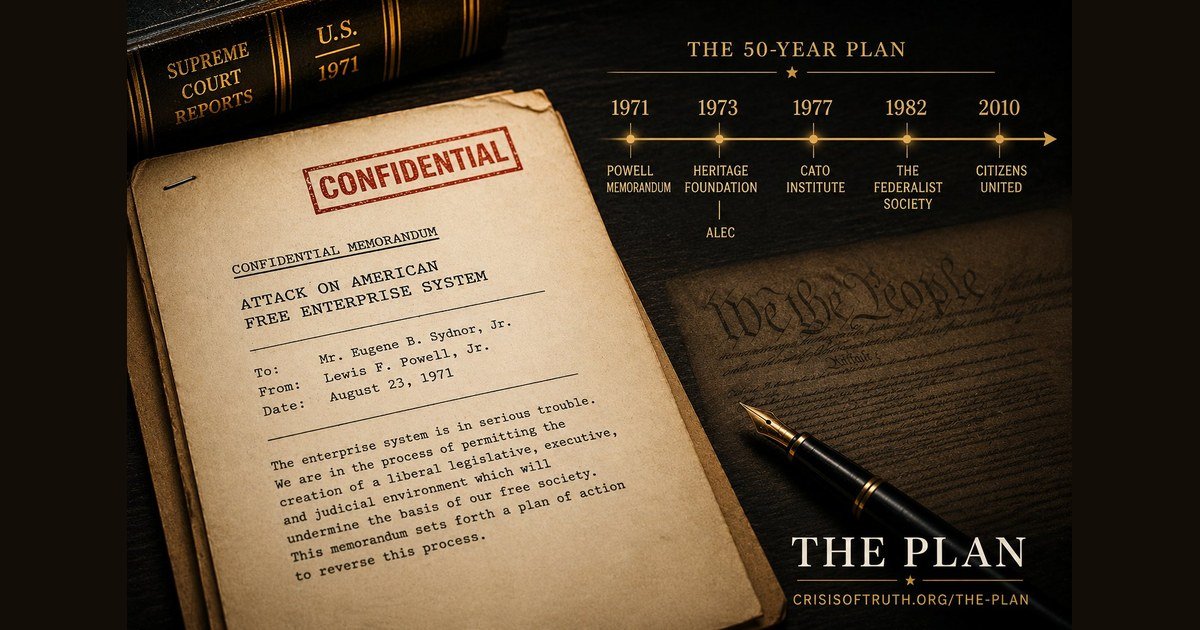
The Powell Memorandum of August 23, 1971 — confidential memo from Lewis F. Powell, Jr. to the U.S. Chamber of Commerce, with timeline of institutions built from its recommendations: Heritage Foundation 1973, ALEC 1973, Cato Institute 1977, Federalist Society 1982, Citizens United 2010.
The actual memo · August 23, 1971 · And what got built from it
1971 The Year the Plan Was Written Down
2 mo. Time From Memo to Powell's Supreme Court Nomination
6+ Major Institutions Built From the Memo's Recommendations
54 Years the Project Has Been Quietly Running
For the skeptical reader · 5-minute verification

If you only check three things on this page, check these.

Don't take this page's word for any of it. Verify these three documented facts yourself, in five minutes, using the named sources below. If even one is true, the rest of this page deserves your attention.

1
Lewis F. Powell, Jr. wrote a confidential memo to the U.S. Chamber of Commerce on August 23, 1971, outlining a multi-decade strategic plan to organize American business as a political force. Two months later, President Nixon nominated him to the U.S. Supreme Court.

Source: The Lewis F. Powell, Jr. Papers, Washington and Lee University School of Law (scholarlycommons.law.wlu.edu/powellmemo). The full memo is publicly archived and freely downloadable.
Search: Powell Memorandum Washington Lee

2
A United States Senator — Sheldon Whitehouse of Rhode Island — has delivered an entire ongoing speech series on the Senate floor titled "The Scheme," documenting how the Powell Memo's recommendations were systematically executed by a network of corporate-funded institutions over fifty years.

Source: Sen. Sheldon Whitehouse, "The Scheme" speech series, U.S. Senate (whitehouse.senate.gov/news/speeches). The series is publicly archived and ongoing.
Search: Whitehouse Senate The Scheme Powell

3
Conservative commentators today openly celebrate the Powell Memo as the strategic blueprint for the modern conservative movement — from the Heritage Foundation to ALEC to the Federalist Society. They are not hiding it. They are proud of it. The story has simply not been taught to most working Americans.

Source: Multiple openly-published conservative writings, including conservative author Barby Ingle's 2025 piece celebrating the Powell Memorandum as "a cornerstone of the fight for limited government." Heritage Foundation and Federalist Society writings have credited Powell-era strategic vision for decades.
Search: Powell Memorandum conservative movement blueprint

If a sitting Supreme Court Justice wrote down the plan, and a sitting U.S. Senator gives speeches about it, and conservatives openly celebrate it — why have so few working Americans ever heard of it?

You have spent your life inside the result of a plan you were never told existed. The plan was written down. It was leaked, then published. It is freely available. It is not hidden — it is just not taught.

Here is the document and what got built from it
I · The Wound

If you have ever wondered when, exactly, the country changed — this is when.

Anyone over fifty has felt it but cannot quite name it. Anyone under thirty was born inside it and assumes it is normal. Somewhere between the country your grandparents built and the country you live in now, something changed. Wages stopped tracking productivity. Pensions disappeared. Healthcare became a debt sentence. Civic education was gutted. The Supreme Court began routinely ruling for corporations against working people. Twenty-four-hour cable news replaced local journalism. And the political conversation got louder, dumber, and angrier — even as the actual decisions about your life moved further and further from anywhere you could reach them.

You did not imagine this. You also did not deserve it. And — this is the part most working Americans have never been told — it did not happen by accident. Most of it was sketched out, on paper, in a single document, by one corporate lawyer, in the summer of 1971.

His name was Lewis Powell. Two months after he finished writing it, President Richard Nixon nominated him to the Supreme Court of the United States. He served for fifteen years. The plan he wrote in his last summer as a private lawyer became, in slow motion across the next half-century, the country you now wake up in every morning.

This page is not about Lewis Powell as a villain. He was a careful, conventional Southern lawyer who ate lunch at the Commonwealth Club in Richmond and served on a dozen corporate boards. As a Justice he wrote the majority opinion upholding affirmative action in Bakke; he voted with the Court's liberal wing more often than his critics admit. The point of this page is not Powell. The point of this page is that he wrote down the plan, on company letterhead, addressed to a friend at the U.S. Chamber of Commerce, and the plan was executed — by people other than Powell, with money that flowed long after his death — exactly as he sketched it. And almost no one taught you the plan existed.

Most American adults today cannot name the three branches of government. That is also not an accident. The civic literacy that would let an ordinary person read this page and immediately recognize what is being described — the constitutional doctrines, the institutional capture, the legal-philosophy machinery — was itself one of the targets the plan named. An uninformed public was not a side effect of this project. It was the project.

"No thoughtful person can question that the American economic system is under broad attack."
— Lewis F. Powell, Jr., opening sentence, August 23, 1971
II · The Memo

What Powell actually wrote — in his own words.

The document is titled "Attack on American Free Enterprise System." It is roughly 6,500 words long. It is written in the dry, lawyerly voice of a man who has billed many hours and is comfortable with corporate boards. It was sent on August 23, 1971, to Eugene B. Sydnor, Jr., Chair of the Education Committee of the U.S. Chamber of Commerce, marked CONFIDENTIAL.

It was leaked thirteen months later by the syndicated columnist Jack Anderson, who suggested that Powell's secret strategic memo should have been disclosed during his Supreme Court confirmation hearings. The Chamber, with the cat out of the bag, then published the full memo in its newsletter Washington Report. Today, the original typescript and the published version both sit in the Powell Archives at Washington and Lee University School of Law, freely searchable, freely downloadable, freely quotable. The memo is the single most-requested document in the entire Powell collection.

Here is what it says — in Powell's own words, with the most consequential passages in his exact phrasing.

The opening — sounding the alarm

Powell did not bury his thesis. The first sentence of the memo reads:

"No thoughtful person can question that the American economic system is under broad attack."

— Powell Memorandum, opening sentence, August 23, 1971

His "broad attack" was not the Soviet Union. It was, in his own framing, the rise of consumer protection, environmental regulation, labor unions, public-interest law, and what he called "the disquieting voices" of campus intellectuals, journalists, and reformers. The named enemies in the memo are American. Powell singles out by name the consumer advocate Ralph Nader (against whom he urged the business community to mount, in his exact words, "no hesitation to attack"), the lawyer William Kunstler, and the popular author Charles Reich.

The diagnosis — business has been losing

Powell argued that American business had grown politically complacent, even as it remained economically dominant. Businessmen, he wrote, had not been "trained or equipped" to wage what he described as a kind of guerrilla war against the people he saw as their cultural and political opponents.

His prescription was a long-term, well-funded, multi-front counter-mobilization — coordinated by the U.S. Chamber of Commerce, sustained over decades, and aimed at four specific arenas. Read this list carefully. Then look at the world around you.

The four targets

Powell named four arenas where the business community had to organize, fund, and dominate if it was to reverse the trend he saw. In his own words, these were:

  1. The campus. Powell argued that American universities had become hostile to free enterprise, and that the business community needed to fund chairs, scholars, textbooks, and student programs to "balance" what was being taught. He called specifically for staff to "evaluate" college textbooks and for "equal time" speakers to be sent into classrooms.
  2. The public — through the media. Powell argued for systematic monitoring of television, radio, newspapers, and "scholarly journals" — and for organized response, paid op-eds, and the construction of business-friendly media voices to counter what he saw as a hostile press.
  3. The political arena. Powell wrote, with notable bluntness, that "political power is necessary; that such power must be assiduously cultivated; and that when necessary, it must be used aggressively and with determination." He called for sustained, organized lobbying — a permanent presence in Washington, not episodic responses to specific bills.
  4. The courts. This is the recommendation that, in retrospect, has had the most consequence. Powell wrote: "Under our constitutional system, especially with an activist-minded Supreme Court, the judiciary may be the most important instrument for social, economic, and political change." He called on the Chamber to build a permanent legal arm — to file briefs, sponsor litigation, recruit lawyers, and shape American jurisprudence over the long term.

The original typescript of the Powell Memorandum is publicly archived at scholarlycommons.law.wlu.edu/powellmemo. A clean transcript is also available at historyisaweapon.com/defcon1/powellmemo.html. Sen. Sheldon Whitehouse's "The Scheme 1: The Powell Memo" speech provides the most thorough modern analysis. Boston College Law School also hosts a copy.

The strategic insight

What made the memo strategically unusual — and what the people who funded its execution understood — is that Powell did not call for a short-term political campaign. He called for a permanent infrastructure. Decades of patient institution-building. Universities, think tanks, legal foundations, media outlets, judicial pipelines. Things that would still be running long after the people who built them were dead.

That is exactly what got built. And Powell was correct: the courts turned out to be the most important instrument of all.

Verdict · Confirmed
"Lewis Powell wrote a strategic plan for the long-term political organization of American business in 1971."
The full text of the Powell Memorandum is publicly archived at the Lewis F. Powell, Jr. Papers, Washington and Lee University School of Law (scholarlycommons.law.wlu.edu/powellmemo). The memo's authorship, date, recipient (Eugene B. Sydnor, Jr. of the U.S. Chamber of Commerce), and four-arena strategic framework are not in dispute and have been documented across academic literature for fifty years — including John B. Judis's The Paradox of American Democracy (2000), Jane Mayer's Dark Money (2016), and Sen. Sheldon Whitehouse's ongoing "The Scheme" speech series in the U.S. Senate.
Verdict · Nuanced
"Powell personally directed everything that got built from the memo."
No. Powell wrote the memo and then went to the Supreme Court, where he served until 1987 and died in 1998. The infrastructure built from his recommendations was funded and constructed by others — Joseph Coors, Charles and David Koch, Richard Mellon Scaife, the John M. Olin Foundation, the Bradley Foundation, and dozens of corporate donors and operatives. Powell's role was to write the strategic blueprint and provide its early intellectual prestige. The fifty-year execution belongs to the donor network that adopted his framework as their playbook.
If you read nothing else on this page
A future Supreme Court Justice wrote a strategic plan to organize American business as a permanent political force. The plan named the courts as "the most important instrument for social, economic, and political change." Two months later, he was nominated to the highest court in the country. This is the public record.
III · The Family Tree

What got built from the memo. The institutions, with their founding dates.

Powell's memo was not a one-time pamphlet. It was a strategic blueprint. Within a few years of its leak, a constellation of new institutions began appearing — funded by a small group of corporate dynasties whose names recur over and over in the founding documents. Each institution targeted one of Powell's four arenas. Together, they form what historians and journalists now call the "conservative legal movement," but the more accurate name is simpler: the infrastructure Powell asked for.

Here is what got built, in chronological order. Each is a real organization with a public founding date, real founders, and real money trails. None of this is hidden. Most Americans have just never been shown the picture in one place.

1973 — The think tank
The Heritage Foundation is founded
Founded by Paul Weyrich and Edwin Feulner with early seed funding from beer magnate Joseph Coors. Heritage was designed, in Feulner's own words, to be different from "objective" think tanks like Brookings — it was built as an advocacy organization, intended to proactively shape policy rather than respond to it. Heritage authored Mandate for Leadership in 1981, which Reagan's administration used as its operating playbook (about two-thirds of its 2,000+ recommendations were implemented in Reagan's first year). Heritage today produces Project 2025 — the same institutional template, fifty years on. See our companion investigation on Paul Weyrich.
1973 — The state-legislature pipeline
The American Legislative Exchange Council (ALEC) is founded
Also founded by Paul Weyrich, ALEC was built to do at the state level what Heritage did at the federal level. Corporate members and state legislators meet at private conferences to draft "model legislation" — pre-written bills that legislators then introduce in their home states, often verbatim. ALEC's bills have been introduced in all fifty state legislatures, on subjects ranging from voter ID requirements to corporate tax breaks to limits on union organizing. The corporations write the bills. The legislators carry them. Most voters never know.
1974–1977 — The libertarian think tank
The Cato Institute is founded
Originally incorporated in 1974 as the Charles Koch Foundation, renamed Cato Institute in 1977. Founded by Charles Koch (chairman and CEO of Koch Industries), Edward H. Crane, and the economist Murray Rothbard. Cato fills the libertarian wing of Powell's intellectual infrastructure — providing book-length policy arguments for privatizing Social Security, deregulating finance, opposing the Federal Reserve, and reducing taxes on capital. Cato remains, fifty years later, one of the most-cited libertarian institutions in American policy debate.
1982 — The judicial pipeline
The Federalist Society is founded
Founded by law students at Yale, Harvard, and the University of Chicago with the explicit mission of challenging what they saw as the dominance of liberal jurisprudence. The Federalist Society does not file briefs or lobby — it does something more strategically powerful: it identifies, mentors, networks, and credentials young conservative lawyers from law school onward, building the bench from which federal judges and Supreme Court Justices are eventually drawn. Of the nine justices currently on the U.S. Supreme Court, six have current or former Federalist Society affiliations. Of the conservative justices appointed during the Trump administration (Gorsuch, Kavanaugh, Barrett), all three were drawn from a Federalist Society–approved list. This is the execution of Powell's "the courts" recommendation.
1980s onward — The funding architecture
The donor network matures
The institutions above were sustained and expanded by a relatively small group of corporate and family fortunes — the Koch network, the Coors family, the Scaife foundations, the John M. Olin Foundation, the Bradley Foundation, the DeVos family, and others. Jane Mayer's 2016 book Dark Money is the definitive journalistic account. The donor network operates as a coordinated long-term project: it funds the universities, it funds the think tanks, it funds the legal foundations, it funds the political organizations, and it funds the donor-advised funds (like DonorsTrust) that obscure where the money came from when it finally arrives at the policy outcome.
2010 — The arc closes
Citizens United v. FEC is decided 5–4 by the Supreme Court
The Supreme Court — staffed substantially with justices who had risen through the Federalist Society pipeline Powell's strategy created — ruled that corporate political spending was constitutionally protected speech. The case was named for an organization (Citizens United, founded 1988) that operated within the conservative-movement infrastructure Powell's framework had built. The decision unleashed what is now $4.3 billion of dark money on federal elections since 2010, with the 2024 cycle alone setting a record at $1.9 billion (Brennan Center for Justice). Powell's blueprint reached its mathematical conclusion. See our companion investigation: The Real Owners of America Are Not Names You Know.

All founding dates and founder identities above are publicly verifiable via Wikipedia, the institutions' own websites, IRS Form 990 filings, and academic histories — including Jane Mayer's Dark Money: The Hidden History of the Billionaires Behind the Rise of the Radical Right (Doubleday, 2016), Kim Phillips-Fein's Invisible Hands: The Businessmen's Crusade Against the New Deal (W.W. Norton, 2009), and Nancy MacLean's Democracy in Chains (Viking, 2017).

What this means at your kitchen table
  • The "think tanks" that appear on cable news as objective experts are, by their own founding documents, advocacy organizations built to deliver pre-determined conclusions.
  • The bills your state legislator introduces are, in many cases, drafted not by him or her but by corporate members of ALEC at private resort conferences you were not invited to.
  • The judges on your federal bench were, increasingly, vetted and credentialed by the Federalist Society from law school onward — a fifty-year talent pipeline that almost no working person was told was being built.
  • This was the entire point of the memo. Powell asked for an infrastructure that would outlast its founders. He got one.
"Under our constitutional system, especially with an activist-minded Supreme Court, the judiciary may be the most important instrument for social, economic, and political change."
— Lewis F. Powell, Jr., on the courts, 1971
IV · The Civics Casualty

One of Powell's recommendations was the campus. Here is what was lost.

Of Powell's four targets, the one most invisibly executed was the first: the campus. Powell asked for staff to "evaluate" college textbooks. He asked for "equal time" speakers to be sent into classrooms. He asked for endowed chairs, scholarship programs, conferences, and the long-term replacement of professors who taught what he saw as anti-business ideology.

What got built was something more comprehensive. The donor network — the Koch network in particular — has spent the last forty years funding endowed chairs, named centers, and entire economics departments at hundreds of American universities, with documented requirements about curriculum, faculty hiring, and reading lists. Inside Higher Ed, The Chronicle of Higher Education, and university journalism programs have documented the pattern across institutions from George Mason University to Florida State to Wake Forest to Wichita State. The relationships are mostly disclosed; they are also mostly unknown to ordinary parents writing tuition checks.

But the deeper casualty was further down the educational chain — in the K–12 civic education that would have given an ordinary American adult the conceptual vocabulary to recognize what was being done. Civics, history, logic, media literacy, and the close reading of primary documents — exactly the skills that would let a working person read this page and immediately follow the argument — have been progressively pushed off the American school schedule for fifty years.

The numbers are stark. According to a 2018 survey by the Annenberg Public Policy Center at the University of Pennsylvania, only 32% of American adults could name all three branches of the federal government. A 2022 follow-up found over half could not name a single First Amendment right beyond freedom of speech. A 2023 survey by the Bipartisan Policy Center found that less than a quarter of eighth-grade American students were proficient in civics — the lowest level since the assessment began. The percentage of high school graduation requirements that include a meaningful civics course has declined steadily since the 1960s.

Annenberg Public Policy Center civic-knowledge surveys are published annually at annenbergpublicpolicycenter.org. The Bipartisan Policy Center's civic-education studies are at bipartisanpolicy.org. The "Nation's Report Card" (NAEP) civics assessment data is at nationsreportcard.gov/civics. For the documented Koch-network influence on university curriculum, see Dark Money (Mayer, 2016) and the UnKoch My Campus archive at unkochmycampus.org.

What going after the children looks like

The plan does not have to recruit children directly. It just has to remove the tools they would otherwise grow up with — so that twenty years later, the adult cannot name what was taken.

  • Civics, gutted from the curriculum. The conceptual vocabulary for recognizing institutional capture is no longer taught in most American public schools.
  • Critical thinking, philosophy, and logic — the disciplines that produce skeptical adults — pushed off the schedule by standardized testing.
  • Primary-source reading replaced with multiple-choice assessment. A generation arrives at voting age without ever having read a federal statute, a Supreme Court opinion, or the U.S. Constitution they were born under.
  • The deliverable is a manageable adult, twenty years later — one who cannot recognize the system being built around them, because the language for naming it was removed before they ever met it.

A child trained to memorize and comply is a manageable adult on a long timeline. That manageable adult was the deliverable.

Read the full investigation: Rich Kids Learn Power. Your Kids Learn Obedience.

It is difficult to recognize the execution of a fifty-year political strategy if you cannot name the three branches of government. It is difficult to follow an argument about regulatory capture if you have never read a federal statute. It is difficult to evaluate a Supreme Court decision if you do not know what the Constitution actually says. This is not a coincidence. It was a target.

What this means at your kitchen table
  • If you feel like you are watching things happen to the country and cannot quite name them — that is the predictable outcome of a deliberately diminished civic education, not a personal failing.
  • The skills that would let an ordinary citizen recognize a constitutional violation in real time are exactly the skills that have been steadily cut from American public schools.
  • The reason the Powell Memo is not commonly taught — even though it is freely available, archived at a major university, and credited by historians as one of the most influential American documents of the late 20th century — is that an informed citizenry would have stopped what was being built.
  • The good news is that it is not too late to get the education you were denied. The materials are public. The histories are written. You are reading one of them now.
This is the part most Americans were never taught
Of the four arenas Powell named — campus, media, politics, and courts — the courts have produced the most consequential outcomes. Six of the nine sitting Supreme Court Justices have ties to the Federalist Society, the legal-pipeline organization Powell's strategy made possible. Powell was right: the courts were the most important instrument.
V · The Court

The arc, in chronological order. From the memo to Citizens United.

If you trace one line through the last fifty years of American politics, the cleanest one is this: Powell asked for the courts. The courts were taken. And the courts then dismantled the rest.

Here is the sequence, with the key cases and dates.

August 23, 1971
Powell Memo written
"The judiciary may be the most important instrument for social, economic, and political change."
October 1971 → January 1972
Powell nominated and confirmed to the Supreme Court
Nixon's nominee. Confirmed 89–1. The memo was not disclosed to the Senate Judiciary Committee.
1976 — Buckley v. Valeo
"Money is speech" enters constitutional doctrine
The Supreme Court rules that limits on independent political spending violate the First Amendment. Powell was on the Court. The decision treats spending money on political messaging as a form of constitutionally protected speech — laying the doctrinal foundation for everything that comes later.
1978 — First National Bank of Boston v. Bellotti
Corporations gain First Amendment political-speech rights
Powell wrote the majority opinion. The Court ruled 5–4 that corporations have First Amendment rights to spend money on ballot initiatives. This decision becomes the cornerstone for treating corporate political spending as protected speech. It is, in retrospect, the single most consequential opinion of Powell's judicial career.
1982 — Federalist Society founded
The judicial pipeline begins
Eleven years after Powell wrote that the courts would be the most important instrument, the long-term mechanism for staffing those courts begins operating.
2010 — Citizens United v. FEC
The arc closes
A 5–4 Supreme Court — staffed substantially with Federalist Society alumni — rules that corporate independent expenditures cannot be limited under the First Amendment, extending and supercharging Buckley and Bellotti. The case unleashes the modern dark-money architecture: $4.3 billion in untraceable political spending since the decision (Brennan Center for Justice). The case was named for Citizens United, an organization built within the conservative-movement infrastructure Powell's strategy made possible.
2013 → present
The downstream rulings
Voting rights weakened (Shelby County v. Holder, 2013). Public-sector union dues struck down (Janus v. AFSCME, 2018). Affirmative action ended in college admissions (2023). Federal regulatory authority restricted (West Virginia v. EPA, 2022; Loper Bright Enterprises v. Raimondo, 2024, overturning Chevron deference). Each of these decisions was decided by a Supreme Court majority drawn substantially from the Federalist Society pipeline. Each of these decisions implements policy outcomes that Powell's network has openly advocated for decades. None of this is conspiracy. This is institutional execution of a documented strategic plan.
Verdict · Confirmed
"The U.S. Supreme Court has been substantially captured by an institutional pipeline that began with the Powell Memo's recommendation."
"Capture" is contested terminology, but the institutional facts are not. Six of the nine sitting Supreme Court Justices have current or former Federalist Society affiliations. The Federalist Society's stated mission since 1982 has been to develop a conservative legal movement and pipeline of credentialed jurists. The Trump administration drew Supreme Court nominees from a Federalist Society–approved list. The pattern of 5–4 and 6–3 decisions favoring corporate and conservative interests over the past two decades — on campaign finance, voting rights, labor, environmental regulation, and federal agency power — is matched against a Court substantially populated by alumni of an organization explicitly built to produce those outcomes. Documented in Jane Mayer's Dark Money, Sen. Sheldon Whitehouse's "The Scheme" series, and the Federalist Society's own publications.
VI · Where You Live Now

This page is the spine. Every other investigation on this site is a chapter in this story.

If you have followed the argument this far, then the rest of CrisisOfTruth.org is no longer a collection of separate scandals. It is a single connected story, with one origin point, written down in 1971.

Here is how the pieces fit together.

The story is not Trump. The story is not any single politician. The story is the fifty-year project that produced the conditions in which figures like Trump become possible — and inside which the working-class voter is asked to choose between two parties whose donor networks substantially overlap. Trump is the fruit. The Powell Memo, and what got built from it, is the soil.

The reader is not the villain in this story. The reader is the one who was not told.

"Trump is not the cause. Trump is the result of fifty years of patient, well-funded, deliberately invisible work."
— Crisis of Truth, editorial bottom line
VII · What's Real

What an ordinary person can actually do, now that you have seen the plan.

This page exists because despair is exactly what the donor network is funded to produce. A despairing electorate does not vote, does not organize, does not run for school board, and does not show up to county commission meetings. Despair is the cheapest political outcome the owners can buy. The page would not be worth writing if there were nothing to do.

What is real, and within reach:

Read the actual memo

Spend twenty minutes with the original document. It is freely available at the Powell Archives at Washington and Lee University: scholarlycommons.law.wlu.edu/powellmemo. Read it in Powell's own words, in his own voice, on his own letterhead. Most Americans have never done this. After you have done it, you will not be able to unsee what is being described.

Get the civic education you were denied

You do not need a degree to understand the U.S. Constitution. The full text is roughly 7,500 words — shorter than this page. Read it. Read the Bill of Rights. Read the Fourteenth Amendment. The National Constitution Center (constitutioncenter.org) maintains a free online interactive version with explanatory commentary from across the political spectrum. iCivics (icivics.org), founded by Justice Sandra Day O'Connor specifically to address the civic-literacy collapse, offers free K–12 and adult civic education.

Read the journalism that documents the rest

For the donor network: Jane Mayer, Dark Money (Doubleday, 2016). For the academic intellectual history of the project: Nancy MacLean, Democracy in Chains (Viking, 2017). For the labor-history pre-history of the modern donor crusade: Kim Phillips-Fein, Invisible Hands (W.W. Norton, 2009). For the ongoing institutional reporting: The American Prospect, Mother Jones, The Lever, ProPublica, and the Brennan Center for Justice. None of these are partisan opinion. All of them are documented investigative work.

Vote in primaries, judicial elections, and on referenda

Presidential elections get the airtime; the institutional capture happens in primaries, in judicial elections (where applicable), and in ballot referenda. Twenty-two states have voted to support a constitutional amendment overturning Citizens United. The infrastructure to push back exists. It is just not as well-funded as the infrastructure being pushed back against.

Refuse the cultural-war frame

The single most powerful weapon the donor network has is the ability to keep ordinary working people fighting one another about identity instead of looking up at the people who fund both political parties. Whatever cultural fight the cable networks are loudly elevating today, ask: who profits if this fight stays loud, and who profits if I look up? The answer, almost always, will be the same set of people Powell asked the Chamber of Commerce to organize in 1971.

Talk about it

The single most threatening thing an informed citizen can do, in the system Powell asked to be built, is say what they have learned to another person at a kitchen table, in language that other person can use. That is the conversation the entire fifty-year project was designed to make harder. Have it anyway.

If you take one thing from this page

In 1971, a corporate lawyer wrote down a fifty-year plan.

It was leaked. Then published. Then archived at a major university.

The institutions it called for got built — by people whose names are on the buildings.

The strategy worked exactly as written.

You were never told the plan existed.

That part was the most important part.

Most people will live and die without ever reading the memo.

You don't have to be one of them.

Crisis of Truth · Send this to one person who needs to read it

If this changed how you see things, send it to one person.

No subscription, no paywall, no algorithm. The only way pages like this travel is hand-to-hand.

Share on Facebook Share on X Bluesky LinkedIn Reddit Pinterest