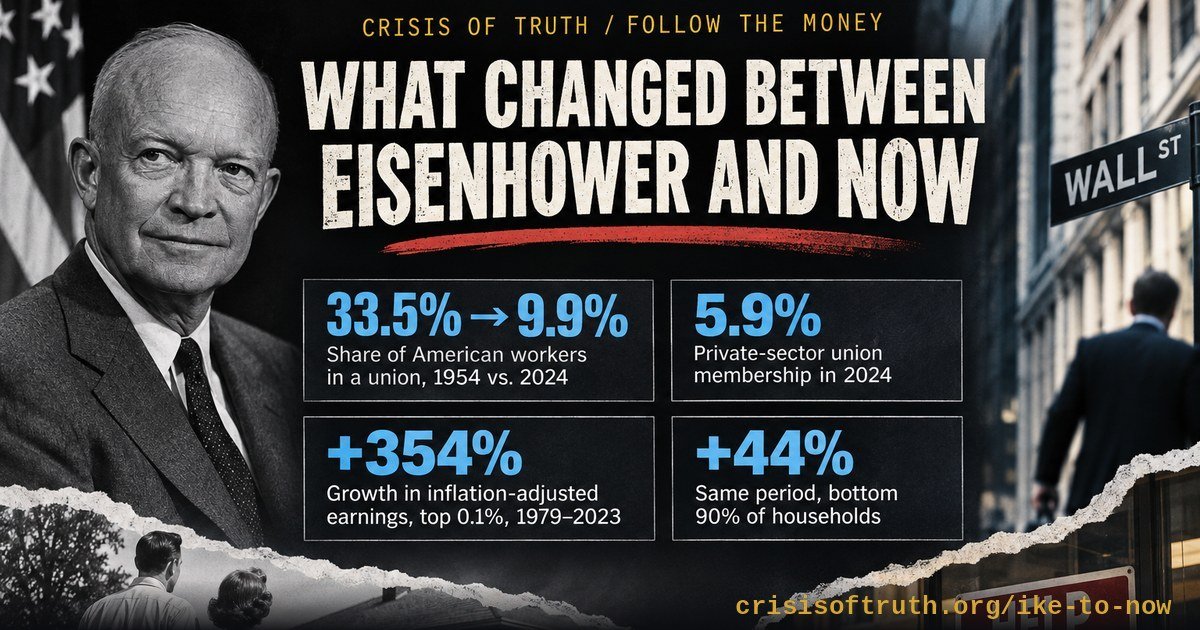
What Changed Between Eisenhower and Now
Ask anyone over sixty what changed, and you will hear the same thing: it used to be possible to raise a family on one paycheck. This page asks why. It answers with documents, not opinion: who organized, who paid, and what the numbers did afterward. Both parties appear in it.
1. Then and now
Sources: EPI union membership table (BLS data); AIER, citing BLS; EPI, 2026 union density report.
2. Eisenhower, accurately
Eisenhower is a good symbol of that era because he accepted the New Deal order. In a 1954 letter to his brother Edgar, he wrote that any political party that tried to abolish Social Security, unemployment insurance and labor laws would never be heard from again in American politics. (Eisenhower letter)
The record also shows he was no union champion. He wanted modest changes to the Taft-Hartley Act, not repeal, and he opposed a national right-to-work law. In 1959 he backed and signed the Landrum-Griffin Act, which tightened regulation of unions. (Lee, Eisenhower and Landrum-Griffin; Eisenhower Library) His Labor Department kept friendly relations with union leaders, and he won 48% of the union vote in 1956. (Mitchell papers)
The fair summary: a Republican who treated unions and the safety net as permanent facts. His brother Edgar was among the party's Old Guard who disagreed.
The tax code of that era. From 1954 to 1963 the top federal income tax rate was 91 percent, and the corporate rate was 52 percent. (Tax Policy Center; EPI) One caution, because skeptics will raise it: almost no one paid 91 percent. In 1963 only 501 returns out of 64 million reported income in that bracket, and the Tax Foundation estimates the top 1 percent paid about 42 percent of their income in all taxes combined. (Tax Policy Center; Tax Foundation)
3. The memo
On August 23, 1971, a corporate lawyer named Lewis Powell, soon to join the Supreme Court, wrote a confidential memo for the U.S. Chamber of Commerce. His argument: the American economic system was under broad attack, and business had to organize politically, with money and long-term planning. (Moyers & Company, with the full memo; The American Prospect)
What followed, from named sources:
- In 1972, the Business Roundtable was formed, with membership limited to top corporate CEOs. (Moyers)
- The Chamber of Commerce doubled its membership between 1974 and 1980. (The Nation)
- Corporate political action committees grew from 89 in 1974 to 949 by January 1980, according to FEC records cited in a law review. Labor PACs went from 201 to 276 over the same stretch. (Arizona Law Review; Christian Science Monitor, 1980)
- By mid-1980, corporate PACs had raised $23 million to unions' $17.5 million, the first time corporate PACs out-raised labor. (Christian Science Monitor, 1980)
Historians call the memo a catalyst and a blueprint, not the single cause. But it is a rare thing: the plan, in the planner's own words.
4. The ideas that gave it cover
Economist Milton Friedman supplied the public argument. In 1970 he wrote that the one social responsibility of business is to increase its profits. In 1980 his PBS series Free to Choose drew an estimated 14 to 15 million viewers, and the companion book was the year's best-selling nonfiction title. (FEE) A 1976 paper by Michael Jensen and William Meckling turned the idea into pay incentives, and executive pay became increasingly stock-based. (Time) Jensen later called stock options “managerial heroin” and said his ideas were misused. (Advisor Perspectives)
5. The political turn
Reagan and Thatcher both embraced these ideas. (Davis) In 1981 Reagan fired striking air traffic controllers and hired replacements, and union membership fell to about 16 percent during that decade. (Hewitt & Lawson, Macmillan)
6. The Supreme Court finishes the job
The same Lewis Powell who wrote the 1971 memo later wrote a landmark opinion as a Supreme Court justice. In First National Bank of Boston v. Bellotti (1978), a 5–4 Court, with Powell writing for the majority, held that corporations have First Amendment protection for speech in ballot campaigns, even on issues unrelated to their business. (Bellotti summary)
In 2010, Citizens United v. FEC, also decided 5–4, built on that reasoning. The Court struck down the ban on corporations and unions spending general treasury money on independent political advertising, ruling that it was a ban on speech, and it overruled its own 1990 decision in Austin v. Michigan Chamber of Commerce. It upheld disclosure requirements and left other campaign finance laws in place. (Congressional Research Service)
Two points a fair reader should know. The ruling applies to unions as well as corporations. And the majority's reasoning was that the government may not suppress political speech based on the speaker's corporate identity. The dissent, written by Justice Stevens and joined by three others, disagreed. (CRS)
Whether you think this was a victory for free speech or the removal of the last guardrail is exactly what the three questions below are for.
7. Not just one party
This story is not a Republican-only story. Several of the biggest changes for working people were signed by a Democratic president, and the documents show it.
- NAFTA (1993). The agreement was initiated under George H. W. Bush. Bill Clinton lobbied Congress for it and signed it in December 1993. (EBSCO; American Yawp) The House passed it 234–200. Democrats split 102 for and 156 against; Republicans voted 132–43 in favor. Big labor unions and two of the three top House Democratic leaders opposed it. (Christian Science Monitor, 1993) Clinton said it would create 200,000 U.S. jobs by 1995. The Economic Policy Institute reported in 2001 a net loss of more than 766,000 actual and potential jobs through 2000, while supporters point to rising trade. The long-term effects remain debated. (EBSCO)
- Telecommunications Act (1996). Clinton signed it on February 8, 1996. It eliminated the national ownership cap on commercial radio stations. By 2002 ten companies controlled about two-thirds of the radio audience, and news staffs shrank sharply. Republican Senator Bob Dole called the law a giveaway to media firms. (EBSCO; Clinton signing statement)
- Gramm-Leach-Bliley Act (1999). Clinton signed it on November 12, 1999. It repealed Glass-Steagall provisions that had separated banks from securities firms. He called its passage an overwhelming bipartisan majority and said it would modernize financial law and increase competition. (American Yawp)
- The 2016 Democratic primary. About 20,000 DNC emails were published by WikiLeaks on July 22, 2016. Some suggested favoritism toward the Clinton campaign, and DNC chair Debbie Wasserman Schultz left her post around the convention. (Snopes) A lawsuit by Sanders supporters was dismissed because the plaintiffs lacked standing. The judge did not rule on whether the DNC was neutral. (Law&Crime) What is not established is that the tactics floated in the emails were carried out or changed the result.
Following the money. In the 2024 cycle, business PACs gave about 55% of their contributions to Republicans and 45% to Democrats, a gap that has narrowed from roughly 60/40 in 2020 and 57/43 in 2022. Finance, insurance and real estate PACs led every sector with $82.6 million in direct contributions to federal candidates, ahead of health-sector PACs at $52.2 million. (Quorum, using OpenSecrets and FEC data) These figures cover business PACs in OpenSecrets' top 20, not all corporate giving, so treat them as a floor, not a total.
The point is not to excuse one party by blaming the other. Both parties took money and made choices, and a reader who wants answers has to follow the votes, not the labels.
8. Why most people never heard this
If these facts are public, why do so many Americans not know them? The record supports two parts of the answer, and it does not support a third.
Fewer owners, fewer voices. The 1996 Telecommunications Act, covered above, removed the national cap on radio station ownership, and a few companies came to own most of the dial. Fewer owners means fewer editorial decisions about which stories get told.
The Fairness Doctrine. From 1949 the FCC required broadcast licensees to cover controversial public issues and to present contrasting views. (Congressional Research Service) In 1987, an FCC led by Reagan appointee Dennis Patrick voted 4–0 to repeal it, concluding it violated the First Amendment. (Reagan Library; CRS) Congress passed a bill to write the doctrine into law, and Reagan vetoed it; Congress could not override. (Snopes, which reports the Senate vote as 59–31 and the House vote as 302–102)
What the record does not show: that the repeal created Fox News or talk radio by itself. The doctrine covered only broadcast licensees, not cable, and the Congressional Research Service reasons it likely could not have been applied constitutionally to cable or satellite. (CRS) Whether the repeal changed what people heard is still debated.
What this page does not claim. Many people say schools were built to keep Americans from thinking critically, and that John D. Rockefeller's education philanthropy was part of it. This page does not make that claim, because we could not support it with a primary source or a historian who documents it. A widely shared 1913 line by Rockefeller adviser Frederick Gates about people yielding “with perfect docility to our molding hand” is real, but in its original essay on rural schools it is framed as a “dream,” so quoting it alone leaves out context. We would rather leave the claim out than lose you on it.
Go deeper on how this works. Two other Crisis of Truth pages cover the mechanics. Rich Kids Learn Power. Your Kids Learn Obedience. compares what elite private schools teach with what most public schools teach, and Somebody Gets Paid When You Get Furious shows how propaganda is built to bypass your critical thinking, with a 10-second test before you share.
9. Money and government: what the record shows
Is there a conspiracy between the rich and elected officials? The documents show something both plainer and more legal than a secret plot: organized, open, coordinated influence. Here is what is on the record.
- The plan was written down. The 1971 Powell memo told business to organize and to use politics and the courts. It was a confidential memo, but what followed (the Business Roundtable, the Chamber’s growth, corporate PACs) happened in public.
- Lobbying is a multibillion-dollar industry. Federal lobbying hit a record $4.4 billion in 2024, per OpenSecrets, with the National Association of Realtors at over $86 million and the U.S. Chamber of Commerce at $76.2 million. (Washington Examiner, citing OpenSecrets)
- The revolving door. Public Citizen found that of the 44 former members of the 115th Congress who took jobs outside politics, 26 (59%) went to lobbying firms, consultancies or business and trade groups that seek to influence government. (Public Citizen)
- Who gets heard. Political scientists Martin Gilens and Benjamin Page compared 1,779 policy issues from 1981 to 2002 against public opinion. They concluded that “economic elites and organized groups representing business interests have substantial independent impacts” on policy, while average citizens have “little or no independent influence.” When business groups strongly favored a policy it was enacted about 47% of the time, and about 16% of the time when they opposed it. (Journalist’s Resource summary of Gilens & Page, Perspectives on Politics, 2014)
What this shows, and what it does not. Money and officials cooperating in the open is documented. A secret agreement to rig the system is not. And Gilens and Page measured who wins, not why; other political scientists have challenged their method and conclusions. (Bashir critique) Lobbying is also protected by the First Amendment right to petition the government, and unions, nonprofits and ordinary citizens lobby too. The better question is the one in section 11: legal, yes; is it healthy?
10. What the other side says
- AEI scholar Scott Winship finds that total worker compensation has tracked productivity, and that rising benefit costs explain part of the wage gap. (AIER, citing Winship)
- The 1950s were not a golden age for everyone. Women and minorities were largely shut out of its gains before the Civil Rights Act. (AIER)
- Union decline is often attributed to the shift to a service economy and to right-to-work laws, not only to organized opposition. (Michael Barone)
- Defenders of Citizens United say it protects political speech by all kinds of groups, including unions and nonprofits, and that the First Amendment does not depend on who is speaking. (CRS, describing the majority's reasoning)
- NAFTA and the 1996 telecommunications law passed with large bipartisan majorities, and Democrats were divided on NAFTA. Clinton and his supporters argued these laws would create jobs, competition and lower prices. (CSM; EBSCO)
- Unions spend on politics too. Union PACs spent about $55 million in the 2024 cycle, and unions reported about $1.75 billion on politics and lobbying in federal LM-2 filings for 2023–2024. (NILRR, a right-to-work research group, citing Department of Labor filings and OpenSecrets) These figures measure different things from the business PAC numbers above and should not be compared directly. We do not use that source's much larger estimate, which rests on its own assumptions.
- Business organized in 1971 partly in response to a real wave of regulation and consumer activism. Unions had organized politically too. Both are legal.
- Defenders of Friedman argue his 1970 essay did not create shareholder primacy; it matched traditional thinking. (Cheffins, Harvard Law forum)
11. What you can do about it
Editor’s note. I run this site. A critical thinking class changed how I read everything, including the things I already believed. It did not tell me what to think. It taught me to ask what a claim rests on and who gains if I accept it. That is the only reason I built this page the way I did: every claim sourced, the other side included, nothing asked of you but a fair look. — Brad Schrunk
Knowing the facts is the first step. Being able to test the next claim you meet, from any side, is the second. Four things you can start today:
- Take a free critical thinking course. Keystone College’s Professional Development Institute offers Introduction to Critical Thinking, free, online and self-paced, about 7 hours with 90 days of access. It teaches how to ask the right questions, critique an argument and logically break down an issue. We have no stake in it; the registration link goes to a partner site, so read what it asks before you sign up.
- Run the 10-second test before you share. Somebody Gets Paid When You Get Furious shows how content is built to bypass your thinking, and gives you a quick check.
- Go to the primary source. The Powell memo, the Citizens United opinion and the EPI and BLS union tables are all public. If a claim, including one on this page, cannot be traced to a document, treat it as unproven.
- Seek the strongest opposing argument. Read section 10 again, then look up what the best critics say about anything you believe. If your view survives that, it is stronger.
12. You decide
Is it legal?
Yes. That is the point: it was done in the open, through lobbying, donations and think tanks.
Is it constitutional?
The Supreme Court has said yes, by 5–4 in Citizens United. Four justices disagreed, and many Americans still do. Whether this concentration of influence is healthy for a democracy is the real question.
Is it morally and ethically acceptable?
That one is yours. You now have the documents.