CRISISOFTRUTH
The Culmination · Primary Sources · 1971 to Today

The Middle Class Didn't Die of Natural Causes

The autopsy of the American middle class — nine wounds, every one with a name, a date, and a signature.

Crisis of Truth has spent a year documenting the pieces one at a time: the Powell Memo, dark money, the trade deals, the bank deregulation, the propaganda machine, the lost rights. This page puts them on one table. Read it as a coroner's report. Each wound is a law, a ruling, or a policy you can look up. Each one was signed by someone. Some of those signatures are Republican. Some are Democrat. None of them were yours.

It's a big club, and you ain't in it. — GEORGE CARLIN · Life Is Worth Losing, HBO, 2005
32.5%
of all U.S. household wealth held by the top 1% — a record high.
Federal Reserve Distributional Financial Accounts, Q2 2026 · FRED
2.5%
of all U.S. household wealth held by the entire bottom half of the country.
Federal Reserve DFA · FRED
10M
more Americans without health insurance by 2034 because of the 2025 reconciliation law.
Congressional Budget Office, Aug. 2025 · summary
10.0%
of U.S. workers belong to a union. In the private sector it's 5.9%. At the 1950s peak it was about a third.
Bureau of Labor Statistics, 2025 · BLS
The scoreboard: who owns America
Share of all U.S. household wealth, 1989–2026
Top 1% of householdsBottom 50% of households (about 66 million)
Share of U.S. household wealth: top 1% vs. bottom 50%, 1989–2026 The top 1% rose from 22.8% in 1989 to 32.5% in 2026. The bottom half fell from 3.5% to 2.3%. 0%10%20%30%1990200020102020 Top 1%: 32.5% Bottom 50%: 2.3%
6.5×In 1989 the top 1% held 6.5 times as much wealth as the entire bottom half of the country.
14.1×Today it's 14.1 times. The gap more than doubled.
+9.7 / −1.2Points of the nation's wealth gained by the top 1% and lost by the bottom half since 1989.
Show the numbers
YearTop 1%Bottom 50%
198922.8%3.5%
199022.4%3.5%
199123.1%3.7%
199223.0%4.1%
199324.5%3.8%
199425.6%3.5%
199527.3%3.7%
199627.1%3.5%
199727.3%3.4%
199827.1%3.5%
199927.3%3.2%
200027.3%3.2%
200125.5%3.1%
200224.7%3.0%
200325.5%2.7%
200426.8%2.5%
200527.2%2.5%
200627.8%2.4%
200729.0%2.0%
200828.4%1.2%
200927.9%0.7%
201028.4%0.5%
201128.8%0.5%
201229.7%0.6%
201329.4%0.9%
201430.2%1.1%
201530.3%1.1%
201630.7%1.3%
201730.5%1.4%
201830.5%1.6%
201930.1%1.7%
202029.8%2.1%
202130.7%2.4%
202229.3%2.7%
202329.8%2.6%
202430.7%2.4%
202531.5%2.4%
2026 (Q2)32.5%2.3%
Source: Federal Reserve, Distributional Financial Accounts, third-quarter values (2026 is Q2, the latest released) · Top 1% · Bottom 50%
Download the data (Excel)
Before the Autopsy

Our Forebears Warned Us

Three films made between 1942 and 1956, by people who had just watched fascism and Stalinism rise, show how authoritarian power is built. None of them is evidence about today. All of them teach you what to look for.

1942 · Keeper of the Flame (MGM)

More than eighty years ago, Katharine Hepburn and Spencer Tracy starred in Keeper of the Flame, a Hollywood film about wealthy Americans quietly financing an authoritarian movement. The fictional conspirators planned to wrap themselves in the flag, use newspapers to spread hatred, set religious and racial groups against each other, attack organized labor, and ride manufactured patriotism into power.

It is a movie, not evidence. It proves nothing about any party today. What it shows is that Americans in 1942 already recognized the method — eight years after a real group of financiers was accused, in sworn testimony before Congress, of trying to recruit a Marine general to lead a march on Washington.

The question is never whether someone calls themselves a patriot. The question is whether their actions protect the Constitution, the Bill of Rights, free elections, a free press, and the rights of ordinary Americans.

Research the film: AFI Catalog · The real 1934 plot: The Business Plot

1956

Orwell's 1984

Full film · Edmond O'Brien, Michael Redgrave · The Sprocket Vault

It wasn't about the past. It was a warning about how power works — not overnight, but step by step:

  • Permanent war justifies fear, obedience and emergency powers. The enemy changes; the fear never stops.
  • History is rewritten so the leader is never wrong. When facts contradict the story, the facts disappear.
  • Slogans, hate rituals and outrage replace the truth.
  • Loyalty tests become normal. Neighbors inform on neighbors. Silence becomes guilt.
  • Language is degraded until people lose the words they need to think critically.
  • Public submission matters more than truth. Power exists to preserve itself.

Comparing today to 1984 isn't about insults. It's about patterns. When you see the press called “the enemy,” loyalty demanded over law, reality dismissed as “fake,” and government power used to punish critics, you're not being dramatic. You're recognizing the warning signs the book was written to teach. Authoritarianism doesn't announce itself. It normalizes itself.

1954

Animal Farm

Full film · FilmRise

Orwell's fable of a revolution betrayed: the animals overthrow a cruel farmer, then watch the pigs become the new masters. Squealer, the pigs' spokesman, rewrites the rules one word at a time until the last commandment reads: “All animals are equal, but some animals are more equal than others.”

Boxer, the loyal workhorse who believes every promise and works himself to death, may be the most painful portrait of the working man in English literature.

The twist most people never learnThis film was itself propaganda. Historian Tony Shaw found documents showing the CIA's Psychological Strategy Board helped get it made, and the filmmakers changed Orwell's ending: in the book, the pigs simply become the new elite; in the film, the animals rise up and overthrow them — the message the CIA wanted aimed at the Soviet bloc. A film about propaganda, shaped by propaganda. Times Higher Education
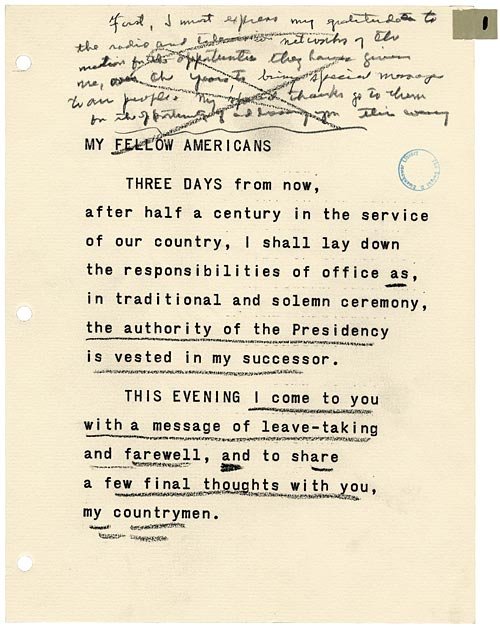
President Dwight D. Eisenhower delivering his televised farewell address, January 17, 1961
Eisenhower delivers his farewell address, Jan. 17, 1961.Public domain · U.S. National Archives

A five-star general and Republican president, on his way out the door, warned the country about the very machine this page documents. Most Americans have never heard the speech. Read or watch it at the National Archives.

1934
A two-time Medal of Honor Marine tells Congress he was asked to lead a private army against the New Deal. He says no.
Maj. Gen. Smedley Butler · McCormack–Dickstein Committee · Business Plot
1938
“The liberty of a democracy is not safe if the people tolerate the growth of private power to a point where it becomes stronger than their democratic state itself.”
Franklin D. Roosevelt · Message to Congress on monopoly, Apr. 29, 1938 · American Presidency Project
1961
“We must guard against the acquisition of unwarranted influence… by the military-industrial complex.”
Dwight D. Eisenhower, Republican · Farewell Address · National Archives
How to Read This Page

Evidence Over Outrage

Every claim below carries a reliability tag. We would rather show you where the evidence is thin than pretend it isn't. A critic who can knock down one overstated line can dismiss the whole page — so there are no overstated lines.

Documented

On the public record: a statute, a vote, a court ruling, an official dataset, or the person's own words.

Estimate

An official or peer-reviewed estimate. Real, but a model — we give the range, not just the scariest number.

Contested

Reported by a credible source but disputed. We tell you who disputes it and why.

Quarantined

Circulating, unverified, or declined. Shown so you know we looked — and why we won't assert it.

01
Wound One · 1971–Present

The Blueprint

Mechanism: organized money builds a permanent machine to produce ideas, laws, and judges

Most of what follows was not improvised. A future Supreme Court Justice wrote down a strategy. Wealthy donors funded it. Within a decade the institutions he described existed. That is not a theory — the memo, the founding dates, and the funders are all on the record.

AUG. 23, 1971Documented

The Powell Memo

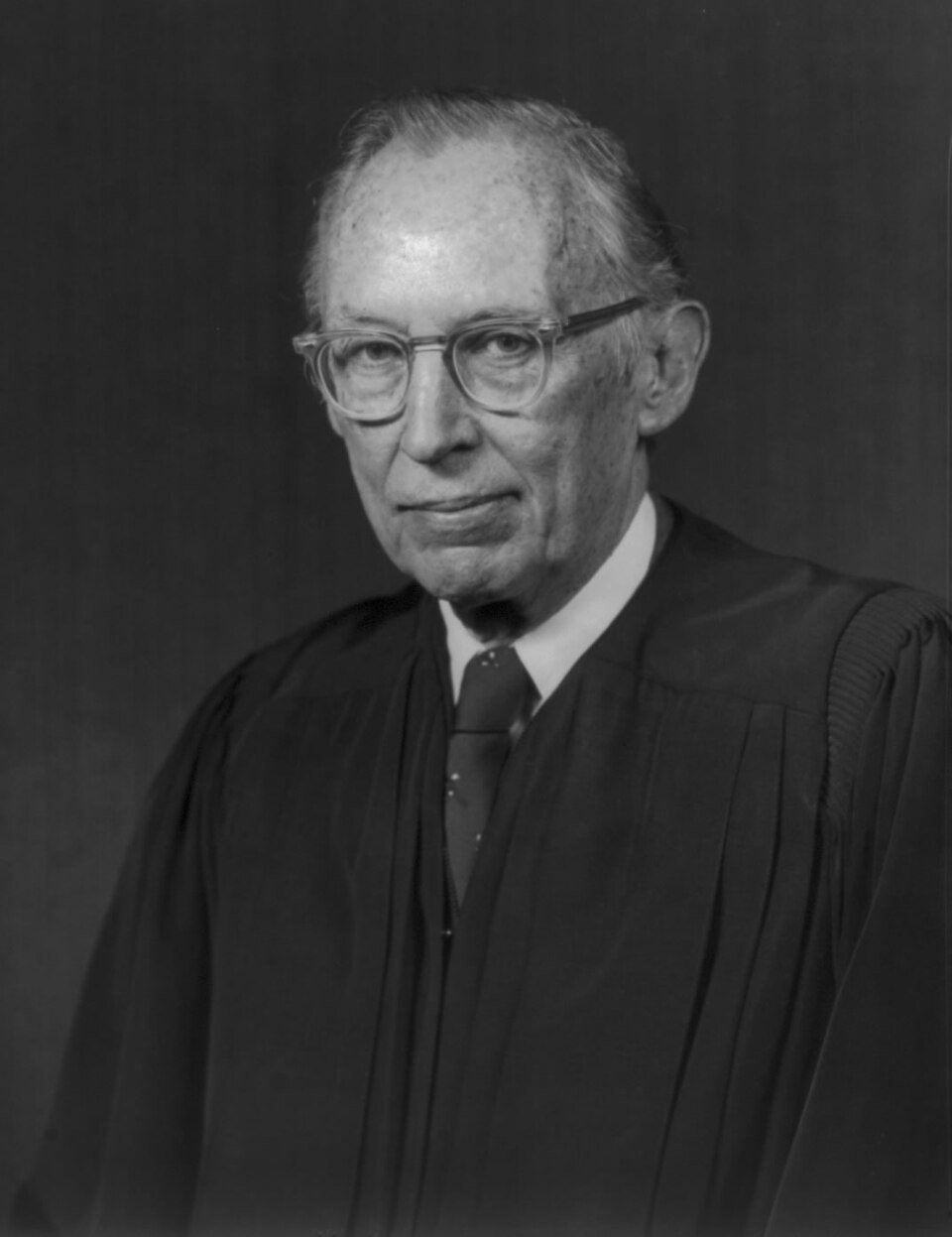
Corporate lawyer Lewis Powell sends a confidential memo to the U.S. Chamber of Commerce urging business to organize: fund scholars, police textbooks and broadcasts, pressure universities, litigate aggressively, and pursue political power “with determination.” Two months later, Nixon nominates him to the Supreme Court. He is confirmed that December.

Justice Lewis F. Powell Jr., official Supreme Court portrait, 1976
Lewis Powell, 1976. He wrote the memo two months before his Supreme Court nomination.Public domain · Library of Congress
1973Documented

The Heritage Foundation and ALEC are founded

Paul Weyrich co-founds the Heritage Foundation with seed money from brewer Joseph Coors, and the same year helps launch the American Legislative Exchange Council — which writes “model bills” that corporate members and state legislators vote on together. Heritage later produces Project 2025.

1977 – 2016Documented

The Koch network builds the assembly line

Jane Mayer's five-year investigation traces the network that funded Cato (1977), university programs, litigation groups, and Americans for Prosperity — and pledged $889 million for the 2016 cycle alone.

Source: Jane Mayer, Dark Money (Doubleday, 2016) · Crisis of Truth: Dark Money · Koch Network
OCT. 30, 2025Documented

Heritage's president defends a friendly interview with a white nationalist

After Tucker Carlson hosted Nick Fuentes, Heritage president Kevin Roberts released a video defending Carlson as a permanent “close friend” of Heritage and attacking his critics. Board member Robert George, visiting fellows, members of Heritage's own antisemitism task force, and senior staff resigned. Roberts apologized for parts of the video but did not retract it.

Declined Claim — Not Published as Fact

Claim: “The Heritage Foundation is a Nazi group in hiding.”

Why we decline it: There is no documentary evidence that Heritage is a Nazi organization, and the people who resigned in protest in 2025 were themselves conservatives who refused to stay silent. The documented record above is damning on its own terms: a think tank that wrote a governing blueprint for the presidency, whose president publicly embraced a man who platformed a Holocaust-denying white nationalist and would not take it back. That is the strongest version that survives a hostile reader. A label we can't prove only gives them an excuse to stop reading.

VERDICT: Declined. Documented conduct published instead.
02
Wound Two · 1947–2011

The Jobs

Mechanism: weaken the workers' bargaining power, then let capital move where labor is cheapest

The middle class was built on a factory paycheck backed by a union contract. Both halves were taken apart — first the union's leverage, then the factory itself.

JUNE 23, 1947DocumentedPassed over President Truman's veto

Taft-Hartley Act

Congress overrides Truman to restrict strikes and allow states to pass so-called “right-to-work” laws. The first major rollback of the New Deal's labor protections.

AUG. 5, 1981DocumentedRonald Reagan (R)

11,000+ air traffic controllers fired

Reagan fires striking PATCO members and bars them from federal work. Employers across the country take the signal: replacing strikers is now acceptable.

Crisis of Truth: Their Plan, Era 6
DEC. 8, 1993DocumentedBill Clinton (D) · House: 132 R + 102 D yes

NAFTA

Negotiated under George H.W. Bush, signed by Bill Clinton, passed the House with more Republican votes than Democratic. The Economic Policy Institute estimates trade deficits with Mexico had displaced about 682,900 U.S. jobs by 2010, mostly in manufacturing.

OCT. 10, 2000DocumentedBill Clinton (D) · bipartisan majorities

Permanent Normal Trade Relations with China

Opens the door to China's 2001 entry into the WTO. MIT/Harvard economists later estimate Chinese import competition cost the U.S. roughly 1 million manufacturing jobs and 2 to 2.4 million jobs overall from 1999 to 2011 — concentrated in specific towns that never recovered.

Source: Acemoglu, Autor, Dorn, Hanson & Price, NBER Estimate — authors call 2.4M an upper bound
Firsthand Account · Crisis of Truth

At Onan Corporation, we watched grown men who had given decades to that company cry when they learned their pension was gone. Not reduced. Gone. These were fathers and neighbors who had built their retirements on a written promise that was taken back in a boardroom they were never allowed to enter.

Witness testimony is labeled as such. It illustrates the pattern; it is not offered as proof of the national numbers. For those, see Ellen Schultz, Retirement Heist (Portfolio, 2011).

03
Wound Three · 1999–2008

The Banks

Mechanism: remove the Depression-era walls, then bail out the gamblers with your money

The law you're thinking of — the one where bankers got to play with ordinary people's money again — is the Gramm-Leach-Bliley Act of 1999. Bill Clinton signed it. Thirteen months later he signed a second law that made the bets themselves unregulated.

NOV. 12, 1999DocumentedBill Clinton (D) · Republican sponsors · Senate 90–8

Gramm-Leach-Bliley repeals the heart of Glass-Steagall

The 1933 wall between ordinary deposit banking and Wall Street securities and insurance comes down. Commercial banks, investment banks, and insurers may now merge under one roof. Sponsored by Republicans Phil Gramm, Jim Leach, and Thomas Bliley; passed by huge bipartisan majorities.

DEC. 21, 2000DocumentedBill Clinton (D) · attached to an omnibus spending bill

Commodity Futures Modernization Act

Keeps over-the-counter derivatives — including the credit default swaps that later sank AIG — largely outside federal regulation. Few members had time to read it; it rode in on a must-pass appropriations bill.

2008DocumentedGeorge W. Bush (R), then Barack Obama (D)

The crash and the bailout

The Financial Crisis Inquiry Commission concluded the crisis was avoidable and pointed to deregulation, reckless risk-taking, and failed oversight. Banks were rescued through TARP. Millions of families lost their homes; almost no senior executives went to prison.

Source: FCIC Final Report · Crisis of Truth: The Bank · Rigged Game
04
Wound Four · 1987–Today

The Airwaves

Mechanism: remove the duty to be fair, consolidate ownership, then use the licensing power as a club

The public owns the broadcast spectrum. Stations borrow it under license on the promise of serving the public interest. For nearly forty years that promise included presenting more than one side. Then it didn't. Today the licensing power itself is being used against newsrooms.

What Happened to the Fairness Doctrine? — BostWiki

1949 / 1969Documented

The Fairness Doctrine — upheld unanimously

The FCC requires licensees to cover controversial issues of public importance and air contrasting views. In Red Lion Broadcasting v. FCC (1969), the Supreme Court upholds it, reasoning that the airwaves belong to the public.

JUNE – AUG. 1987DocumentedRonald Reagan (R) veto · Reagan-appointed FCC

Congress tries to save it. Reagan vetoes. The FCC kills it.

Congress passes a bill writing the doctrine into law. Reagan vetoes it in June. In August, his FCC abandons the doctrine. National one-sided talk radio launches the next year; Fox News follows in 1996.

FEB. 8, 1996DocumentedBill Clinton (D) · Senate 91–5, House 414–16

Telecommunications Act of 1996

National radio ownership caps are lifted. One company, Clear Channel, grows to well over 1,000 stations. Local newsrooms are consolidated, then closed.

2025DocumentedDonald Trump (R) · FCC Chair Brendan Carr

The license as a weapon

FCC Chair Brendan Carr opens reviews of ABC, CBS, NBC, NPR, and PBS and revives a complaint against CBS's 60 Minutes that his predecessor had dismissed. ABC and CBS's parent companies each settle Trump's personal lawsuits for about $16 million — suits many legal experts considered weak. In September, ABC pulls Jimmy Kimmel Live after public pressure from Carr.

MARCH – JULY 2026Documented

“Correct course before their license renewals come up”

In March, Carr warns broadcasters running what he calls “news distortions” about the Iran war that their renewals are coming. In April the FCC orders early license reviews for eight ABC-owned stations; Disney files “under protest.” In July, after ABC and NBC decline to carry a prime-time presidential address live, Trump calls for their licenses to be pulled, and Carr says ABC's decision can factor into its review.

Precision matters here. The FCC does not license networks; it licenses local stations, including the ones the networks own. And a viral claim that the FCC fined ABC and NBC $25 million each for skipping the speech is false — no such fine exists. The real story doesn't need the embellishment: a government regulator publicly tying license reviews to editorial decisions the president dislikes.
05
Wound Five · Ongoing

The Minds

Mechanism: a public that can't spot propaganda can be sold anything — and now there's a paycheck for selling it

A population that can't name its own rights, can't tell news from opinion, and doesn't know who owns the outlet it's watching is a population that will blame its neighbor for what a boardroom did. Civics was hollowed out. Media literacy was never taught. And the platforms now pay people to keep you angry.

1920s –Documented

Propaganda becomes a profession

Edward Bernays openly describes the “engineering of consent” and sells it to corporations and governments. The techniques were never secret. They were simply never taught in school.

2012 / 2013DocumentedBarack Obama (D) · bipartisan NDAA

Smith-Mundt “modernized”

An amendment in the FY2013 defense bill lets U.S. government-produced international broadcasting be made available to domestic audiences — ending a 65-year firewall.

2020sDocumented

Outrage is monetized

Platforms like X pay large accounts based on engagement. Anger is the most reliable engagement there is. The result is a class of full-time political influencers whose income rises with your blood pressure.

Why do you feel the way you do about “them”?

Someone studied how to produce that feeling. Someone paid for it. Someone profits from it. The techniques have names, and they've been taught in business schools for a century. Most Americans have never heard of them. Start with these four videos.

Start here · The full story

Edward Bernays — The Man Who Invented Mass Manipulation — The System Archives

The short version

Propaganda & PR: How to Manipulate the Masses — Tiffany Ferg

The techniques, named

A Guide to Propaganda — Shawn Grenier, The Canvas

How it works on you today

Propaganda and Manipulation — Prof. Jerry Kroth. His sections on euphemism and the Iraq War hold up well. Some of his statistics on hip-hop, graduation rates and school shootings are his interpretation and are not verified here.

Edward Bernays, in his own words · Propaganda, 1928
“The conscious and intelligent manipulation of the organized habits and opinions of the masses is an important element in democratic society. Those who manipulate this unseen mechanism of society constitute an invisible government which is the true ruling power of our country.”
Chapter I, “Organizing Chaos”
“We are governed, our minds are molded, our tastes formed, our ideas suggested, largely by men we have never heard of.”
Chapter I
“…regimenting the public mind every bit as much as an army regiments the bodies of its soldiers.”
Chapter II, “The New Propaganda”
“If we understand the mechanism and motives of the group mind, is it not possible to control and regiment the masses according to our will without their knowing it?”
Chapter IV, “The Psychology of Public Relations” · Full text: libcom.org · Free audiobook, Internet Archive

He wasn't a fringe figure. Nephew of Sigmund Freud, he worked for the U.S. government's World War I propaganda office, then for American Tobacco, General Electric, and the United Fruit Company. In 1929 he staged women smoking Lucky Strikes in New York's Easter Parade as “torches of freedom.” In the early 1950s he ran United Fruit's campaign to paint Guatemala's elected government as a communist threat, the groundwork for the CIA-backed coup that overthrew it in 1954.

In his 1965 autobiography, Bernays wrote that a Hearst correspondent told him in 1933 that Joseph Goebbels, Hitler's propaganda minister, was using Bernays' book Crystallizing Public Opinion as a basis for the Nazi campaign against Germany's Jews. Bernays, who was Jewish, wrote: “This shocked me.” Supreme Court Justice Felix Frankfurter had already described Bernays and fellow publicist Ivy Lee to Franklin Roosevelt as “professional poisoners of the public mind.”

Sources: Edward L. Bernays, Biography of an Idea (1965) · Larry Tye, The Father of Spin (1998) · Boston University on Tye's research · PR Watch — Bernays and Guatemala · Crisis of Truth: Bernays

Field guide: six techniques used on you this week

01 · Reframing

Give a bad thing a good name

Pick words that make people feel the opposite of what the policy does.

Real examples: “collateral damage” for dead civilians, “enhanced interrogation” for torture, “job creators” for the wealthy, “right-to-work” for laws that weaken unions, “death tax” for an estate tax that only a tiny share of estates ever owed.
SPOT IT: Ask what the policy actually does, not what it's called.
02 · Repetition

Say it until it feels true

Repeat a claim through many trusted voices until people remember it as fact.

Real example: officials repeatedly linked Saddam Hussein to al-Qaeda before the Iraq War. By 2003, 80% of people who got their news mainly from Fox held at least one major false belief about the war, compared with 23% of NPR and PBS audiences (PIPA, via Nieman Reports). In 2005 President Bush said in public, “See, in my line of work you got to keep repeating things over and over and over again for the truth to sink in, to kind of catapult the propaganda.” Asked in 2006 what Iraq had to do with 9/11, he answered: “Nothing.”
SPOT IT: Hearing it often isn't evidence. Ask for the source.
03 · Borrowed Authority
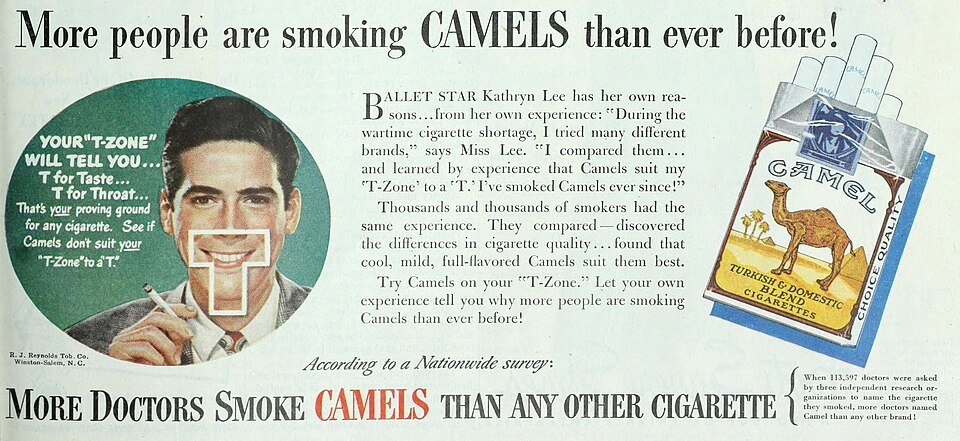
Vintage magazine ad reading More Doctors Smoke Camels than any other cigarette

Put a white coat on it

Use doctors, scientists, generals or “experts” to vouch for something they have no real basis to vouch for.

Real example: “More doctors smoke Camels than any other cigarette,” R.J. Reynolds ads, 1946–1952 (Stanford Research into the Impact of Tobacco Advertising). Ad image: Internet Archive Book Images, no known copyright restrictions. Today: think tanks with friendly names, funded by the industries they defend.
SPOT IT: Who is this expert, and who pays them?
04 · Emotional Transfer

Attach the product to a feeling

Connect a product, candidate or policy to freedom, patriotism, faith, fear or belonging, so you react before you think.

Real example: Bernays sold cigarettes to women as “torches of freedom” by tying them to women's rights. Today it's a candidate standing in front of a giant flag, or a bill named after a murdered child.
SPOT IT: Take away the flag and the music. What's left?
05 · Flooding & Distraction

Bury the story under noise

Keep attention on outrage, scandal and celebrity so the important story never gets heard.

Real example: “The real opposition is the media. And the way to deal with them is to flood the zone with [expletive].” — Steve Bannon, as reported by Michael Lewis, 2018. Too much noise and people give up trying to sort out what's true.
SPOT IT: When everyone's yelling about one thing, ask what passed quietly that week.
06 · Us vs. Them

Give people someone to blame

Point working people at each other — immigrants, welfare recipients, minorities, the other party — so they never look up at who wrote the rules.

Real example: the “welfare queen” story, the Southern Strategy, and today's rage-bait accounts that X pays by engagement. See Rage Bait, Please Share and The Tribal Mind.
SPOT IT: If a post makes you hate a neighbor, ask who benefits.
Case study · Us vs. Them, in our own state · Minnesota, 2025–2026

A real crime, an inflated number, a scapegoated community, and a political target

$250M
Documented Proven in federal court

The Feeding Our Future scheme stole about $250 million in federal child-nutrition money. Its ringleader, Aimee Bock, was convicted on all counts in March 2025. The Justice Department announced its 68th conviction in July 2026. The fraud was real, and the system is prosecuting it.

“$9B”
Estimate Said at a press conference

On Dec. 18, 2025, a federal prosecutor said half or more of roughly $18 billion billed to 14 Minnesota Medicaid services since 2018 may be fraudulent. Governor Walz called the figure “speculation.” The state's Medicaid inspector general said “I wouldn't say it's wrong” but that he had not seen evidence supporting it. No one has been charged with a $9 billion fraud. Repeated online, “may be” became “was stolen.”

Then came the four steps of the playbook:

  1. Attach it to a group. At a Dec. 2, 2025 Cabinet meeting, the President called Somali immigrants “garbage.” About 108,000 Somali Americans live in Minnesota; the overwhelming majority had nothing to do with the fraud, and Somali Americans were among the whistleblowers who exposed it. Fortune / AP
  2. Let a viral video make policy. A YouTuber's late-December video of locked daycare doors drew more than 100 million views. Within days, federal childcare funding to all of Minnesota was frozen. State inspectors then visited the nine centers in the video and found eight operating normally; the ninth had not yet opened for the day.
  3. Inflate the number. “Up to $9 billion may be fraudulent” became “$9 billion stolen” in memes, posts and campaign messaging.
  4. Point it at a political opponent. Memes now claim Sen. Amy Klobuchar, running for governor, went from broke to a “$20 million” fortune by stealing taxpayer money.
Checked — The Klobuchar Meme

Claim: Klobuchar personally stole millions and is worth “$20 million or more.”

What the record shows: Forbes estimated in 2019 that she and her husband were worth about $2 million. Her Senate financial disclosures report assets in ranges; we found nothing approaching $20 million. The millions on the Federal Election Commission site belong to her campaign committee, which is regulated political money and not her personal bank account. We found no indictment, charge, bank transfer, testimony or DOJ allegation connecting her to the Feeding Our Future money. The meme's “570 credit score” has no source we could find.

Who's paying for the attacks: Wisconsin billionaires Richard and Elizabeth Uihlein have put more than $13 million into Restore Sanity, a super PAC that had spent about $1.8 million on ads opposing Klobuchar by mid-September 2026.

VERDICT: No evidence for the meme. You don't have to like Klobuchar or vote for her. But an accusation of stealing requires evidence, not a meme. If someone has the evidence, post it. · Forbes 2019 · FEC · KAXE — Uihlein PAC money

The lesson isn't “no fraud happened.” It did, and people are going to prison for it. The lesson is how fast a proven $250 million crime became an unproven $9 billion one, then a whole community's fault, then a weapon against a candidate. Ask the questions that come before every share: what's proven, what's only claimed, and who profits if you believe it? Full investigation: The Scapegoating of Minnesota's Somali Community →

Go deeper · Crisis of Truth investigation

Rage Bait, Please Share

Oxford's Word of the Year for 2025 was “rage bait.” It's no longer a fringe complaint — it's a named business model. We traced it from a 2002 Usenet post about road rage to a leaked internal Facebook report that found troll-farm pages reaching 140 million Americans a month before the 2020 election. In between: how platforms pay per angry reply, and Rally Forge, the company Facebook banned for paying teenagers to post under fake identities.

Every claim traces to a company's own disclosed policy, a court record, or a named academic on the record. No accusations we can't prove.

Read it →
Who paid for this — and what do they gain if you believe it?

Ask it about every ad, every post, every headline, and every page on this site.

Misattributed Quotation

“Ours must be a leadership democracy administered by the intelligent minority who know how to regiment and guide the masses.” — widely shared as Bernays, Propaganda (1928).

We searched the full text of Propaganda and that sentence is not in it. It circulates on quote sites with no page reference. It sounds like him and may paraphrase his later writing, but until it's traced to a source, we use only words we can show you in the book. His real words, above, are worse — including the one that actually uses the word “regiment”: “control and regiment the masses according to our will without their knowing it.”

VERDICT: Unverified attribution. Not quoted as Bernays.

What we were never taught

Civics, the Constitution, the Bill of Rights, how to spot propaganda: few schools require any of it in depth. Here is what that produces.

22%
of 8th graders scored proficient in civics in 2022, the first decline since the test began. In U.S. history it was 13%.
National Assessment of Educational Progress (NAEP), 2022 · EdSource
65%
of American adults can name all three branches of government. 16% can't name a single one.
Annenberg Constitution Day Civics Survey, 2026 · Axios
9%
can name all five First Amendment freedoms. One in four thinks the First Amendment protects the right to bear arms.
The Law Most Americans Have Never Read · Ratified July 9, 1868

The 14th Amendment, Section 1

“All persons born or naturalized in the United States, and subject to the jurisdiction thereof, are citizens of the United States and of the State wherein they reside. No State shall make or enforce any law which shall abridge the privileges or immunities of citizens of the United States; nor shall any State deprive any person of life, liberty, or property, without due process of law; nor deny to any person within its jurisdiction the equal protection of the laws.”

In plain English: the government has to treat every person equally under the law, and can't take your life, freedom, or property without a fair legal process. It says any person, not any citizen and not any group a politician happens to like.

It was written after the Civil War to protect formerly enslaved people from Southern states. It is the clause behind:

  • Brown v. Board of Education (1954): ended legal school segregation
  • Gideon v. Wainwright (1963): your right to a lawyer if you can't afford one
  • Loving v. Virginia (1967): struck down bans on interracial marriage
  • Obergefell v. Hodges (2015): same-sex marriage
  • Applying most of the Bill of Rights to state and local governments, including your city police

Every American's protection rises or falls with everyone else's. When the courts narrow it for one group, the precedent is available against the next one. Where it applies today is argued over case by case. In 2025, in United States v. Skrmetti, the Supreme Court ruled 6–3 that a Tennessee law restricting medical care for transgender minors did not violate equal protection. The principle is settled. How far it reaches is still being decided in court.

Quarantined — Unverified

Case: “Gunther Eagleman” (real name David Freeman). A monetized political influencer whose reported law-enforcement employment history is inconsistent across sources (Harker Heights PD vs. Metro Transit PD — unresolved). A viral post from a single X user claims he charges $300 per promotional repost; it has not been independently verified, and Freeman has not publicly responded. Claims that he was paid by India, Russia, or another foreign entity trace to a single low-reliability source with no payment trail.

CONFIRMED: He profits from X's engagement-based monetization, like any large account. EVERYTHING ELSE: quarantined. Full breakdown at /ragebaitpleaseshare/.
06
Wound Six · 1971–Today

The Rights

Mechanism: declare a war on a substance or an enemy — and let the emergency powers fall on the public

The Bill of Rights was written to protect ordinary people from their own government. Half a century of “wars” — on drugs, then on terror — quietly reversed the burden: now the citizen has to prove innocence, to a government that may profit from the answer.

Civil Forfeiture — Last Week Tonight with John Oliver (HBO)

JUNE 17, 1971DocumentedRichard Nixon (R)

The War on Drugs is declared

Nixon calls drug abuse “public enemy number one.” Federal drug enforcement expands every decade after, under presidents of both parties.

1994 interview / 2016Contested

The Ehrlichman admission

Journalist Dan Baum reported in Harper's (2016) that Nixon aide John Ehrlichman told him in 1994 the drug war was designed to disrupt the antiwar left and Black communities by criminalizing the drugs associated with each — and that the administration knew it was lying about the drugs. Ehrlichman died in 1999. His family disputes the quote, and Baum's notes are the only record. We report it as Baum's account, not as established fact.

OCT. 12, 1984DocumentedRonald Reagan (R) · bipartisan Congress

Police get to keep what they seize

The Comprehensive Crime Control Act creates the Justice Department's Assets Forfeiture Fund and “equitable sharing” — letting local agencies keep up to 80% of what they seize through federal forfeiture. Forfeiture becomes a budget line.

1986 → 1994DocumentedReagan (R) · Clinton (D)

100-to-1 and the Crime Bill

The 1986 Anti-Drug Abuse Act punishes crack cocaine 100 times more harshly than powder — a disparity not reduced until 2010, and then only to 18-to-1. The 1994 Crime Bill funds prison expansion and mandatory minimums.

OCT. 26, 2001DocumentedGeorge W. Bush (R) · Senate 98–1

The USA PATRIOT Act

Passed six weeks after 9/11 with almost no debate. Only Sen. Russ Feingold voted no. It expanded secret searches, records demands, and surveillance. Its Section 215 bulk-records authority lapsed in 2020; its successor powers did not.

DEC. 31, 2011DocumentedBarack Obama (D) · bipartisan

NDAA indefinite-detention provisions

Section 1021 affirms military detention without trial for people the government designates as connected to al-Qaeda or “associated forces,” with deliberately ambiguous language on U.S. citizens. Obama signed it with a statement saying his administration would not authorize indefinite military detention of American citizens — a promise that binds no future president.

Source: Congress.gov — H.R. 1540 · Crisis of Truth: Habeas Corpus
JUNE 12, 2026Documented

Section 702 warrantless surveillance lapses — but doesn't stop

After deadlocking over whether the FBI should need a warrant to search Americans' communications in the Section 702 database, Congress let the statute expire. Collection continues anyway under a court certification issued in March 2026 that runs into 2027. Status as of this page's publication; check for updates.

Firsthand Account · Crisis of Truth editor · former Minneapolis Police Department network manager

I worked in law enforcement in Minneapolis, and I witnessed something that should trouble every American: officers seizing property from people — often over something as minor as a small amount of marijuana — without due process, without a trial, and without regard for constitutional rights. Property taken without a charge. The burden reversed, so the owner has to prove innocence. The poorest people, least able to fight, hit hardest. And departments allowed to keep what they take.

That's not justice. That's not liberty. The Bill of Rights was written to stop exactly this.

Minnesota has since reformed its law twice — a 2014 conviction requirement for judicial forfeitures and a 2021 overhaul passed with bipartisan authors. But the Institute for Justice still grades the state a D: from 2022 to 2023 at least 82% of Minnesota forfeitures went through administrative proceedings with no judge, and agencies can still route cases through the federal equitable-sharing program. IJ: Minnesota profile · Minnesota Reformer

07
Wound Seven · 2010–2024

The Courts

Mechanism: when Congress won't change the rules, a five-justice majority will

The Powell Memo said the courts were the most important arena of all. Fifty years of judicial pipeline-building produced a Supreme Court majority that has, ruling by ruling, removed limits on money, weakened the Voting Rights Act, cut union funding, stripped agencies of authority, and placed the president largely beyond prosecution for official acts.

DateCaseWhat it didVote
Jan. 21, 2010Citizens United v. FECUnlimited independent political spending by corporations and unions. Dark money follows through nonprofits that don't name donors.5–4
June 25, 2013Shelby County v. HolderStruck the Voting Rights Act formula that required jurisdictions with histories of discrimination to pre-clear voting changes.5–4
June 27, 2018Janus v. AFSCMEPublic-sector unions may no longer collect fees from the workers they are legally required to represent.5–4
June 28, 2024Loper Bright v. RaimondoOverturned 40 years of Chevron deference, shifting power from expert agencies to judges.6–2*
July 1, 2024Trump v. United StatesPresidents have broad immunity from criminal prosecution for official acts.6–3

*Justice Jackson recused in Loper Bright itself; the companion case, Relentless v. Department of Commerce, was decided 6–3.

08
Wound Eight · July 4, 2025

The Safety Net

Mechanism: cut health care and food aid at the bottom, extend tax cuts at the top — and sign it on Independence Day

The 2025 reconciliation law — sold as the “One Big Beautiful Bill” — is the clearest single example on this page, because Congress's own nonpartisan scorekeeper did the math.

AUG. 11, 2025Official EstimateSigned by Donald Trump (R) · passed on party lines

CBO: the bottom loses, the top gains

The Congressional Budget Office estimates the poorest tenth of households lose about $1,200 a year — roughly 3.1% of their income — mainly from Medicaid and SNAP cuts. The richest tenth gain about $13,600 a year, mainly from tax cuts. Middle-income households see modest gains.

2026 → 2034Official Estimate

10 million more uninsured

CBO projects 1.3 million more uninsured in 2026, rising to 10 million by 2034 — 7.5 million of them from Medicaid changes. Counting the expiration of enhanced ACA subsidies, the total climbs to roughly 14 to 15 million.

Who pays and who gains
Average yearly change in household resources, 2026–2034, per CBO
LosesGains
$14,800 a yearThe gap between what the richest 10% gain and what the poorest 10% lose under the 2025 law, by CBO's own numbers.
Show the numbers
HouseholdsPer yearShare of income
Poorest 10%−$1,200−3.1%
5th tenth+$800+0.8%
6th tenth+$1,200+1.0%
Richest 10%+$13,600+2.7%
Source: CBO letter, Aug. 11, 2025, 2025 dollars. CBO's letter states these four groups in its text; the other six tenths appear only in its figures, here.
Download the data (Excel)
Go deeper · Crisis of Truth investigation

Who Pays for the Nursing Home?

The law cuts nearly a trillion dollars from Medicaid over a decade — and Medicaid pays for most nursing-home care in America. CBO, Congress's own nonpartisan scorekeeper, estimates the law adds $3.4 trillion to federal deficits through 2034 and leaves 10 million more people uninsured, about 7.5 million of them from the Medicaid changes alone. Those are the official numbers, not a pundit's.

Read it →

Socialism for the rich. The free market for everyone else.

While the safety net shrinks, the people at the top collect public benefits most Americans never see: tax breaks written into law, subsidies, and deals buried in the fine print. Jane Mayer spent five years documenting the billionaire network that pushed for exactly this. In this talk she explains how it was built, starting from the Powell Memo.

Jane Mayer on Dark Money, Politics and Prose Bookstore, 2016.

Jane Mayer, in that talk
“If you press down on the rhetoric of the free market, you'll find, for instance, that Koch Industries benefits from a tremendous number of government subsidies, tax deals of various sorts… The free market is a utopian idea, but we all work with rules that are made by the people we elect.”

She also reported that in 2014, 80% of dark money — political spending from groups that never name their donors — came from the right. Her advice for anyone who wants to push back: look at who wrote the rules, and who they were written for.

Book: Jane Mayer, Dark Money (Doubleday, 2016) · How the tax code was rewritten: Two Tax Codes · Dark Money & The Fine Print
09
Wound Nine · 1898–Today

The Wars

Mechanism: sell the war on a false premise, send working-class kids to fight it, and pay the contractors

Every dollar spent on an unnecessary war is a dollar not spent on a school, a road, or a pension. Every one of those wars was fought mostly by the sons and daughters of working people. And at least two of the biggest were sold to the public on claims the government's own records later showed were false.

1787
“The means of defence against foreign danger have been always the instruments of tyranny at home.”
James Madison · Constitutional Convention, June 29, 1787 · Avalon Project, Yale Law
1795
“Of all the enemies to public liberty war is, perhaps, the most to be dreaded, because it comprises and develops the germ of every other.”
James Madison · Political Observations, April 20, 1795 · Founders Online, National Archives
1953
“Every gun that is made, every warship launched, every rocket fired signifies, in the final sense, a theft from those who hunger and are not fed, those who are cold and are not clothed.”
Dwight D. Eisenhower, Republican · “The Chance for Peace,” April 16, 1953 · Eisenhower Library
1935Documented

War Is a Racket

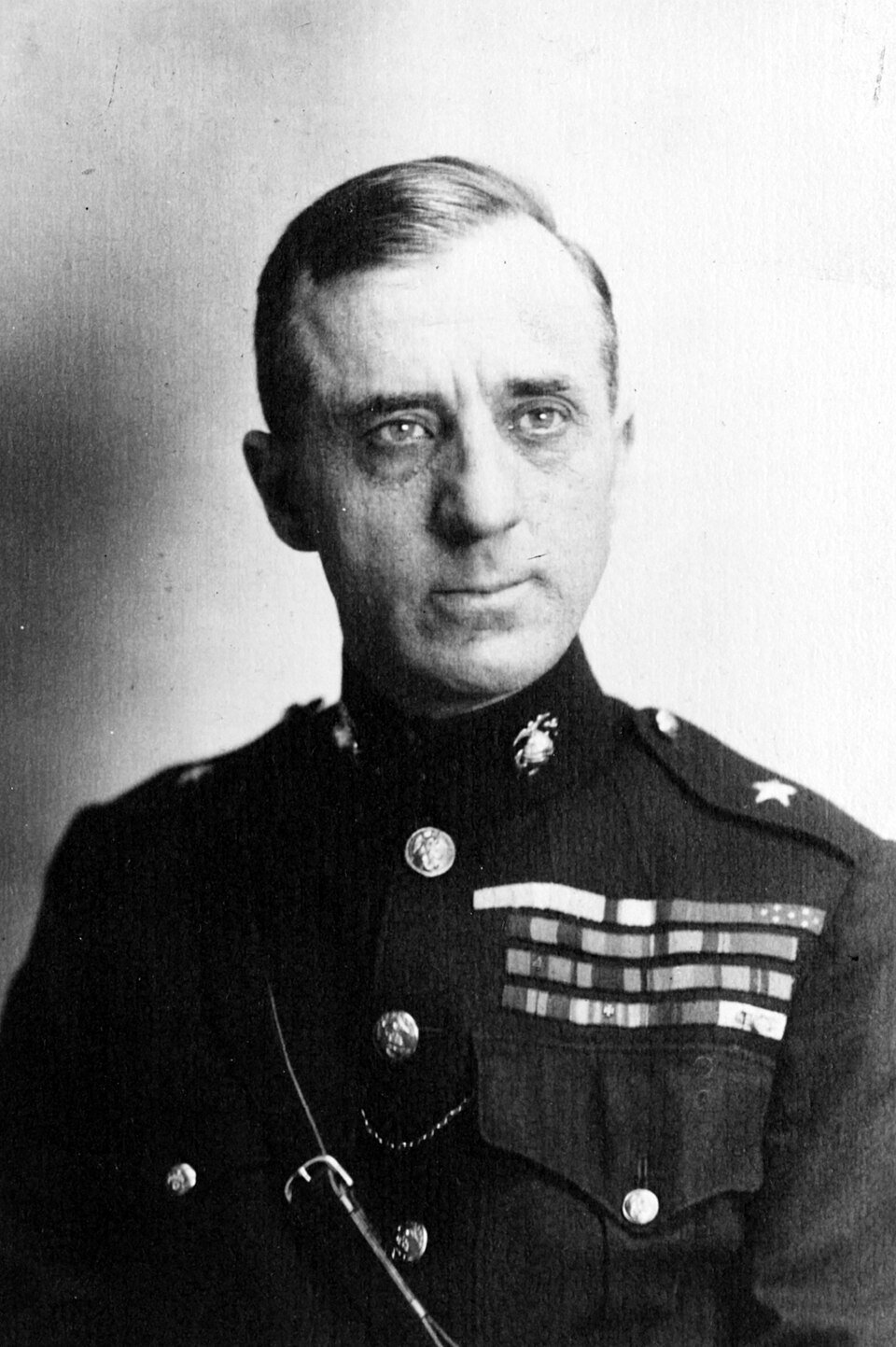
Maj. Gen. Smedley Butler, two-time Medal of Honor Marine, writes that war is “conducted for the benefit of the very few, at the expense of the very many,” and lists the companies whose profits multiplied during World War I while soldiers came home to nothing. He wrote it from the inside: 33 years of leading Marines into Mexico, Haiti, Nicaragua, China and the Philippines.

Source: Smedley D. Butler, War Is a Racket (1935; Feral House edition, 2003) · Amazon · Crisis of Truth: Selling War
Brigadier General Smedley D. Butler, U.S. Marine Corps, in uniform
Smedley Butler, two-time Medal of Honor recipient.Public domain · U.S. Naval History and Heritage Command, NH 64355
AUG. 4–7, 1964DocumentedLyndon Johnson (D) · Senate 88–2, House 416–0

The Gulf of Tonkin: an attack that never happened

Johnson goes on national television to report a second North Vietnamese attack on U.S. destroyers. Three days later Congress passes the Gulf of Tonkin Resolution, giving him broad power to wage war without a declaration. Only Senators Wayne Morse and Ernest Gruening vote no. In 2005 the NSA declassified its own internal history, which concluded that the August 4 attack did not occur and that intelligence had been “skewed” to support the claim that it had.

1965 – 1972Documented

The president's backers build the war

Brown & Root, the Texas construction firm of Herman and George Brown — financial backers of Lyndon Johnson since the 1930s — joins the RMK-BRJ consortium in 1965. The consortium's Vietnam construction contracts total about $1.9 billion. In 1967 the General Accounting Office faulted the “Vietnam builders” for losing track of hundreds of millions of dollars. Brown & Root later became KBR, a major Iraq War contractor under Halliburton.

JUNE 13, 1971Documented

The Pentagon Papers

Daniel Ellsberg leaks the Defense Department's own secret history of the war. It shows four administrations, from Truman to Johnson, saying one thing in public and another in private. Nixon's administration goes to court to stop newspapers from publishing it and loses, 6–3, in New York Times Co. v. United States.

1955 – 1975Documented

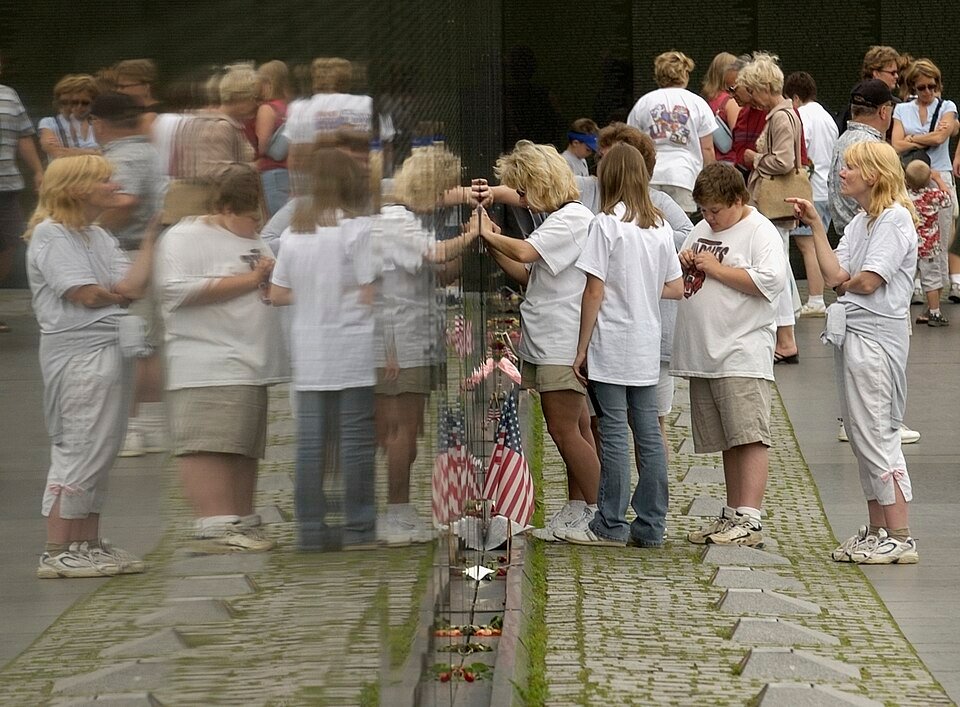
58,281 names

That is how many Americans are on the Vietnam Veterans Memorial today. Most were young, and most were working-class. A college deferment kept many wealthier families' sons out until the draft lottery began in 1969.

The destroyer USS Maddox underway at sea in the early 1960s
USS Maddox, the destroyer at the center of the Gulf of Tonkin reports.Public domain · U.S. Navy photo NH 97900
Visitors taking pencil rubbings of names on the black granite Vietnam Veterans Memorial wall
Visitors take rubbings of names at the Vietnam Veterans Memorial.Public domain · U.S. Navy photo by CWO Seth Rossman, 030616-N-9593R-153
SEPT. 18, 2001 → OCT. 2002DocumentedGeorge W. Bush (R) · bipartisan majorities

Sixty words and a war sold on weapons that weren't there

The 2001 Authorization for Use of Military Force, about 60 words long, has since been cited for operations in more than a dozen countries against groups that did not exist when it passed. Rep. Barbara Lee cast the only vote against it. In 2002 Congress authorized the Iraq War on claims of weapons of mass destruction; the Senate Intelligence Committee later found that the prewar claims were not supported by the intelligence.

2001 – 2021Estimate

The bill for the War on Terror: about $8 trillion

Brown University's Costs of War project estimates the post-9/11 wars cost roughly $8 trillion, including future medical care for veterans and interest on the borrowed money. None of it was paid for with a tax increase. It was borrowed, and the interest is still being paid.

Since 1789, Congress has formally declared war only 11 times, in five wars. The last was World War II. Korea, Vietnam, Afghanistan, Iraq and hundreds of smaller operations were all fought without one, even though Article I gives that power to Congress, not the president. U.S. Senate — Official Declarations of War
Not Found in the Record — Not Published as Fact

Claim: “President Johnson personally made hundreds of millions of dollars from the Vietnam War.”

We found no documentation of Johnson personally profiting from Vietnam contracts. What is documented is above: his longtime financial backers' company was a major Vietnam contractor, and the war itself was escalated on a false report. That is serious enough to stand on its own, and it can't be knocked down.

VERDICT: Personal-profit claim quarantined. Documented contractor ties published instead.
Misattributed Quotation

“If tyranny and oppression come to this land, it will be in the guise of fighting a foreign enemy.” — widely attributed to James Madison.

There is no record of Madison writing or saying it. Quotation researcher Barry Popik traces it to a 2001 internet post. It appears to be a paraphrase of Madison's real 1787 statement, which is quoted above. We use the real words.

VERDICT: Spurious. Barry Popik's research
The Signatures

Who Signed It

The wounds were not inflicted by one party. The design and most of the money came from the organized right. But at the decisive moments, Democrats held the pen too.

YearLaw or ActionSigned / Done ByParty
1947Taft-HartleyCongress, over Truman's vetoCONGRESS
1964Gulf of Tonkin Resolution (Vietnam)Lyndon JohnsonD
1981PATCO firingsRonald ReaganR
1984Federal forfeiture fund & equitable sharingRonald ReaganR
1986100-to-1 crack sentencingRonald ReaganR
1987Fairness Doctrine veto & repealRonald Reagan & his FCCR
1993NAFTABill ClintonD
1994Crime BillBill ClintonD
1996Telecommunications ActBill ClintonD
1999Glass-Steagall repeal (Gramm-Leach-Bliley)Bill ClintonD
2000Derivatives deregulation (CFMA); China PNTRBill ClintonD
2001USA PATRIOT ActGeorge W. BushR
2002Iraq War authorizationGeorge W. BushR
2008TARP bank bailoutGeorge W. BushR
2011NDAA indefinite detentionBarack ObamaD
2013Smith-Mundt modernizationBarack ObamaD
2025One Big Beautiful Bill ActDonald TrumpR
2025–26FCC license pressure on newsroomsDonald Trump & FCC Chair CarrR
Read the table honestly. Clinton's name appears more often than anyone's on the economic side. The Powell network supplied the blueprint and the funding; a Democratic administration chasing the same donors signed several of the most consequential pieces. That is the point Carlin was making. Both Parties Failed Working People →
They Told Us

The People Who Had the Nerve

None of this was discovered by Crisis of Truth. It was dug up, at real personal cost, by people who could have stayed comfortable. They come from the left, the right, and the libertarian corner — which is exactly why they're worth reading together.

Marine · 1881–1940

Smedley Butler

Two Medals of Honor. Spent 33 years fighting America's wars, then wrote that he had been “a gangster for capitalism.” In 1934 he told Congress that wealthy financiers had tried to recruit him to lead a march on Washington.

What it costMajor newspapers mocked his testimony; no one he named was ever prosecuted.
Read: War Is a Racket (1935) · Selling War
Consumer Advocate · b. 1934

Ralph Nader

Unsafe at Any Speed (1965) showed automakers knowingly sold dangerous cars. Within a year Congress passed the first federal auto-safety law. Seat belts, airbags, and the agencies that test your car trace back to him.

What it costGeneral Motors hired private investigators to dig up dirt on him. GM's president apologized under oath before a Senate subcommittee in 1966.
Read: Unsafe at Any Speed · Public Citizen (founded 1971)
Comedian · 1937–2008

George Carlin

Said out loud what economists hedge: the owners of the country want workers smart enough to run the machines and not smart enough to question the arrangement. “It's a big club, and you ain't in it.”

What it costArrested on stage in Milwaukee in 1972 over his “Seven Words” routine; a broadcast of a version of it reached the Supreme Court in FCC v. Pacifica (1978).
Watch: Life Is Worth Losing (HBO, 2005)
Libertarian Author · b. 1956

James Bovard

Lost Rights (1994) documented civil asset forfeiture, no-knock raids, and regulatory abuse years before it was fashionable, with more than 2,000 footnotes. A reminder that defending the Bill of Rights is not a left or right project.

What it costPer his publisher's biography, his work has been publicly denounced by the heads of the FBI, DEA, TSA, and FEMA.
Read: Lost Rights · Attention Deficit Democracy · jimbovard.com
Investigative Reporter · Pulitzer 2001

David Cay Johnston

Won the Pulitzer for exposing loopholes in the tax code at The New York Times. His books show, filing by filing, how the rules were rewritten so the people at the top pay less and everyone else pays the difference.

What it costDecades spent being the reporter powerful people least wanted to hear from.
Read: Perfectly Legal · Free Lunch · The Fine Print · Dark Money
Journalist · Pulitzer team 2002

Chris Hedges

Fifteen years as a New York Times foreign correspondent, part of the team that won a Pulitzer for coverage of global terrorism. Has spent two decades writing about empire, spectacle, and the decay of American democracy.

What it costThe Times formally reprimanded him in 2003 for a commencement speech against the Iraq War. He left the paper rather than be muzzled.
Read: Empire of Illusion · America: The Farewell Tour
Investigative Journalist · The New Yorker

Jane Mayer

Spent five years on court records, private archives, and interviews to map the billionaire network behind the modern right — how it built think tanks, university programs, and front groups, and how it hid the money.

What it costMayer has reported that private investigators looked into her background while she was reporting on the network.
Read: Dark Money (2016) · Dark Money
Congressman · Constitutional Law Professor

Jamie Raskin

Taught constitutional law for decades before entering Congress. Lead House manager for the 2021 impeachment trial and a member of the January 6th Committee. Explains the Constitution in plain English to people who were never taught it.

What it costLed the impeachment within weeks of losing his son — and has been a constant target since.
Read: Unthinkable (2022)
Independent Broadcaster

David Pakman

Built an independent, audience-funded political show from community radio, outside the corporate cable model that Wound Four describes. Proof that viewers will support reporting that respects their intelligence.

What it costNo network, no corporate safety net — the show lives or dies on its audience.
Watch: The David Pakman Show

Recognition is not endorsement of every view each person holds. Read them against each other. The Reading List →
The Claims We Didn't Make

Declined & Quarantined

These circulate widely on our own side of the argument. Here is why they are not on this page as fact.

Contested Attribution

“We may have democracy, or we may have wealth concentrated in the hands of a few, but we can't have both.” — attributed to Justice Louis Brandeis.

The sentiment matches Brandeis's views, but the line does not appear in his writings or opinions. It traces to a recollection published years later by someone who knew him. We don't put words in a Justice's mouth.

VERDICT: Attribution unverified. Not quoted on this page as Brandeis's words.
Declined — Evidence Doesn't Fit the Claim

“This gun-store robbery compilation proves poverty causes crime.”

Economic hardship and crime are linked in a large research literature. But a true-crime video of ten robberies is not that evidence: of the ten cases it narrates, only one robber is reported as citing poverty (he said he was homeless). Several had prior felony records; one was apparently suicidal; for others the motive was never established. Using it as proof invites a critic to dismantle the claim and the page with it.

VERDICT: Declined as evidence. A properly sourced page on poverty and crime research is a separate future investigation.
Framing Check

“This was one secret conspiracy.”

What is documented is not a single hidden plot. It is something harder to dismiss: a publicly written strategy, openly funded institutions, recorded votes, and signed laws — pursued over decades by people with overlapping interests, joined at key moments by the other party. It happened in plain sight. That is the scandal.

VERDICT: “Coordinated and documented,” yes. “Single secret conspiracy,” not shown.
For the Record

The Strongest Case Against This Page

Every Crisis of Truth page includes the best counterarguments, stated fairly. If this page is right, it can survive them.

“Automation killed more factory jobs than trade.”

Many economists argue productivity gains and automation explain most of the long decline in manufacturing employment, and that the China-shock estimates are upper bounds measured from a boom year to a recession year.

Fair point. The research shows trade's damage was real but concentrated — devastating to specific towns rather than the whole economy. Policy chose not to cushion those towns. That choice is the indictment.

“Trade made everything cheaper.”

Imports lowered prices on clothing, electronics, and household goods, which helps lower-income families most.

True. Cheaper TVs do not offset a lost pension, a closed plant, or a $400 emergency you can't cover. The gains were spread thin; the losses landed on specific people.

“Glass-Steagall's repeal didn't cause 2008.”

Bear Stearns and Lehman were pure investment banks; AIG was an insurer. None needed the 1999 repeal to fail.

Largely correct, and it's why this page pairs the repeal with the 2000 derivatives law and the regulatory failures the Crisis Inquiry Commission documented. The repeal enabled giant combined firms like Citigroup that then required rescue; it was one cause among several.

“The Fairness Doctrine chilled speech.”

Critics across the spectrum, including some civil-liberties advocates, argued it discouraged stations from covering controversy at all, and that with cable and internet the scarcity argument no longer holds.

A serious argument. Restoring the 1949 rule isn't the only answer. But the alternative that emerged — consolidated, one-sided, outrage-driven media — is the documented result.

“Wealth shares swing with the stock market.”

The top 1% share rises in bull markets because the wealthy own most stocks. Measured after taxes and government transfers, income inequality has grown less than raw figures suggest.

Both true. Neither changes that the bottom half holds about 2.5% of the wealth, or that the 2025 law moves resources from the bottom tenth to the top tenth by CBO's own count.

“Vietnam was about stopping communism, not profit.”

Most historians see Cold War containment, domino theory, and fear of looking weak as the main drivers of escalation — not contractor money.

Probably right about motive, which is why this page doesn't claim profit started the war. What's documented is that the escalation was sold on a false report, and that well-connected firms profited while working-class families buried their sons.

“The FCC is only enforcing the law.”

Chairman Carr says the agency's actions rest on existing rules — public-interest obligations, equal-time requirements, and an anti-discrimination investigation — and are not directed by the White House.

That's his position, on the record. Readers can weigh it against the timing: reviews and warnings that track the president's public demands, criticized even by Republican Sen. Ted Cruz.
Now That You Know

What You Can Do

01

Verify one thing

Pick a single entry on this page and follow the source link. Don't believe it because we posted it. If we got something wrong, tell us — corrections are published.

02

Call Congress

202-224-3121

The Capitol switchboard connects you to any member. Ask how they voted on forfeiture reform, Section 702 warrants, and the 2025 Medicaid cuts.

03

Share the receipts

Send this to one person who disagrees with you — not to win, but so they can check the signatures themselves.

Don't Take Our Word for It

Read the Books

Everything on this page was dug up first by the people who wrote these books. If you read only two, read the first two. Between them they explain who bought the system, and how the system now takes from you.

Dark Money

Dark Money: The Hidden History of the Billionaires Behind the Rise of the Radical Right

Jane Mayer · Doubleday, 2016

Five years of court records, private archives and sealed depositions. How a small group of billionaires built think tanks, university programs, front groups and a judicial pipeline — starting with the Powell Memo — and hid the money.

Find the book →
The Fine Print

The Fine Print: How Big Companies Use “Plain English” to Rob You Blind

David Cay Johnston · Portfolio, 2012

The Pulitzer-winning tax reporter shows, filing by filing, how hidden fees, rigged contracts and government-granted monopolies move money from your pocket to theirs — legally, because they wrote the laws.

Find the book →

More: the full Crisis of Truth reading list. We earn nothing from any link on this page.

Primary Sources

Check Everything