Start Here
Being Fooled Is Not a Character Flaw
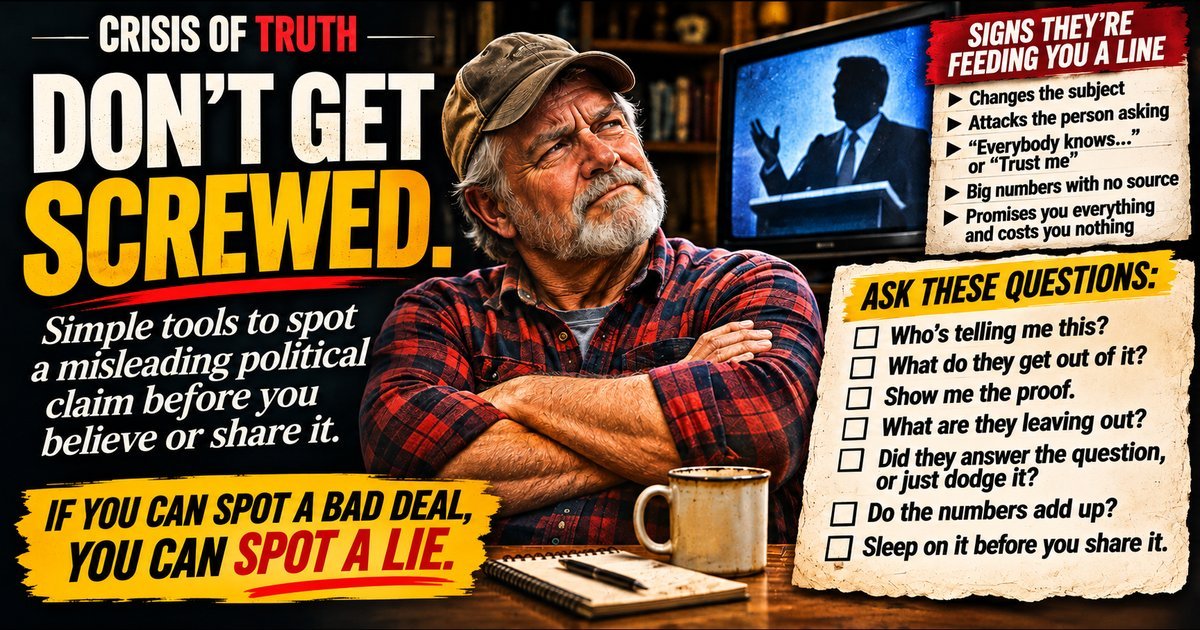
Every one of us has believed something that turned out to be false. Most of us have shared it. The difference between people who stay fooled and people who don't is not intelligence. It is a handful of habits, and habits can be learned at any age.
A British psychiatrist was once asked what surprised him most about human nature. His answer was not war, or greed. It was this:
"The inability of people to change their minds despite overwhelming evidence to the contrary."From the discussion featured on our Willful Ignorance: The Documented Case page
That is real, and our cognitive dissonance page explains why. When a belief becomes part of who you are, evidence against it can feel like an attack on you. Your mind defends it the way it would defend you.
But here is the part almost nobody tells you, and it is good news.
VerifiedFor years, people repeated a finding called the "backfire effect": correct someone's false belief and they believe it harder. Two researchers set out to map it. Across five experiments with more than 10,100 people and 52 politically charged claims, they could not trigger backfire even once. Their conclusion: by and large, people accept factual corrections, even when the facts cut against their own side. [1]
VerifiedA team at MIT and the University of Regina found something similar about sharing. People who shared false headlines mostly said accuracy mattered to them. They shared bad information because their attention was somewhere else, not because they didn't care about the truth. [2]
VerifiedAnd smart people are not immune. In a 2015 study, repeating a false statement made people rate it as more true, even when they demonstrably knew the right answer. The researchers called it "knowledge neglect." [3] Hearing a lie ten times on cable news or in your feed does not just fool the uninformed. It works on everybody.
I've seen it myself. I've talked with people who hold advanced degrees who did not, or could not, see that they were being lied to. The Stanford study in Step 2 found the same thing: Ph.D. historians were fooled by websites that professional fact-checkers saw through in minutes. [4] A diploma is not a defense. A habit of checking is.
So here is the deal
You are not broken. You are a normal human being living inside a machine built to rush you, scare you and repeat things at you until they feel true. The steps below slow the machine down. You don't have to change any belief to use them. You only have to be willing to check.
This is not Democrat vs. Republican
You will not find serious constitutional scholars, historians or legal experts treating the questions on this site as a team sport. That framing is itself the distraction. Propaganda works on liberals, conservatives and people who swear they don't follow politics. The research on this page tested people from every part of the spectrum, and the tricks worked on all of them. So did the fixes. [6]
The three questions this site asks about everything
Keep those in your back pocket. Step 7 uses them.
Why I built this page
When I was 32, I took a class in Science, Critical Thinking, and Skepticism. It changed my life.
It taught me something uncomfortable: the claims I believed most strongly were the ones I had checked the least. Not because I was stupid, but because nobody had ever taught me how to check.
A few years later I spent five years as the network administrator for the Minneapolis Police Department. Seeing how the system actually works from the inside changed me again. I think every citizen should spend three months inside a police department. You come out seeing the world differently.
Here is what both experiences taught me. Most of us, left and right, were taught civics as a list of facts to memorize for a test. We were never taught how to use the Bill of Rights and the Constitution as a measuring stick. Is this legal? Is this constitutional? Is this right? That is not a partisan skill. It is the reason this country exists.
So I'm not asking you to agree with me. I'm asking you to do one thing: pick a claim you believe strongly, from any side, and trace it back to the original source. Not a meme, not a clip, not a post. The actual document, vote, or data. Then see if it still holds up.
I do this on every page I publish, and I post the strongest arguments against my own conclusions right alongside them. If I'm wrong, show me the source. That's how this is supposed to work.
Brad Schrunk, founder, Crisis of Truth
The Method
Ten Steps Before You Believe It
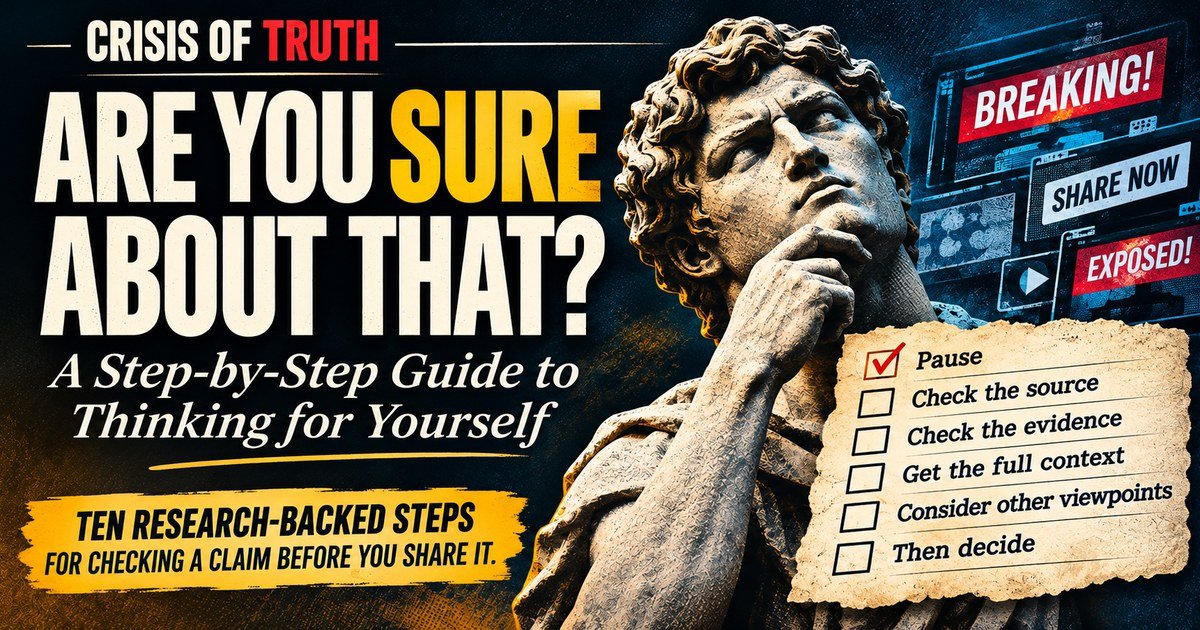
Steps 1 through 4 come from the method professional fact-checkers actually use. Steps 5 through 10 are about the harder part: the frame, the feeling and the person in the mirror.
Notice the feeling. Then stop.
Stop
Before you read the comments, reply, repost or get angry, notice what the post is doing to you. Furious? Scared? Smug? Vindicated? A strong emotion is not proof that something is false. It is a signal that someone may be steering you, and a reason to slow down.
VerifiedResearchers who study manipulation list emotionally loaded language as one of the five most common tricks in misinformation. [6] And the MIT team found that just prompting people to think about accuracy made them more careful about what they shared. [2] The pause itself is the tool.
Ask: says who?
Investigate the source
Who made this? Not who posted it. Who made it. Is it a news organization, a think tank, a campaign, a company, an anonymous account?
VerifiedHere is the trick that separates the pros from everyone else. Stanford researchers watched 10 professional fact-checkers, 10 Ph.D. historians and 25 Stanford students judge real websites. The historians and students read "vertically." They stayed on the page and studied its logo, its "About Us" and its web address, and were often fooled. The fact-checkers read "laterally." They glanced at the page, then left it and opened new tabs to see what everyone else said about the source. They reached better answers in a fraction of the time. [4]
On X, the checks are specific:
- A checkmark is not a credential. On X, the blue check can be bought with a subscription. It tells you someone paid, not that they are who they say or know what they're talking about.
- Look at the account, not the post. When was it created? Does it post around the clock? Does it only post about one topic? Has the name changed? Our bot farms page shows the warning signs.
- Check for a Community Note, and then check the note's sources too.
Is anyone else reporting this?
Find better coverage
If a claim is huge and true, many outlets will be covering it, including ones that don't like each other. If only one corner of the internet has it, that is worth noticing.
Search for the claim itself, not the post. Put the key phrase in quotation marks. Look for a wire service like the Associated Press or Reuters, a local newspaper close to the event, or an outlet that usually leans the opposite way from the one you saw it on. When outlets that disagree on everything else agree on a fact, that fact is probably solid.
Go to the original.
Trace it back
Most viral claims are copies of copies. Somewhere at the bottom there is a real study, a real video, a real bill or a real court filing, and the copy on your screen may have changed its meaning. A clip gets cut at the convenient moment. A headline says the opposite of the article. A study about mice becomes a claim about people.
Where to find the originals for free:
- Bills and votes: congress.gov has the full text of every federal bill and how each member voted.
- Court cases: CourtListener has free federal court opinions and many filings.
- Studies: search the study title on Google Scholar. Read the abstract and the conclusion yourself.
- Video: find the full-length upload, not the clip. For Congress, C-SPAN posts the whole session.
Steps 1 through 4 are Mike Caulfield's SIFT method: Stop, Investigate the source, Find better coverage, Trace claims to the original. It is free to use and taught in college libraries across the country. [5]
Separate the facts from the frame.
Spot the technique
A post can be built on a true fact and still mislead you, because of how it's framed. Learn to see the five tricks that show up again and again. Researchers at Cambridge and Bristol picked these five because they power so much of what gets shared: [6]
- Emotional language. Words chosen to make you feel outrage or fear instead of think. "Destroyed." "Invasion." "Evil."
- Incoherence. Several claims that can't all be true at once, thrown together so you stop trying to sort them out.
- False choice. "Either you support X or you hate America." Real life almost always has more than two options.
- Scapegoating. One group gets blamed for a complicated problem. Ask who benefits when you're angry at them.
- Attacking the person. Instead of answering the argument, they insult whoever made it. If they can't answer the point, that tells you something.
VerifiedThe good news: each of these has a short animated video that teaches you to spot it, using clips from movies and cartoons instead of politics. In seven studies with about 30,000 people, the videos improved people's ability to recognize the tricks, and the effect held for liberals and conservatives alike. [6] You can watch all five free at inoculation.science. Our Propaganda Playbook goes deeper.
Watch out for the team jersey.
Question the frame
The most powerful frame in America is "your side vs. their side." Once a question becomes a test of team loyalty, evidence stops mattering, because changing your mind feels like betraying your people.
Ask: who benefits from me seeing this as a fight between parties? Who funded both campaigns? Who owns the network? Who profits from the bill named after children or patriots? Our Is It Really Democrats vs. Republicans? page walks through seventeen documented examples where the money ran to both sides.
Run the three questions.
Legal · Constitutional · Moral
Once you know what actually happened, judge it on its merits, not on who did it.
- Is it legal? Find the actual statute or ruling (Step 4). "It's illegal" and "it's legal" are both claims that need proof.
- Is it constitutional? Which right or limit is involved? Would it be acceptable if the person you trust least in politics had the same power?
- Is it moral? Plenty of things are legal and still wrong. Would you accept it being done to you?
Ask what would change your mind.
Ask it of yourself first
This is the hardest step, and it is the whole point of this page. Pick a belief you hold strongly. Then ask: what evidence would make me change it?
If the honest answer is "nothing," that is no longer a belief based on evidence. It has become part of who you are, and that is exactly the place where everyone, including the people who run this site, is easiest to fool.
"Are you sure about that?" is a fair question to ask anyone. It only counts if we are willing to have it asked of us.
Before you share, wait thirty seconds.
Don't be the delivery system
Every share is a repetition, and repetition is what makes a falsehood feel true (see Start Here). [3] If you aren't sure, don't share. You lose nothing by waiting a day. The outrage will still be there, and the facts may have caught up.
Be extra careful with posts that tell you to share before "they" take it down. That urgency is a technique, not a news bulletin. Our Rage-Bait Economy page shows who gets paid when you take the bait.
Keep practicing.
It's a skill, not a gift
Nobody is born a critical thinker, and nobody finishes learning it. The rest of this page gives you ways to keep going: why school never taught you this, a free seven-hour critical thinking class, how to check what AI tells you, five videos worth your time and a card to keep by your computer.
Why Nobody Taught You This
You Weren't Stupid. You Weren't Taught.
If the ten steps above feel new, ask a fair question: why did twelve years of school never teach you any of them? Not because you couldn't learn them. For most of American history, teaching ordinary people to question was simply not the goal. You don't have to take my word for that. The people who shaped the system wrote it down.
There is a difference between stupid and uninformed. Stupid can't be fixed. Uninformed can, and the people who benefit from you staying uninformed know it.
In their own words
VerifiedTaylor's efficiency system reshaped how American workplaces were run, and critics argue it shaped how schools were run too. In his most famous book he described the right kind of man for loading pig iron:
"...he shall be so stupid and so phlegmatic that he more nearly resembles in his mental make-up the ox..."
He was not insulting workers by accident. He was writing a job requirement. A thinking man, he explained, would find the work's monotony unbearable. [10]
In contextYou may have seen this line on social media:
"In our dream, we have limitless resources, and the people yield themselves with perfect docility to our molding hand."
It is real. But read the whole essay, The Country School of To-Morrow, and it is about poor rural schools, sick children and failing farms. Gates wanted practical schooling in health, farming and home life instead of rote memorizing, and he hoped country people would one day choose their own books and their own leaders. It is not a confession of a plot, and anyone who tells you it is hasn't read it. [11]
What it does show is how the wealthy men funding American schools talked about ordinary families: as material for "our molding hand," and as people to be trained for the lives they already had, not for law, science or leadership. Read it yourself and decide. That's the point of this page.
VerifiedIn a confidential memo to the chairman of the U.S. Chamber of Commerce's Education Committee, Powell urged business to organize and push back on what was taught. Among his recommendations, business should:
"...evaluate social science textbooks, especially in economics, political science and sociology."
He also complained that "balance" was "conspicuous by its absence on many campuses" and urged business to press universities on who taught there. The memo became a blueprint for the think tanks, campus programs and corporate-funded media that followed. The original typescript is archived at Washington and Lee University. [12] The full story is in our case file The Plan: The Memo That Built the World You Live In.
What it produced
The perfect example: the rule of 72
72 ÷ the rate = years to double
Here is a piece of math that takes thirty seconds to learn and can change a working family's whole life. Divide 72 by an interest rate, and you get roughly how many years it takes money to double at that rate. It works for money you save, and it works for money you owe.
| Your money | Rate | Doubles about every | $10,000 becomes |
|---|---|---|---|
| Retirement fund | 8% | 9 years | $20,000 → $40,000 → $80,000 in 27 years |
| Savings account | 2% | 36 years | $20,000 in 36 years |
| Credit card balance, unpaid | 24% | 3 years | $20,000 owed in 3 years |
Same rule, opposite directions. At 8%, money works for you. At 24%, you work for the bank. A teenager who knows this is much harder to sell a payday loan, a rent-to-own couch or a "low monthly payment." An adult who knows it starts saving at 25 instead of 45.
It's simple, it's powerful, and most American adults never learned it in school. As of mid-2025, only 29 states guaranteed a personal finance course before graduation, and the newest ones don't start until the class of 2030. [14] Ask yourself who benefits from that gap. Our pages What They Never Taught You and Rich Kids Learn Power. Your Kids Learn Obedience. walk through the other lessons that were left out.
What it looks like when a country wants citizens who think: Finland
VerifiedFinland has ranked first out of 41 European countries on the Media Literacy Index every year since the index began in 2017. [21] That's not luck. Its schools have included media education since the 1970s, and since 2019 media literacy has been woven into every subject, from early childhood through high school. [21]
In Finland, ten-year-olds practice sorting real news from fake as a normal class assignment. Kindergarten teachers start by helping children tell the difference between a story and an advertisement. Finland's former education minister calls it a civic skill, as basic to a democracy as reading. Finland shares an 800-mile border with Russia and has been a target of its propaganda for decades. It decided the best defense was a population that can't easily be fooled.
CBS Sunday Morning, Sept. 29, 2024: Chris Livesay visits Finnish classrooms where students learn to spot hoaxes, scams and propaganda. [22]
"You have the right to your own opinion, but you do not have the right to your own facts."A Finnish saying, quoted by former education minister Li Andersson in the CBS report
Ask the obvious question: if a country of 5.5 million can teach this to every child, why doesn't the richest country in the world?
So is this a conspiracy?
Not in the secret-meeting sense. Most of it happened in the open, in books, memos and budgets anyone can read. Here is the honest way to say it: for more than a century, the people with the most money and power have said, in writing, that they prefer workers who follow instructions over citizens who ask questions. They have spent heavily to shape what gets taught and what gets broadcast. Democrats and Republicans have both gone along, because both depend on the same donors. Our page Is It Really Democrats vs. Republicans? lays out who funds whom.
You can check every document above. What you conclude is up to you. But the fix is the same either way: learn the skills they left out. The free critical thinking class below takes about seven hours. The Dumbing Down Wasn't an Accident covers what happened to the schools, the textbooks and the airwaves in more detail.
Take the Class. It's Free.
Free Critical Thinking Class
You just read why school never taught you this. Here is the fix: a real college class in critical thinking, online, at your own pace, and it costs nothing.
Introduction to Critical Thinking
Keystone College Professional Development Institute
Keystone describes critical thinking as a model for reasoning through issues to reach well-founded conclusions, and possibly the most valuable skill anyone can bring to a job or a life challenge. The course teaches you to define and identify critical thinking and reasoning skills, and to build them: asking the right questions, critiquing an argument and taking an issue apart logically. [8]
Per Keystone, the course includes videos, real-world examples, interactive exercises and an "Ask the Expert" feature that answers questions within 24 hours. It works on a phone. [8]
Take the free classCrisis of Truth has no relationship with Keystone College and receives nothing for this link. We list it because it is free, from an accredited college, and nonpartisan.
Checking AI
Is the AI Telling You the Truth?
More and more people skip the search and just ask a chatbot. The answers come back fast, well written and confident. Sometimes they are also wrong, and nothing in the tone tells you which time is which.
VerifiedIn the largest study of its kind, 22 public broadcasters in 18 countries, led by the BBC, checked more than 3,000 news answers from ChatGPT, Copilot, Gemini and Perplexity. 45% had at least one significant problem. 31% had serious sourcing problems, such as a source that was missing, misleading or wrong. 20% had major accuracy problems, including made-up details and outdated facts. [17]
VerifiedThis isn't only a problem for casual users. In 2023, two New York lawyers filed a brief citing six court cases that ChatGPT had invented. The cases did not exist. A federal judge fined them and their firm $5,000. [18]
VerifiedHere is the part that matters most. Before filing, one of the lawyers asked ChatGPT directly: "Is varghese a real case." It said yes. He asked if the other cases were fake. It said no, they were real and could be found in Westlaw and LexisNexis. His own screenshots of that exchange are in the court record. [19]
Does it help to tell AI "only give me verified facts"?
A little, but it is not a guarantee. An instruction like that can make an AI more careful: more likely to search, to cite sources and to say when it isn't sure. But it can still be confidently wrong, and it can tell you something was "checked" when it wasn't. The lawyers above asked, and got a confident yes.
What actually prevents mistakes is a process that doesn't depend on the AI's word:
- Require a link for every fact, then click it. Ask for the exact sentence from the source, not a summary. If the AI can't point to the sentence, the fact doesn't get used.
- Ask "What are you least sure of?" A good tool will name its weak spots. That question is how a famous quote got cut from this page and another one got its missing context.
- Sort what you find. Label each claim: verified against the original, true but needs context, or unconfirmed. Unconfirmed claims stay off the page until someone confirms them.
- Get a second, independent check. Have a person, or a separate AI that didn't write the material, go through it looking for errors. The job is to find mistakes, not to agree.
An AI telling you it's sure is not proof. The original source is.
How to check what AI tells you
- Treat the answer as a lead, not a fact. It's a tip from a confident stranger. Useful, but unproven.
- Click every source. Then read the source and make sure it actually says what the AI says it says. This is where AI fails most often: a real link that doesn't support the claim, or a link that doesn't exist at all.
- Ask for the other side. "What is the strongest evidence against this?" A good answer will give you some. If it can't, be suspicious.
- Ask a second tool, or ask the same question a different way. If the answers don't match, at least one is wrong.
- Check the date. AI often doesn't know what happened recently, and it won't always tell you that.
- Then run Steps 1 through 4 above. AI is a research assistant. You are still the judge.
A practical walkthrough: why AI "hallucinates," which tools show their sources, and a step-by-step workflow for checking a claim with AI.
We use AI too
AI tools helped research and build this page. That's exactly why every quote and number on it was checked against the original source before it went up. When something couldn't be confirmed, like a famous Woodrow Wilson quote, it came off the page (see For the Record). Use the steps above on us, too.
Watch
Five Videos Worth Your Time
1. One class can change how you see everything
Watch on YouTube → You're Falling For The Propaganda. A Critical Thinking Class Changed My Life Forever. A personal account of what changed after learning these skills formally. It's the best argument for taking the free course below: the habits on this page can be taught, and they stick.2. Why people double down
The 11-minute discussion behind the psychiatrist's answer, using the Exodus story as a case study. Full transcript excerpts on our cognitive dissonance page.
Watch this one with yourself in mind, not someone else. The pattern is human, not partisan.
3. This is what you're up against
A Mississippi street interview aired by Bill Maher. Transcript and context on our cognitive dissonance page.
A man on food stamps, without health insurance, explains why he opposes the programs that help him, and says he would rather go broke than give up his beliefs.
Read key lines from the interview
"Why is Mississippi so conservative?" "Well, you're in the heart of the Bible Belt."
On the president: "His name is Obama. This is America. Our president should be American, not Muslim." (Obama was born in Hawaii and is a Christian. Both claims are false.)
"You get food stamps?" "Yeah, but I think I deserve food stamps. I have no unemployment."
"A lot of people in Mississippi need health care." "Yeah. Back when I was growing up... we didn't have all that, and people still made it."
"Republican hasn't worked for you, but it could?" "It hasn't. But it could."
"We would rather go broke and die hungry than to give up our moral beliefs... I'm going to stand up for what I believe in even if I go broke doing it."
Full transcript on our cognitive dissonance page.
Clips like this get shared online under headlines about "shockingly stupid" voters, and usually with one party's name attached. We are not going to do that, for two reasons. First, it isn't fair: every party, every movement and every one of us has a version of this, a belief we hold so tightly that the facts of our own lives can't loosen it. Second, it doesn't work. Mocking someone is the fastest way to make them defend the belief harder.
This man is not the villain of the story. He is the target. Somebody spent a great deal of money teaching him what to believe, and they are not in the video. The point of watching is not to laugh at him. It is to ask: where am I doing the same thing?
4. How America got here
"America Being Dumb Is Not an Accident. It Is the Intent." The history of factory-model schooling, funding fights and the attention economy.
Worth your time for the history, and a good chance to practice the steps above. Most of it holds up. Two things don't hold up as stated: the Gates quote is used without its context, and the claim that 70% of prisoners can't read above a fourth-grade level isn't what the federal data shows. Both are explained in For the Record. Checking a video you agree with is the hardest kind of checking, and the most important.
5. George Carlin said it first
Language warning: this is Carlin. Turn the volume down if strong words offend you, but don't skip the point.
Twenty years ago, in his 2005 HBO special Life Is Worth Losing, the comedian made the same argument as the documents on this page, minus the footnotes. The real owners of the country, he said, don't want a population capable of critical thinking. They want people smart enough to do the work and not smart enough to question who it's for. [16]
Notice what Carlin never did: he never blamed one party. He said both answer to the same owners. Our page The Real Owners of America Are Not Names You Know picks up where he left off, with the receipts.
Keep This
The Pocket Card
Print it and tape it next to your screen. When something online makes your blood boil, run down the list before you touch the share button.
Are You Sure About That?
crisisoftruth.org/are-you-sure · Before you believe it, before you share it
- Stop. What is this post making me feel?
- Says who? Leave the page. Look up the source in a new tab.
- Who else has it? Search the claim, not the post.
- Find the original. The full video, the actual study, the bill text.
- Facts or frame? Emotional words, false choices, scapegoats, insults.
- Team jersey? Would I feel the same if the other party did it?
- Legal? Constitutional? Moral? One sentence each.
- What would change my mind? If "nothing," be careful.
- Wait 30 seconds. Not sure? Don't share.
- Wrong? Say so. Correcting yourself is the most credible thing you can do.
The truth will set you free, if you can find it.
When It's Someone You Love
How to Actually Change a Mind
Maybe you came here because of someone else: a parent, a brother, an old friend who has gone somewhere you can't follow. Here is what the research says works, and what doesn't.
VerifiedPolitical scientists Joshua Kalla and David Broockman ran field experiments with real canvassers knocking on real doors. Conversations that used arguments alone had no measurable effect on the attitudes they studied. Otherwise identical conversations that added what they call a "non-judgmental exchange of narratives," where both people share personal stories and the canvasser listens without judging, produced changes that lasted for months. [7]
That lines up with the backfire research. People do update on facts. [1] They just don't update when they feel attacked.
What tends to work
- Ask before you tell. "What got you interested in this?" "Where did you first hear about it?" Then really listen.
- Share a story, not a statistic. A time you were wrong about something and how you found out. That gives them permission to do the same.
- Pick one thing. You won't untangle everything in one conversation. Choose the one claim that matters most.
- Leave the door open. "I might be wrong about this too. Want to look it up together?" works better than winning.
- Send them the method, not the conclusion. Share this page, or the free critical thinking class. Let them check things themselves.
What tends to backfire
- Calling them stupid, brainwashed or a cultist, even if you're frustrated.
- Dumping twenty links on them at once.
- Arguing in public, where backing down means losing face in front of their friends.
- Making it about their party. The moment it's a team fight, the jersey goes on.
Keep Going
Where to Go Next on This Site
For the Record
What This Page Can't Promise
We hold ourselves to the same standard we're asking of you. Here are the limits of the research above.
Sources
The Record
- Thomas Wood & Ethan Porter, "The Elusive Backfire Effect: Mass Attitudes' Steadfast Factual Adherence," Political Behavior 41, 135–163 (2019). doi.org · Open version: ssrn.com
- Gordon Pennycook, Ziv Epstein, Mohsen Mosleh, Antonio Arechar, Dean Eckles & David Rand, "Shifting attention to accuracy can reduce misinformation online," Nature 592, 590–595 (2021). doi.org · Summary: MIT Media Lab
- Lisa Fazio, Nadia Brashier, B. Keith Payne & Elizabeth Marsh, "Knowledge does not protect against illusory truth," Journal of Experimental Psychology: General 144(5), 993–1002 (2015). pubmed.gov
- Sam Wineburg & Sarah McGrew, "Lateral Reading: Reading Less and Learning More When Evaluating Digital Information," Stanford History Education Group Working Paper 2017-A1. ssrn.com · Stanford News, "Fact checkers outperform historians evaluating online information" (Oct. 24, 2017). stanford.edu
- Mike Caulfield, the SIFT method ("The Four Moves"), from Check, Please! (CC BY 4.0). checkplease.cc · Library guide: City Colleges of Chicago
- Jon Roozenbeek, Sander van der Linden, Beth Goldberg, Steve Rathje & Stephan Lewandowsky, "Psychological inoculation improves resilience against misinformation on social media," Science Advances 8(34) (2022). doi.org · University of Cambridge, "Social media experiment reveals potential to 'inoculate' millions of users against misinformation." cam.ac.uk · The videos: inoculation.science
- Joshua Kalla & David Broockman, "Reducing Exclusionary Attitudes Through Interpersonal Conversation: Evidence From Three Field Experiments," American Political Science Review 114(2), 410–425 (2020). yale.edu · Yale News, "Study finds non-judgmental, personal approach can reduce prejudice" (Feb. 7, 2020). yale.edu
- Keystone College, "Introduction to Critical Thinking – Free Course." keystone.edu
- Brendan Nyhan & Jason Reifler, "When Corrections Fail: The Persistence of Political Misperceptions," Political Behavior 32(2), 303–330 (2010). doi.org
- Frederick Winslow Taylor, The Principles of Scientific Management (1911), excerpt. Oxford University Press
- Frederick T. Gates, The Country School of To-Morrow, General Education Board, Occasional Papers No. 1 (1913). Full text: archive.org · Context discussion: Metabunk
- Lewis F. Powell Jr., "Attack on American Free Enterprise System," confidential memorandum to Eugene B. Sydnor Jr., U.S. Chamber of Commerce (Aug. 23, 1971). Washington and Lee University School of Law
- Annenberg Public Policy Center, Constitution Day Civics Survey. 2026 results as reported Sept. 18, 2026: WEAR-TV · 2025 release with survey-method note: annenbergpublicpolicycenter.org
- Next Gen Personal Finance, "Texas Becomes 29th State to Require Personal Finance Course for High School Graduation" (June 23, 2025). ngpf.org
- National Center for Education Statistics, PIAAC Survey of Incarcerated Adults (2014), results summary. nces.ed.gov
- George Carlin, "The American Dream," from the HBO special Life Is Worth Losing (2005). Discussion: ScheerPost
- European Broadcasting Union & BBC, "AI's systemic distortion of news is consistent across languages and territories" (Oct. 22, 2025). ebu.ch
- Bloomberg Law, "Phony ChatGPT Brief Leads to $5,000 Fine for NY Lawyers" (June 22, 2023), on Mata v. Avianca, No. 22-cv-01461 (S.D.N.Y.). bloomberglaw.com
- Steven Schwartz, Affidavit in Opposition, Attachment 1 (ChatGPT screenshots), Mata v. Avianca, ECF No. 32-1 (S.D.N.Y. May 25, 2023), reproduced by Simon Willison, "Lawyer cites fake cases invented by ChatGPT, judge is not amused" (May 27, 2023). simonwillison.net
- National Assessment Governing Board, "Civics and U.S. History," The Nation's Report Card, 2022 results. nagb.gov
- Agence France-Presse via Voice of America, "Finnish youth taught how to spot disinformation" (Dec. 24, 2024), citing the Open Society Institute–Sofia Media Literacy Index. voanews.com
- CBS News, "In Finland, classes in recognizing fake news, disinformation," CBS Sunday Morning (Sept. 29, 2024). cbsnews.com
Video embeds are the property of their creators and are shown via YouTube. Found an error? It goes in the public corrections ledger.